

Spain Train Accident Leaves 69 Dead as Control Centre Faces Questions Over Why Renfe Was Cleared To Move Again
Investigators examine why rail controllers authorised a Renfe train to proceed towards a stalled Iryo service
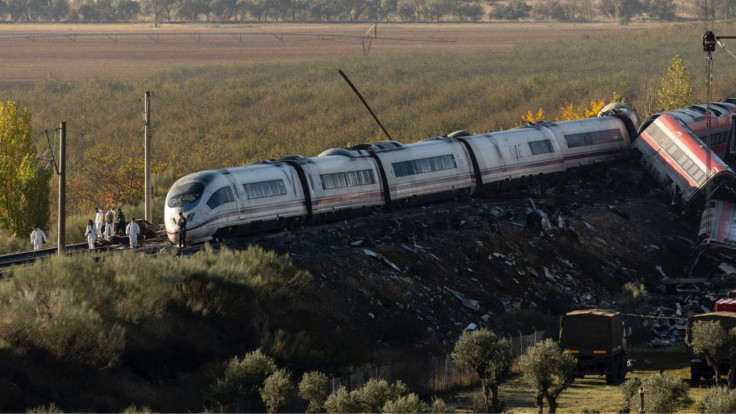
Spain's latest train accident killed at least 69 people near Urda, Toledo, on Wednesday, 28 October. Transport Minister Óscar Puente stated that controllers had cleared a Renfe train to proceed despite an Iryo service remaining stationary ahead. Investigators are examining why.
The collision followed a January disaster involving the same operators, Renfe and Iryo, on the Madrid-Seville high-speed route. That crash, near Adamuz in Cordoba province, killed 46 people, intensifying scrutiny of a network long regarded as a source of national pride.
Spain Train Accident Puts Control Centre Decision Under Scrutiny
The trains collided at approximately 8:53am on Wednesday. A technical failure had initially halted six services, according to Puente. Control staff subsequently authorised the Renfe train to proceed at normal speed, although an Iryo train remained stopped on the line ahead.
Puente described the decision as 'inexplicable'. 'In the event of a system failure, the control center takes over,' he explained.
Investigators are seeking to establish why the Renfe train was allowed to continue despite the Iryo service remaining stationary on the track ahead. Investigators estimated the collision speed at between 99 mph and 124 mph (160–200 km/h), pending analysis of the trains' onboard recorders.
Spain Train Accident Toll Corrected as Rescuers Search
The death toll stood at 69 on Thursday, after officials corrected an earlier Interior Ministry figure of 74, ABC News reported. Cranes had worked through the night lifting mangled carriages, while emergency crews searched an overturned carriage for victims.
Regional leader Emiliano Garcia-Page confirmed the 69 deaths. The Interior Ministry had also received 67 reports from families searching for loved ones, while identification work continued on 52 bodies.
Among those killed was Fatima Banez, a former labour minister. Spain's Foreign Ministry reported that 42 citizens of seven foreign countries were involved in the crash, with one killed and at least seven injured.
Families still awaiting news described their distress. César Vicente, whose father was missing, told the Associated Press, 'This is unbearable. This is hell.' Carmen Bejarano, searching for her husband, explained that Renfe staff could not provide information without official confirmation.
Spain Train Accident Rekindles Rail Safety Dispute
Train drivers proceeded with a previously planned strike on Thursday, pressing for greater investment in railway safety. 'We cannot tolerate, under any circumstances, this type of incident happening again,' SEMAF union representative Diego Martín stated at Madrid's Atocha station. Renfe reported significant disruption and offered free ticket changes or cancellations.
Unions accused the government of abandoning safety discussions in April following January's collision, Reuters reported. Puente rejected claims that Spain's railways were broadly unsafe, describing the system as 'reliable and safe...with the limits of the material itself and of human action, as is the case with any form of transport.'
Prime Minister Pedro Sánchez announced three days of national mourning and pledged to establish the cause and assist affected families. Both main political parties suspended campaign events ahead of the 29 November snap election.
The Interior Ministry deployed more than 800 military and police personnel, alongside over 200 vehicles, three helicopters, drones and search dogs. A Toledo judge imposed a 2-kilometre (1.2-mile) exclusion zone along the railway to protect emergency work and the investigation.
© Copyright IBTimes 2026. All rights reserved.