Erdoğan Vows To Be Voice of 'Free and Sovereign' Palestine as US Again Denies Abbas UN Visa
The Turkish president criticised Washington's decision as Israel's delegation walked out during his address to the General Assembly
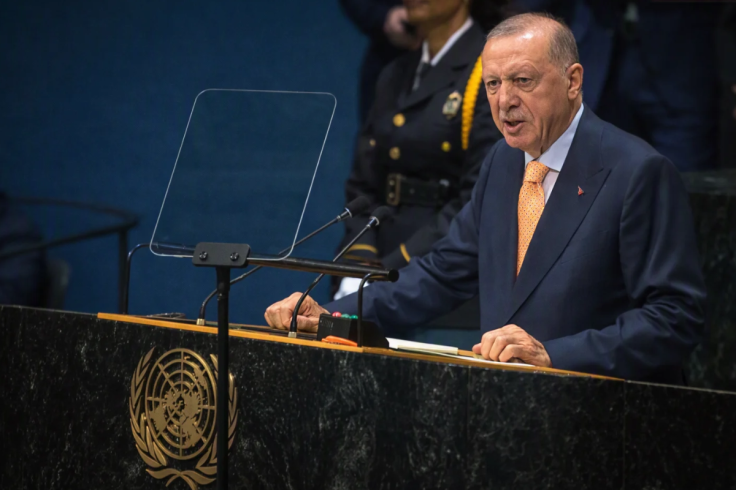
Recep Tayyip Erdoğan stood at the United Nations podium on Tuesday and said Turkey would continue to make the Palestinian struggle heard, after the United States denied Palestinian President Mahmoud Abbas a visa to attend the General Assembly for the second year in a row.
The visa denial prevented Abbas from travelling to New York to attend the meeting in person.
'His Excellency Mahmoud Abbas has been unable to take his place in this hall for two consecutive years,' Erdoğan said. 'Just as we did last year, we will continue to make the struggle of the Palestinian people heard by the world from this rostrum.'
The Turkish president spoke on the opening day of the general debate of the 81st session, which began on 22 September. Abbas was instead authorised to address the Assembly by pre-recorded video after the UN approved special arrangements for Palestinian participation.
"Özgür ve egemen Filistin Devleti’nin sesi olacağız."
— TRT HABER (@trthaber) September 22, 2026
Cumhurbaşkanı Erdoğan: Sayın Mahmud Abbas üst üste 2 yıldır bu salonda yer alamıyor. Bizler tıpkı geçen yıl olduğu Filistin halkının mücadelesini bu kürsüden dünyaya duyurmaya devam edeceğiz.#ErdoganTheVoiceOfJustice…
Israeli Delegation Walks Out as Erdoğan Speaks
The address prompted members of Israel's delegation to leave the hall while Palestinian representatives applauded, according to footage from the session. Erdoğan said: 'Let it be known that although President Abbas is unable to be with us here in person, we will, as we did last year, continue to be the voice of a free and sovereign state of Palestine.'
He went on to describe Gaza as 'the most inhumane, most shameful concentration camp of our time'. He also said more than 1,300 civilians had been 'murdered' in Gaza despite what he called a 'so-called ceasefire'.
Erdoğan also criticised the UN, saying the organisation 'has failed to fulfil its duty' to preserve global peace and stability. His remarks came as he called for wider recognition of a Palestinian state and criticised the UN Security Council's ability to maintain global peace.
How Abbas Was Kept Out for a Second Year
The US visa decision led the General Assembly to vote on 17 September on special arrangements allowing the high-level Palestinian delegation to participate virtually. The resolution passed by 152 votes to three, with the US, Israel and Paraguay opposed and Colombia, Honduras, Panama and Peru abstaining.
Under the resolution, Abbas may submit a pre-recorded statement to be played in the Assembly Hall during the general debate.
A Palestinian representative who is physically present must introduce it first, while the measure also permits Abbas and other high-level Palestinian officials to participate by video in UN meetings over the following year if they are prevented from travelling to the US.
What Washington and Ramallah Said
Before the vote, US Deputy Representative Tammy Bruce said the Palestinian Authority and the PLO were not meeting what Washington described as their commitments under the Oslo Accords.
'If the PA wants to be treated as a partner, it must stop subsidizing terror and stop using diplomatic theater as a substitute for serious governance,' she told the chamber.
Palestinian UN envoy Riyad Mansour said the Palestinian leadership 'rejects and condemns' the decision. He described it as denying the delegation headed by Abbas the opportunity 'to exercise their lawful right to participate in the works of the United Nations'.
Türkiye's President Recep Tayyip Erdogan says the past 12 months have been among the bloodiest periods of the last 30 years, with more than 60 conflicts and wars.
— TRT World (@trtworld) September 22, 2026
Speaking at the UN General Assembly, he highlighted the suffering of Palestinians in Gaza and called on countries… pic.twitter.com/LbfqyZvfWn
China's representative, Ambassador Sun Lei, urged the US to comply with relevant international legal instruments, including the UN Headquarters Agreement. China's mission said the agreement establishes obligations for the host country concerning visas for representatives attending UN meetings.
Erdoğan's remarks put the absence of Abbas directly into the Turkish president's UN address, with Turkey saying it would continue to make the Palestinian cause heard. The US, meanwhile, maintains that its visa restrictions are linked to actions by Palestinian officials that Washington says sought to 'internationalize' the Israeli-Palestinian conflict.
The 152-3 vote authorised a mechanism for Abbas to address the Assembly despite the US visa denial, while the dispute over Palestinian participation at the UN remains tied to wider disagreements between Washington, Palestinian officials and other member states over diplomatic and legal issues.
© Copyright IBTimes 2026. All rights reserved.
- Recommended For You