

Free Palantir 'War Room' Alternative Created by Solo Dev Exposes What Governments Pay Millions For — Already Live
World Monitor offers a transparent, open-source intelligence platform for public use
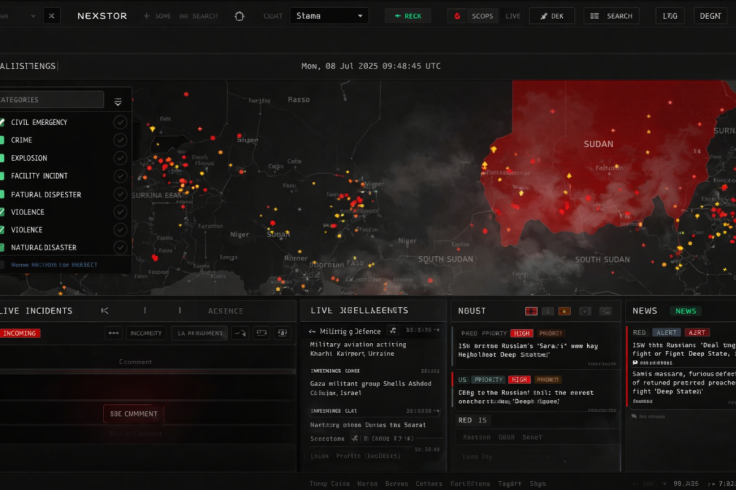
A solo software developer has released a free, open-source alternative to Palantir's government intelligence platforms, and it is live for anyone to download.
The tool, called World Monitor, was built by developer Elie Habib and published on GitHub under the username koala73. It combines live news feeds, military tracking, economic data and infrastructure monitoring into a single browser-based dashboard, according to the project's GitHub repository.
World Monitor: 65 Data Sources, 500 Feeds, One Dashboard
According to World Monitor's GitHub page, the platform aggregates more than 65 external providers and APIs across geopolitics, finance, energy, climate, aviation, cyber, military, infrastructure and news intelligence, surfaced through more than 500 curated feeds and tracked by a freshness monitor covering 35 source groups.
The software is released under an AGPL-3.0 licence, meaning commercial use is permitted so long as users comply with its copyleft and source-availability terms, while a separate commercial licence is available for teams that need different terms. It also ships as a native desktop app built with Tauri 2 for macOS, Windows and Linux, supporting 25 languages with native-language feeds and right-to-left text support.
The X Post That Launched a Thousand Reposts
The project was thrust into the spotlight after developer Ihtesham Ali posted about it on X, framing it as a free rival to Palantir's enterprise software. In the post, Ali wrote that 'Palantir sells governments a war room that costs millions a year,' before describing how Habib 'rebuilt it, put it on GitHub, and gave it away.'
Ali's post described a live 3D globe pulling in news across categories including military movements, cyber incidents, flight paths and shipping lanes, alongside a panel tracking stock exchanges, commodities and crypto. He also claimed the dashboard scores 31 countries on a 'stress index' and offers 56 stackable map layers, though these specific figures come from Ali's post rather than the GitHub documentation itself.
By 19 July, the post had drawn more than 341,000 views, 5,400 likes and over 1,000 reposts, with 107 replies debating the tool's implications.
Palantir sells governments a war room that costs millions a year.
— Ihtesham Ali (@ihtesham2005) July 20, 2026
So, a guy named Elie just rebuilt it, put it on GitHub, and gave it away.
It's called World Monitor.
Open it and you get a live 3D globe with 500+ news feeds pouring in across 15 categories, all summarized by AI… pic.twitter.com/stqNnHoIZ9
What World Monitor Offers That Palantir Does Not
Palantir Technologies supplies data-analysis and situational-awareness software to governments and defence agencies, typically through large, long-term contracts. World Monitor does not replicate Palantir's full product suite or client relationships. Instead, its documentation positions it as an openly auditable alternative for OSINT researchers, analysts and anyone wanting a self-hosted situational awareness tool without a subscription or licensing fee attached.
Unlike commercial intelligence platforms, World Monitor runs with no environment variables required for basic operation, though feature-specific data sources may still require separate credentials.
The Open-Source Reality Check for Defence Tech
The free release of a tool this capable raises questions that go beyond price. Military and cyber analysts have long relied on paid, access-controlled platforms partly because that gatekeeping limits who can build a real-time picture of troop movements, flight paths or shipping lanes at once. An openly downloadable tool that stitches these signals together removes that barrier, for better or worse.
For journalists, researchers and everyday citizens, that means genuine access to situational awareness capabilities once reserved for institutions with large budgets. It could help newsrooms verify breaking events faster, or let independent analysts track conflicts and infrastructure risks without a government contract.
The same openness cuts both ways for security planners. A tool built entirely from public data sources cannot expose classified information by design, but the ease of aggregating open-source military and infrastructure signals into one dashboard is itself a capability that defence and cybersecurity officials will likely be watching closely, given how quickly it has spread since Ali's post went viral.
World Monitor's rapid spread signals real public appetite for transparent, ownable alternatives to closed defence-tech systems, and its AGPL licence means the code itself remains open to scrutiny by anyone who wants to check how it works. Whether the project can maintain the same data quality and reliability as commercial platforms over time is a separate question, one that will likely determine whether it remains a viral curiosity or becomes a genuine working tool for the people now downloading it.
© Copyright IBTimes 2026. All rights reserved.