

Why Did Iran Strike UAE, Kuwait, and Qatar? Allies Targeted to Send Washington a Message
Tehran's calculated attacks on Gulf allies underscore the fragility of regional security and US influence
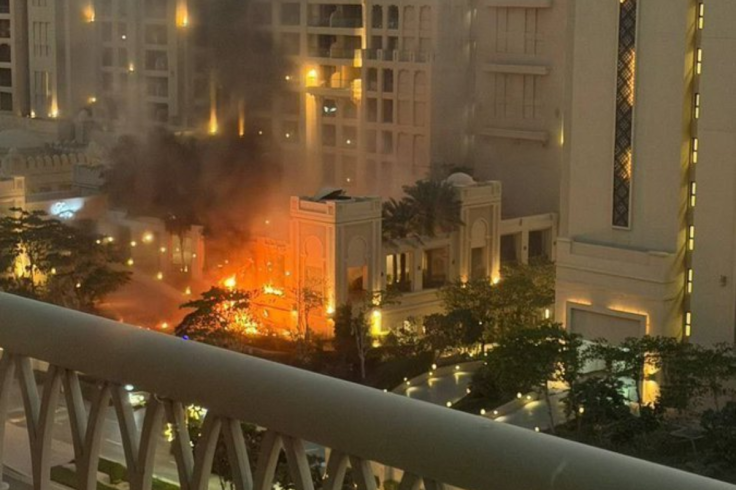
Loud explosions rang out across Dubai, Kuwait City and Doha for a third consecutive day on Monday as Iran continued launching missile and drone strikes against Gulf states hosting US military assets. Thick plumes of black smoke were reported rising above industrial districts and ports, with sirens echoing through urban centres that had, until days earlier, been operating as normal. Kuwaiti air defences intercepted the majority of the drones near Rumaithiya and Salwa neighbourhoods.
The strikes were Iran's response to coordinated US-Israeli military operations launched on 28 February 2026. Iran's Supreme Leader Ayatollah Ali Khamenei, 86, was killed in those strikes at his office in Tehran. His daughter, son-in-law and grandson were also killed. Tehran's retaliation was immediate and wide-ranging, with the Gulf states bearing much of the brunt.
US Bases as the Declared Target
Iran's government has been consistent in its stated rationale. The IRGC claimed all Israeli and US military targets in the Middle East had been struck 'by the powerful blows of Iranian missiles', adding that 'this operation will continue relentlessly until the enemy is decisively defeated' and that all US assets throughout the region are considered legitimate targets.
According to the IRGC, Al Udeid Air Base in Qatar, Al Salem Air Base in Kuwait, Al Dhafra Air Base in the UAE, and the US naval base in Bahrain were among the sites targeted. Geolocated footage confirmed strikes in all three countries, including a Shahed drone attack near the Fairmont Hotel in Dubai's Palm Jumeirah district and a strike on the upper floors of the Era Views Tower, a residential high-rise roughly a mile from the US Navy base in Bahrain.
Iran's Deputy Foreign Minister Majid Takht-Ravanchi, speaking in an interview on 2 March, addressed why Gulf neighbours found themselves in the crossfire. 'First of all we have good relations with our neighbors,' he said, before explaining that Tehran had issued prior warning. 'Before the aggression we informed our neighbors that if America or Israel engages in animosity against Iran, definitely we will be in self-defence mode and we will target the American military bases in the region,' he added. 'Wherever they are located, because they are legitimate targets in accordance with Article 51 of the UN Charter.' The remarks drew a clear line between Gulf governments and the American military infrastructure on their soil — a distinction Tehran has used to justify strikes that have nonetheless caused civilian casualties and economic disruption.
@cnn Iranian Deputy Foreign Minister Majid Takht-Ravanchi speaks to CNN’s John Berman about military strikes in the region.
♬ original sound - CNN - CNN
'Everything Is on the Table'
Analysts have characterised Iran's targeting of Gulf states as a calculated pressure campaign directed at Washington rather than at the Gulf governments themselves. Hasan Alhasan, a senior fellow for Middle East policy at the International Institute for Strategic Studies, said the strikes indicate 'everything is on the table' for Iran, and that Tehran's calculus is to 'ratchet up the pain on the Gulf states, in order to compel them to apply pressure on the Trump administration to bring a quick end to the war.' He warned, however, that the strategy could backfire, since it remains unclear how much leverage Gulf capitals hold over Washington. Mass casualty events, he added, could compel them 'to start considering options up the escalation ladder.'
That escalation risk is already present. Sinem Cengiz, a researcher at Qatar University's Gulf Studies Center and a non-resident fellow at the Gulf International Forum, said: 'For the first time in history, all the GCC states were targeted by the same actor within 24 hours. Their long-standing nightmare scenario has happened.'
Gulf States Push Back
The Gulf states have condemned the strikes and warned they will not remain passive indefinitely. UAE Minister of State for International Cooperation Reem Al-Hashimy stressed that the UAE had made its position clear before the conflict began. 'We have, before this began, been very clear about not having our territories being used to attack Iran. We have always encouraged dialogue and we have wanted to make sure it doesn't amount to this because our region does not need another war,' she said. She added that the UAE would not 'sit idly by' as attacks continued, and when asked whether it might adopt a more combative role, said: 'If it needs to come to that, it will come to that.'
The attacks shut down several major regional airport hubs, including Dubai International, one of the world's busiest. Some 1,579 flights were cancelled on Sunday, with Dubai International accounting for 747, or 70 per cent of its schedule.
The remnants of Iran's resistance are sealing their own fate. Lashing out at peaceful neighbors like a cornered beast. Their strikes expose the rot they are, a threat that the region can no longer tolerate. A new era is about to begin without the Iran we knew. pic.twitter.com/P2KsiMIw2I
— PatriotsWillPrevail (@Real_PWP) March 2, 2026
The strikes on the UAE, Kuwait and Qatar represent a significant shift in the region's security landscape. Countries that had deliberately positioned themselves as neutral, commercially open hubs have found themselves drawn into a conflict they sought to avoid. According to Atlantic Council experts, Iran's decision to widen its attacks to include GCC states— despite their clear and consistent rejection of war'—amounts to a serious strategic miscalculation, as none of these states launched offensive operations against Iran from their territory. Whether that miscalculation deepens the conflict or forces a diplomatic opening remains the defining question for the Gulf in the days ahead.
© Copyright IBTimes 2026. All rights reserved.