

Why Did Iran Attack Dubai? What You Need to Know
Dubai's Palm Jumeirah hit by Iranian drones in response to US-Israel offensive
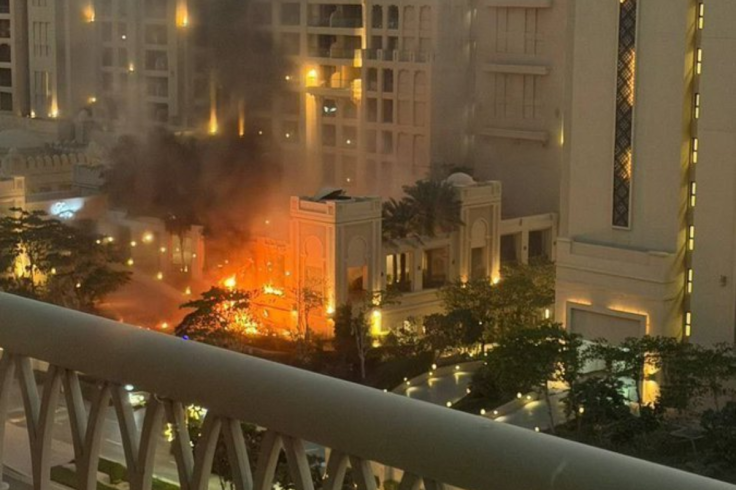
Smoke rose above Dubai's Palm Jumeirah on Saturday after Iranian drones struck the Fairmont The Palm hotel, setting the luxury property ablaze in one of the most visible attacks of Iran's retaliatory campaign against US and Israeli military targets across the Gulf. The Dubai Media Office confirmed an 'incident' in the Palm Jumeirah area, stating that four individuals sustained injuries and were transferred to medical facilities, and that the fire was subsequently brought under control by civil defence teams.
The Burj Khalifa, the world's tallest building, was also evacuated as a precautionary measure, as UAE air defence systems worked to intercept what authorities described as multiple waves of incoming Iranian ballistic missiles and drones across the emirate.
What Triggered the Strikes
The attacks on Dubai were part of a sweeping Iranian retaliation after the US and Israel launched a large-scale joint military offensive against Iran earlier that day, designated 'Operation Epic Fury' by US Central Command. The operation began at 1:15am local time, targeting Iran's ballistic missile capabilities, nuclear programme infrastructure and senior leadership. President Donald Trump confirmed in a video statement that 'major combat operations in Iran' had begun, intending to eliminate 'imminent threats from the Iranian regime.'
Iran's Islamic Revolutionary Guard Corps responded swiftly, declaring that all US bases in the region had been struck and warning that its 'operation will continue relentlessly until the enemy is decisively defeated.'
President Donald J. Trump on the United States military combat operations in Iran: pic.twitter.com/LimJmpLkgZ
— The White House (@WhiteHouse) February 28, 2026
Why Dubai Specifically
The UAE was not a random choice. A Gulf official had anticipated the UAE would come under heavy Iranian fire, citing the country's geographic proximity to Iran and Abu Dhabi's close ties with Israel following the 2021 Abraham Accords normalisation. The US military's Al Dhafra Air Base, which hosts the 380th Expeditionary Wing of the US Air Force, is situated near Abu Dhabi — approximately 140 kilometres from Dubai — and was listed by Iran's IRGC as one of the primary targets of its retaliatory campaign.
Iran's stated targets were US military installations, but the Shahed-series loitering munitions identified in footage of the Palm Jumeirah strike are not precision weapons. Civilian areas, hotels and residential neighbourhoods absorbed significant impact from both direct hits and interceptor debris. The UAE Ministry of Defence confirmed that missile fragments landed across areas of Abu Dhabi, including Saadiyat Island, Khalifa City and Mohamed bin Zayed City. However, it stated no injuries occurred in those locations.
The Wider Gulf Picture
Dubai was one part of a much larger assault. Iran confirmed strikes on Bahrain, Kuwait, Qatar and the UAE, where US military airbases are based. In Bahrain, footage showed an Iranian Shahed drone striking the upper floors of a residential high-rise roughly a mile from the US Navy's Fifth Fleet headquarters. Kuwait International Airport was also hit, with its aviation authority confirming minor injuries to staff and limited damage to Terminal 1.
The scale of the assault forced an unprecedented aviation shutdown across the region. The Emirates, the world's largest international airline, suspended all flight operations to and from Dubai, citing 'multiple regional airspace closures.' Qatar Airways, Lufthansa, Air France, and Turkish Airways were among the carriers to cancel or divert flights. Europe's aviation safety regulator EASA issued a conflict zone bulletin for the Middle East, advising airlines against operating in affected airspace, citing a 'high risk to civil aviation.'
Palm Jumeirah, Dubai. #Iran #UAE pic.twitter.com/FSGJJ7FmiG
— Abhilash Badli (@AbhilashBadli) February 28, 2026
What It Means for Dubai's Reputation
Beyond the physical damage, Saturday's strikes carried deeper significance for a city that has built its brand on stability. Dubai and Abu Dhabi have long positioned themselves as global financial centres grounded in security and openness. Aviation consultant Linus Bauer of UAE-based BAA & Partners warned that prolonged airspace disruption would bring 'structurally higher operating costs, weaker aircraft utilisation and profit margin pressure — especially on long-haul networks reliant on Middle East transit corridors.'
The UAE Ministry of Defence called Iran's strikes 'a blatant violation of national sovereignty and international law,' and affirmed 'the UAE's full right to take all necessary measures to protect its territory and people.' The UK, France, and Germany issued a joint condemnation, telling Iran to stop its attacks across the region immediately.
The strikes on Dubai mark a significant shift in the Iran-US-Israel conflict — one that has now reached civilian infrastructure in neutral, non-belligerent states. The UAE was not a party to the US-Israeli offensive against Iran, yet its cities absorbed the consequences of a war it did not choose. A city that positioned itself as the world's safe harbour — neutral, open, prosperous — found itself burning because of a military base 140 kilometres away and a geopolitical alignment its leadership chose years ago. As Iran signals it is prepared for a prolonged campaign, the Gulf states that have long served as the region's economic backbone now find themselves caught between their military alliances and the cities — and populations — they are responsible for protecting.
© Copyright IBTimes 2026. All rights reserved.