

'I Support Genocide': Woman's Placard at London Protest Contrasts With 325 Palestine Action Arrests
Police arrested 325 people during a Defend Our Juries protest outside the US Embassy
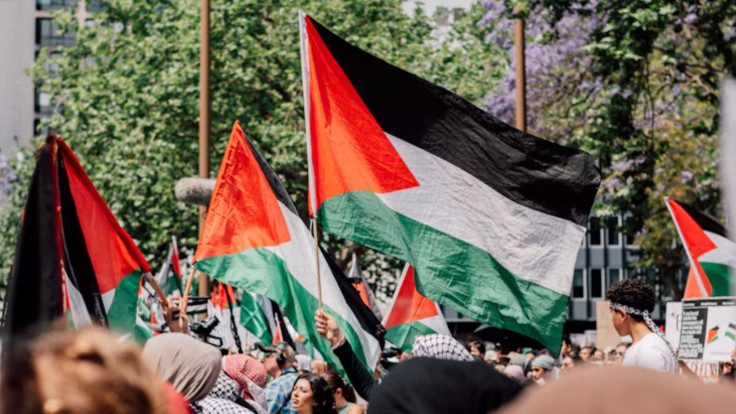
A London protest against the government's ban on Palestine Action has drawn attention to an unusual contrast in how police responded to demonstrators holding opposing messages.
Outside the US Embassy on Saturday, 31 October, hundreds were faced with arrest for displaying support for the proscribed group. Meanwhile, footage of another protester carrying a placard apparently endorsing genocide raised questions about the boundaries of free expression under British law.
Why Was the 'I Support Genocide' Placard Allowed at the London Protest?
The demonstration, organised by Defend Our Juries, took place outside the US Embassy in Nine Elms, where protesters gathered to challenge Palestine Action's designation as a terrorist organisation.
According to the Metropolitan Police, officers made 325 arrests, including 320 for expressing support for a proscribed organisation under the Terrorism Act 2000.
Many demonstrators carried signs that read 'I oppose genocide. I support Palestine Action'.
However, footage circulating online showed another individual holding a deliberately inverted message: 'I support genocide. I oppose Palestine Action'.
The placard appeared to be intended as satire, highlighting the difference between expressing support for a banned organisation and making a provocative statement about genocide.
The video showed the individual interacting with an officer before the officer walked away. No arrest was visible in the footage.
Under UK law, expressing support for a proscribed organisation can constitute a criminal offence. A statement supporting genocide, however, does not automatically amount to an offence, although its context and any accompanying conduct may be relevant.
Palestine Action Arrests Spark Debate Over Free Speech
The contrasting police responses prompted criticism online, with commentators questioning whether the legislation places disproportionate restrictions on peaceful political expression.
One X user wrote, 'We are approaching a time where ostensibly pro-genocide satire is going to be the only practical avenue of protest.'
Another commented, 'The Met Police don't do irony,' while others questioned the officer's apparent smile as he left the placard holder.
The footage does not establish the individual's identity or whether police subsequently investigated the incident.
The arrests also included older demonstrators, reflecting the participation of pensioners and campaigners who have joined previous protests against the ban.
Defend Our Juries has organised repeated demonstrations in which participants display identical placards, deliberately risking arrest to challenge the legislation.
Why Palestine Action Was Banned and What Happens Next
Palestine Action was proscribed in July 2025 following direct-action campaigns targeting businesses and facilities linked to Israel's military supply chain.
The government cited concerns about the group's activities, including damage to military aircraft at RAF Brize Norton.
Campaigners argue that criminalising expressions of support for the organisation threatens freedom of speech and peaceful protest.
Supporters of the ban maintain that organisations meeting the statutory threshold for proscription should face enforcement regardless of their political objectives.
The legality of the designation has also faced court challenges, with further proceedings expected to examine its compatibility with fundamental rights.
For protesters, the contrasting placards have become a pointed illustration of their objections to the law.
The incident has also revived debate over whether existing terrorism legislation draws an appropriate distinction between political expression and support for unlawful activities.
© Copyright IBTimes 2026. All rights reserved.