Forensic Psychologist Says Two Ransom Notes in Nancy Guthrie Case May Point To Different Writers
Linguistic experts and Arizona detectives are now pinning fresh hopes on the kidnapper's 'word print' to break open the six‑month‑old case
The Nancy Guthrie investigation has entered its sixth month in Arizona, and a forensic psychologist now believes the two ransom notes at the heart of the case were written by different people.
Two typed ransom notes, one demanding millions in cryptocurrency and another later claiming Nancy was dead and 'buried in nature', have since become a central focus for detectives.
A forensic psychologist, Gary Brucato, has publicly argued that the contrast in style and tone between the notes suggests 'two different people' were involved in writing them.
For investigators who have yet to name a suspect, the language on the page may now be almost as important as the physical evidence.
Nancy Guthrie Investigation Turns to Words on the Page
Detectives decided to take an unusual step, releasing both ransom notes in full and asking the public to help identify the writer or writers by their language.
Pima County Sheriff Chris Nanos said officers were hoping that particular turns of phrase might jog someone's memory. As he put it, the publication of the notes 'just might jar someone to say, "You know, I've heard that."'
Linguistic and psychological experts have since begun pulling the notes apart line by line. Brucato, a forensic psychologist who has reviewed the documents, said he is struck by what he calls a 'rupture' between the first and the second note.
The first message, sent on 2 February and addressed directly to 'Savannah', reads in part, 'Hello Savannah, we have your mother Nancy. She is safe but scared. She will be held for ransom and once payment is received she will be released unharmed.'
Brucato described that initial note as the work of an 'intelligent' writer with a single focus on money, structured, controlled and, in its own way, cold.
The second note, which arrived four days later and was addressed to the broader 'Guthrie Family', reads very differently.
'We did not fully grasp the seriousness of her physical condition. We never intended to hurt her,' it says, before claiming that Nancy had 'perished shortly after she was taken' and is 'buried in nature'.
Brucato told interviewer Brian Entin that the language in the follow‑up was more emotional and, in his view, 'florid', with a 'modicum of sympathy and the distancing' that suggested a riskier, more personal kind of communication.
He went further, suggesting the second note may have been written by a woman who knew Savannah Guthrie or who was, at the very least, deeply aware of her public persona.
Brucato argued that the way the second writer tried to soften the narrative, while also stepping back from direct responsibility, hinted at a different psychology from the person who simply demanded millions in cryptocurrency.
'These two ransom notes do suggest to me two different people who are perhaps experiencing some kind of rupture in terms of their attitude about what happened,' he said.
Two Voices, One Crime? Expert Sees a 'Rupture' in Nancy Guthrie Case
Rather than a single, disciplined kidnapper controlling every message, Brucato pictures at least two people behind the scenes, pulling in different directions.
'The first one is demanding money and the second one is undoing the ability of the first person to get money,' he noted, adding that this would likely have made the original writer 'kinda mad' that the second note ever went out. In his reading of the case, there is a power struggle, or at least a disagreement, playing out in black and white.
The psychologist also cast doubt on whether the masked figure captured on Nancy's porch, widely dubbed 'porch guy' online, actually wrote either note.
In his view, that man looked more like, as he bluntly put it, 'some sort of goon that was put there to give the impression of a totally outside agent who never met this woman who came in to do the dirty work'.
Brucato has taken to calling that unidentified figure 'the waiter who served it', arguing that the more calculating minds are likely off camera, orchestrating events and drafting the letters.
To recall, previous reporting has already highlighted that investigators are examining Nancy's financial records and personal connections, alongside the physical and digital trail of the kidnapper.
Brucato's theory does not contradict that, but rather adds another layer, hinting at conflicting motives inside the group. He believes the primary driver was money, yet he also suggested the author of the second note may have been pushed by 'something else, emotion, something that was preyed upon', and that this person may now regret getting involved because 'it all went up in smoke'.
How Linguists Read the Ransom Notes in the Nancy Guthrie Investigation
Meanwhile, detectives have not only turned to psychology but to linguistics in the hunt for whoever took Nancy Guthrie.
Retired linguistics professor and forensic consultant William Eggington has pointed out that every person uses language in a distinctive way, known as an idiolect or 'word print'.
Speaking about the Guthrie case, he said that this idea, that each of us carries our own fingerprint in words, underpins modern forensic stylistics.
Eggington noted several features in the first ransom note, including its heavy use of passive constructions and 'if‑then' style sentences, which, in his view, hint at someone with at least a high school education and possibly some university experience.
The text also contains a small but intriguing slip. In one section, the writer spells 'received' correctly, only to produce 'received' later on.
The second note, by contrast, is less clinical and more circuitous. Eggington argued that the phrase 'perished shortly after she was taken', instead of a blunt description of death, and the unusual line that she was 'buried in nature', both suggest an attempt to distance the writer from the alleged outcome.
Talking about Nancy in the third person, instead of saying what 'we' did, may also point to someone struggling with the reality of what they are claiming.
Sheriff Nanos has said investigators are now hoping that friends, colleagues or even casual acquaintances of the writer might recognise these turns of phrase. Language has cracked cases before, and detectives in Arizona will be well aware of past examples where a family member recognised a manifesto or a threatening letter and alerted authorities.
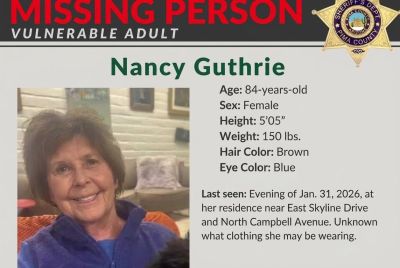
Nancy Guthrie was reported missing after what police believe was a targeted abduction from her home in Tucson, Arizona, on 1 February. The following day, the first ransom note was sent, demanding $4 million worth of cryptocurrency in exchange for her safe release.
Days later, a second message arrived, this time telling the Guthrie family that Nancy had 'perished shortly after she was taken' and was now 'buried in nature'.
Police continue to process DNA evidence and review the doorbell footage of the masked visitor to Nancy's home. At the same time, they have consulted closely with the Guthrie family about each new public step, including the release of the letters.
Shortly after that decision, Savannah Guthrie issued an emotional appeal, saying simply, 'We are desperate. We need someone to come forward. Someone knows something.'
The hope, shared quietly by detectives and viewers alike, is that the words on two anonymous pages will finally prod that someone into speaking. Despite all of that police have yet to publicly identify a suspect.
© Copyright IBTimes 2026. All rights reserved.
- Recommended For You