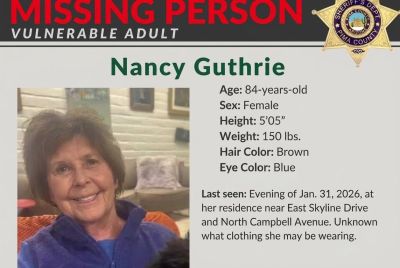
Why Was Nancy Guthrie Kidnapped? The Real Motive Shift Away From Savannah Guthrie Explained
The search for why Nancy Guthrie was taken is shifting from celebrity ransom fantasies to the far more unsettling question of who, in her everyday life, might have turned on her.

Former police officer Charles Brewer has told viewers on YouTube that the question 'Why was Nancy Guthrie kidnapped?' may have been framed wrongly from the start, arguing in a video posted on 25 May that the Arizona grandmother could have known her alleged abductor and that money, or daughter Savannah Guthrie's fame in New York, may never have been the real motive.
The comments came after months of public speculation that Nancy's disappearance was a so-called celebrity kidnapping, supposedly aimed at Emmy-winning Today co-anchor Savannah Guthrie. That theory rested largely on Savannah's profile and the assumption of family wealth. But as time has passed with no clear ransom demand, no arrest and almost no public detail from investigators, the idea that Nancy was taken purely because of her daughter's television career has started to look less convincing. None of the alternative motives being floated by commentators has been confirmed by law enforcement, and there is still no official account of what happened.
Why The Theory Is Shifting
In his latest video, titled 'Nancy Guthrie Case: We May Have Been Looking At The Wrong Person', Brewer sets out the doubts that have led him to question the original narrative. A former officer who has become a regular online commentator on the case, he turns his attention to the basic mechanics of a kidnap for ransom and suggests they are simply not visible here.
'If this truly was a celebrity-targeted kidnapping connected directly to Savannah Guthrie, why has there been no meaningful ransom communication?' he asks. 'Why leave over a million dollars untouched? Why create ransom-style messages that reportedly make little sense? Why no sustained negotiations or proof of life, no sophisticated extortion strategy?'
For Brewer, those unanswered questions point away from the image of a calculated, money-driven kidnapper and towards something less organised. 'Because if somebody kidnaps for money, money usually becomes the priority,' he continues. 'But here, the behaviour feels chaotic, disconnected, even emotionally driven, or possibly connected to something far more personal than the public originally believed'.
He is careful not to accuse any relative directly. Instead, he widens the frame around Nancy's life, arguing that the same public willing to connect the case to Savannah Guthrie's status now needs to consider more ordinary, and potentially more disturbing, possibilities.
'Listen, if the public, including myself, was comfortable enough early on in discussing whether this crime was connected to Savannah Guthrie's fame, her wealth and public visibility, then it is equally reasonable to ask whether this case may somehow connect to someone else inside Nancy's immediate world,' he says.
Did Nancy Know The Kidnapper?
That line of thinking feeds into Brewer's most pointed suggestion: that Nancy Guthrie may have known the person who allegedly took her. He does not name anyone or present hard evidence, but he sketches out the kind of connection he believes investigators should be probing.
'Not necessarily family directly, but maybe somebody connected to them,' he says, listing 'a friend, an associate, maybe a business relationship, or what about a debt?' He paints a picture of 'a dangerous person orbiting somewhere close to this family that nobody fully recognised at the time', adding that 'after more than 100 days, something still feels off. Something still feels untouched'.
Those phrases capture the uneasy space the case now occupies. More than three months on, the public knows almost nothing concrete about who might be responsible or why, yet theories continue to multiply. Brewer's comments tap into that frustration, but they do not resolve it. He is offering one more hypothesis, grounded in his policing experience but not backed by disclosed files.
Authorities have not publicly endorsed any version of events that answers the question of why Nancy Guthrie was kidnapped. There has been no official statement backing the celebrity-ransom idea and no confirmation that she knew her alleged abductor. In the vacuum, voices like Brewer's carry more weight than they otherwise might, precisely because they sound methodical and willing to walk through the logical gaps.
The Search For Clues
Alongside this swirl of commentary, current and former investigators insist the case is still, in effect, a grind through sheer volume. In an interview with News 4 Tucson, retired Pima County Sheriff's Department detective Robbie Mayer likened Nancy's disappearance to a notorious crime spree he helped crack in the 1980s.
Back then, Mayer was part of the team that unmasked Brian Larriva as the 'Prime Time Rapist', a man behind a series of home invasions and sexual assaults in Tucson, Arizona. He recalls facing around '4,000 leads' before finally identifying Larriva, who died by suicide before he could be brought to trial.
'One of the detectives had Larriva's name as a lead,' Mayer told the station, 'but he hadn't gotten to it yet because he had so many leads in front of that.' The memory clearly shapes how he views the present investigation.

Speaking about Nancy Guthrie's case, he says he is confident that 'the suspect's names are in those 50,000' tips that authorities are now believed to have received. The challenge, he suggests, is not a lack of information but the ability to spot the crucial pattern.
'The question is if they can recognise it when they see it,' Mayer says. 'Being in a case like this is like being in a field with rocks, and what you're looking for is under one rock. You just have to keep turning'.
Between Brewer's insistence that the original money-for-celebrity theory no longer holds and Mayer's reminder of how slowly complex investigations can move, the public picture of why Nancy Guthrie was kidnapped remains stubbornly incomplete, suspended between instinct, private grief and the hope that somewhere in a mountain of tips, one overlooked name will finally explain it.
© Copyright IBTimes 2026. All rights reserved.
- Recommended For You