

'Buy It. Period.': Michael Burry Urges Investors to Hold This Long-Term Compounder Stock for Life
Burry's guidance on when to invest in Samsung Electronics and Lululemon Athletica


In a Monday post on Substack, The Big Short's Michael Burry explained that Samsung Electronics is among those stocks that are backed by businesses so good that the time to buy is defined by a simple, recurring rule.
'Samsung Electronics is the belle of the ball these days. Just last year, however, it traded extensively at tangible book value. When Samsung Electronics stock hits tangible book value per share, buy it. Period. No more analysis needed,' he wrote.
For investors who wouldn't blindly follow Burry's signal, he urged them to 'do the analysis once,' and 'then just buy it at net asset value' for the rest of your life. He revealed buying into the stock in early 2025 when the stock was trading at or near tangible book value, and even making it one of the top three holdings of his firm, Scion Asset Management fund.
Buy Samsung at Tangible Book Value or Lower 'Every Time'
Burry's recurring rule is to buy Samsung Electronics when the stock drops to net tangible asset value. Burry stated that the stock has given the opportunity to buy at tangible book value eight times over the past three decades. The stock keeps coming back to this level because Samsung Electronics remains a cyclical company. 'Has always been. And always will be,,,' Burry said.
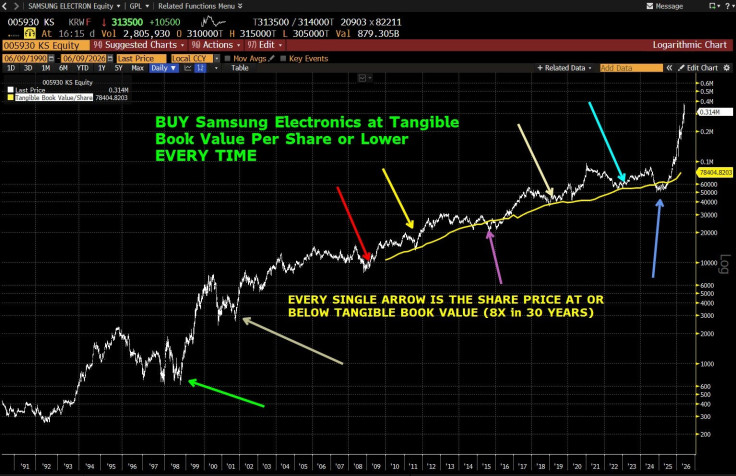
Burry highlighted that the stock has appreciated 470 times since the 1998 crisis, posting average annual returns of 24.6%. He described the company as the 'homecoming queen', adding that the stock gained over 15% in May, lifting its market cap to beyond $1 trillion.
While predicting that the Samsung Electronics stock will offer a chance again in the future for investors to buy at tangible book value, Burry highlighted how the stock recovered sharply after the 1998 Asian currency crisis, which pushed forward share prices too quickly.
'But even after this rally, the stock proved to be a great long-only investment, albeit one that yielded slightly less – 15% per annum. Perhaps it was better to wait until the price touched net book value again. If you buy from that point, the average annualized return up to today again jumps above 20%. It is always wise to get into a security on downturns, at the balance sheet line, even if the plan is to hold it for the long term,' Burry had explained.
About when to sell the stock, Burry said 'one option is never,' highlighting its robust and steady market share gains over the years.
Burry Says Lululemon Offers More Value Than Microsoft
In a separate post on Substack late last week, Burry had disclosed bumping his stake in the apparel company Lululemon Athletica even though the stock tanked despite reporting a fiscal Q1 beat.
Market experts believe the stock price pullback was because of the company downwardly revising its full-year 2026 guidance and setting a Q2 forecast that is lower than expected by analysts' consensus amid faltering customer interest and partly due to product performance failures.
However, Burry argued that markets could be overlooking Lulu's underlying financial strengths, like $1.5 billion in cash reserves and almost negligible debt. 'Cash conversion cycle is nearly 3 months, roughly in line with history back to 2012, though trending up ever so slightly,' Burry added.
'The relative value in LULU and PYPL by my estimation outweighs that of Microsoft at this time,' Burry had noted. He had also mentioned earlier that AI leaders are artificially inflating revenue through accounting tricks to make balance sheets appear stronger than they actually are.
Disclaimer: Our digital media content is for informational purposes only and does not constitute investment advice. Please conduct your own analysis or seek professional advice before investing. Remember, investments are subject to market risks, and past performance does not guarantee future returns.
© Copyright IBTimes 2026. All rights reserved.