

JPMorgan CEO Is Avoiding US Stocks and Long-Term Bonds: 'Risks Are Bigger Than People Think'
JPMorgan's CEO highlights geopolitical and fiscal dangers while the bank reports record profits
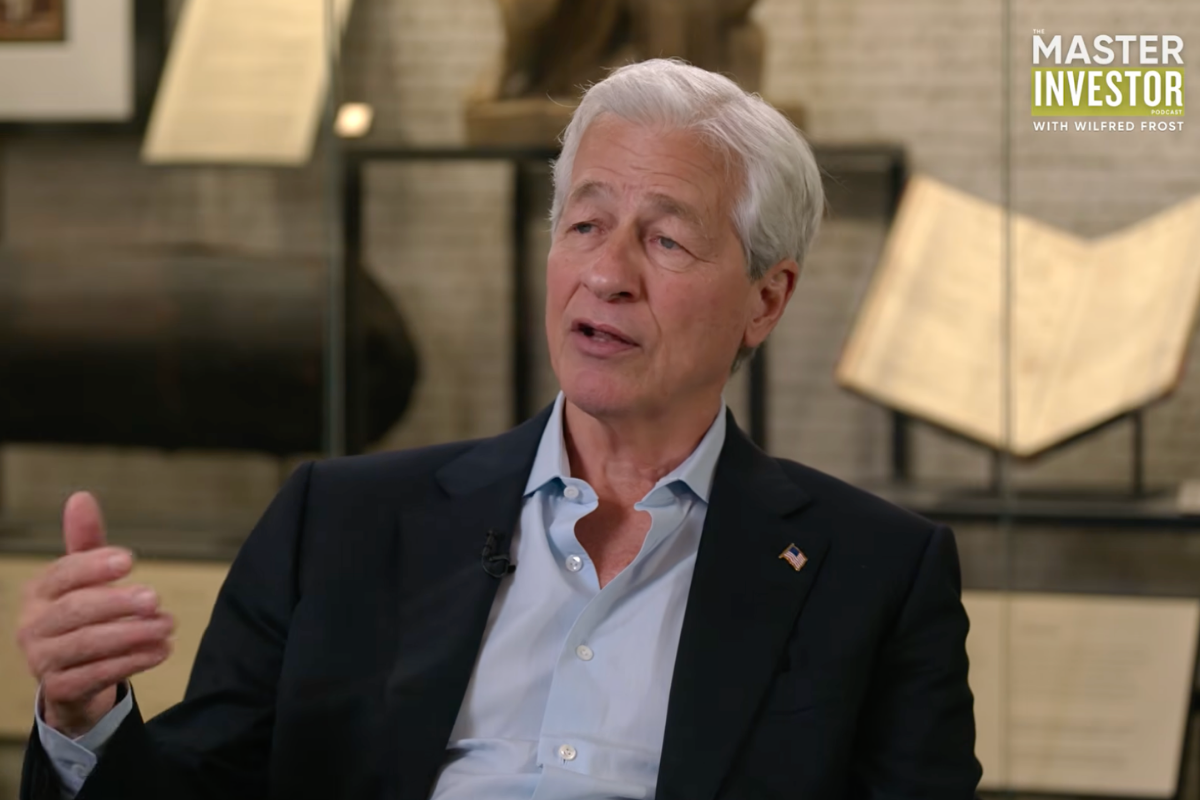
Jamie Dimon would not put his own money into US stocks or long-dated government bonds at today's prices. The chairman and chief executive of JPMorgan Chase, the world's largest bank by market value, said investors are underpricing a build-up of geopolitical and fiscal danger, and that neither side of the traditional portfolio looks worth owning.
Dimon set out the view in an hour-long interview on the Master Investor Podcast with Wilfred Frost on 20 July.
'I do think those risks are probably bigger than other people think,' he said, pointing to the wars in Ukraine and the Middle East, tensions between the United States and China, and rising military spending at a time of widening government deficits.
Asked whether markets were underpricing the chance of a major shock, he said it was hard to know what was already sitting in asset prices. 'It's possible something's baked in, but what's not baked in is what actually happens,' he said.
He allowed that the global economy had grown more durable, helped by lower energy dependence than in decades past. That, he said, does not rule out a sudden turn.
'You may need more straws in the camel's back to cause that tipping point,' he said, adding that even a fresh flare-up in conflict might not be enough on its own.
Why Jamie Dimon Will Not Buy Long-Dated Treasuries
When Frost asked directly whether he would buy long-dated Treasuries, Dimon said, 'Personally, no'. Even if inflation fell back to the Federal Reserve's 2% target, he said, the 10-year Treasury should sit at roughly 4% to 4.5%, close to where it already trades. He said he could not see the upside, and that inflation had run above 3% for almost five years.
Persistent US budget deficits would, in his view, eventually force interest rates higher as so-called bond vigilantes demand more to finance the debt. 'My view is it will become a problem,' he said.
On equities, Dimon separated individual companies from the wider index. He said he might still buy a single stock that offered a strong opportunity, but would not buy the broad market at current valuations.
Jamie Dimon's Caution Clashes With Record Profits
The comments came with US equities near record highs. The S&P 500 has gained close to 10% this year, lifted by resilient consumer spending, cooling inflation, and enthusiasm for artificial intelligence.
The interview followed the largest quarterly profit in JPMorgan's history. The bank reported second-quarter net income of $21.2B (£15.8B), or $7.70 (£5.73) a share, powered by an 86% jump in equity-trading revenue and a $4.6B (£3.4B) gain on its Visa stake. Every business line set a revenue record, with investment-banking fees up 30% and the bank among the underwriters of the SpaceX flotation.
JPMorgan also raised its full-year guidance for net interest income to about $105.5B (£78.5B), from the $103B (£76.6B) it had projected three months earlier.
Announcing those figures on 14 July, Dimon called the US economy notably resilient while flagging threats he said were 'shifting below the surface like tectonic plates.' He listed sticky inflation, swelling sovereign debt, and stretched asset prices among them. Speaking to analysts on the earnings call, he said, 'It's getting close to as good as it gets.' He added, 'We just don't know how long it's going to last.'
Dimon also addressed the AI boom, comparing the current wave of spending to the early internet. 'Will it in total pay off? Probably, just like the internet did,' he said. 'Will it pay off the way you expect and the timetable you expect? Definitely not.'
Dimon has issued similar warnings for months, even as trading and dealmaking have lifted JPMorgan's results.
He did not forecast a market crash. In the statement accompanying its record quarter, JPMorgan said it was positioning itself for a broad range of outcomes.
Disclaimer: Our digital media content is for informational purposes only and does not constitute investment advice. Please conduct your own analysis or seek professional advice before investing. Remember, investments are subject to market risks, and past performance does not guarantee future returns.
© Copyright IBTimes 2026. All rights reserved.