Minnesota Prosecutors Charge ICE Agent Over Minneapolis Shooting: 'No Absolute Immunity'
The case against officer Christian Castro marks a dramatic escalation by state authorities, who rejected claims of federal immunity


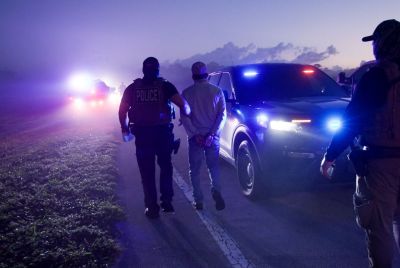
State prosecutors in Minnesota pressed charges on Monday against an Immigration and Customs Enforcement (ICE) agent involved in a January shooting. The incident occurred amidst a widespread border enforcement crackdown initiated across the region by the Trump administration.
Officials confirmed that ICE agent Christian Castro faces multiple counts, marking a rare instance of state-level prosecution against a federal officer. The move underscores growing scrutiny of Operation Metro Surge, a crackdown that left several residents injured and two US citizens dead.
Federal Agent Charged for Minneapolis Shooting
During a press briefing on Monday afternoon, Hennepin County Attorney Mary Moriarty announced that federal officer Christian Castro is facing four counts of second-degree assault alongside a single charge of making a false crime report.
The Hennepin County Attorney’s Office has filed charges against Christian Castro, an ICE agent, in the shooting of Julio Sosa-Celis in north Minneapolis on Jan. 14, 2026.
— Hennepin County Attorney Mary Moriarty (@HennepinAtty) May 18, 2026
He has been charged with four counts of second-degree assault and one count of falsely reporting a crime. pic.twitter.com/lT8Dwbqyhu
'Mr. Castro is an ICE agent, but his federal badge does not make him immune from state charges for his criminal conduct in Minnesota,' Moriarty said. 'I've said it many times and I'll say it again: there is no such thing as absolute immunity for federal officers who commit crimes in this state or any other.'
Gunfire Erupts in Innocent Family Home
The case involves Julio Cesar Sosa-Celis, a Venezuelan immigrant who survived being shot in the leg inside a Minneapolis home. The gunfire erupted during Operation Metro Surge, a federal crackdown where agents were actually searching for a completely different target.
🇺🇸 An ICE agent in Minnesota got charged with assault after video blew up his agency's own version of events.
— Mario Nawfal (@MarioNawfal) May 18, 2026
Christian Castro shot Venezuelan immigrant Julio Sosa-Celis through a front door during a botched arrest. The bullet lodged in a child's bedroom wall.
Charges against… https://t.co/CH2She8hj5 pic.twitter.com/lH5WB3Khoy
Back in February, acting ICE director Todd Lyons confirmed that the Justice Department was investigating two federal officers over the incident. He revealed that a joint review by ICE and the DOJ discovered that 'sworn testimony provided by two separate officers appears to have made untruthful statements.'
Federal authorities confirmed on Monday that the US Attorney's Office is still looking into the matter, with ICE noting that the involved officers face potential sacking, disciplinary penalties, or criminal prosecution. Meanwhile, it is still unknown whether Castro has secured legal representation.
Official Cover-Up Narrative Unravels
Top DHS officials, including the department's chief at the time, Kristi Noem, initially stood by the officers involved in the incident. Leadership claimed that an agent 'fired a defensive shot to defend his life' while pointing the blame at Sosa-Celis by accusing him of taking part in 'an attempted murder' of federal agents.
⚠️ WARNING: This post contains graphic descriptions of violence/gore/abuse
— True Crime Updates (@TrueCrimeUpdat) January 16, 2026
Julio Cesar Sosa-Celis, Alfredo Alejandro Ajorna, & Gabriel Alejandro Hernandez-Ledzema have been arrested in Minneapolis following an incident described as the attempted murder of a federal agent on… pic.twitter.com/52v9cE3CaL
That official narrative quickly unravelled, leading a federal judge to permanently throw out the case against Sosa-Celis and his roommate, Alfredo Aljorna, in February. The dismissal came after prosecutors admitted in a legal filing that 'newly discovered evidence' completely undermined the original accusations.
Here's the criminal complaint in MN v Christian Castro, charging ICE agent Christian Castro with 4 cts of assault 2d degree (with firearm) & 1 ct falsely reporting crime. (Reportedly for shooting Julio Sosa-Celis.)https://t.co/lVxScvXkPO pic.twitter.com/D3CiYJ56jn
— Roger Parloff (@rparloff) May 18, 2026
Moriarty confirmed that Sosa-Celis held legal status in the US when the gunfire occurred, emphasising that her team had partnered with the Minnesota Bureau of Criminal Apprehension to conduct a meticulous review before filing any charges.
The Battle Over Legal Jurisdiction
She further pointed out that state authorities anticipate a legal manoeuvre from Castro's defence team to shift the trial into the federal system. This type of venue transfer is a standard tactic available to defendants who were acting in an official federal role when an alleged crime took place.
Such a manoeuvre could trigger a wider legal battle over the legality of the agent's conduct. It would also likely spark a fierce debate over whether federal courts hold jurisdiction over actions carried out by federal personnel who are no longer employed by the government.
Moriarty clarified that even if a judge approves the transfer, Hennepin County lawyers will maintain control over the prosecution. She also highlighted that because the prosecution is being handled at the state level, Castro would not be eligible for a presidential pardon if a jury finds him guilty.
Fatal Fallout from Operation Metro Surge
Castro is now the second federal immigration officer to face prosecution from Moriarty's office regarding this crackdown, following assault charges pressed against Gregory Donnell Morgan Jr. last month. According to an arrest warrant, Morgan reportedly aimed his weapon at two motorists while driving along a highway shoulder.
🚨NEW VIDEO shows the moment an ICE agent pulled up next to a U.S. citizen’s vehicle, rolled down his window, and pointed a gun directly at the people inside.
— Jesus Freakin Congress (@TheJFreakinC) April 17, 2026
Gregory Donnell Morgan Jr. is now facing two felony counts of second-degree assault for pointing his weapon at both… pic.twitter.com/ivrk9dUK2L
The fallout from that night also extended to Aljorna's partner, a minor who originally entered the country as a minor. Immigration authorities detained her immediately after the shooting, but a federal judge later ruled the detention unlawful upon learning that the couple's one-year-old baby had been badly hurt and needed urgent, life-saving surgery.
The operation was marred by intense friction between immigration officers, demonstrators, and immigrants, particularly after federal agents shot and killed two US citizens. Following the fatal encounters, the administration ultimately called time on the operation after hammering out a deal to work in partnership with state authorities.
Back in March, the state took legal action against the Trump administration to force the release of investigative files. The lawsuit sought clarity surrounding the shooting of Sosa-Celis, as well as the fatal encounters involving Minnesota residents Alex Pretti and Renee Good, both of whom lost their lives to federal agents during the enforcement surge.
© Copyright IBTimes 2026. All rights reserved.
- Recommended For You