NASA Warns: You Need a Telescope to See Comet 3I/ATLAS in December Skies
Seeing Comet 3I/ATLAS requires a 30cm telescope

The undisputed star of the December sky is the Comet 3I/ATLAS, a truly exotic object making its closest approach to Earth on Dec. 19! This moment is likely your best chance to see this rare, high-speed interstellar interloper before it exits our solar system forever. The '3I' designation confirms its extraordinary status: it is only the third object in history from outside of our solar system to be discovered within our solar system.
This rarity alone makes it a priority target for scientific study. Its faintness, estimated to be around magnitude 11 to 15 during its closest approach, means it is far too dim to be seen with the naked eye and requires powerful magnification.
NASA continues to observe and study the object using a variety of spacecraft and telescopes so we can learn as much as we can about it while it's in our solar neighbourhood. Scientists are working furiously to gather data on its composition and trajectory, knowing that this object carries secrets from a distant stellar forge. Based on Hubble Space Telescope observations, the comet's icy nucleus is estimated to have a diameter between 320 metres and 5.6 kilometres.
It must be stressed that Comet 3I/ATLAS poses absolutely no threat to Earth and will remain far away. On its closest approach to our planet on Dec. 19, it will still be about 170 million miles away, or more than 700 times the distance between the Earth and the moon.
Despite this colossal distance, observers have a chance to spot it. Still, at this distance, skywatchers looking east to northeast in the pre-dawn window, roughly between 02:00 and 07:00 local time, could catch the comet right under Regulus, a star at the heart of the constellation Leo, the lion. However, its small size and vast distance mean the comet requires optical aid. To see the comet before it leaves our vicinity, you'll need to be looking through a telescope with an aperture of at least 30 centimetres.
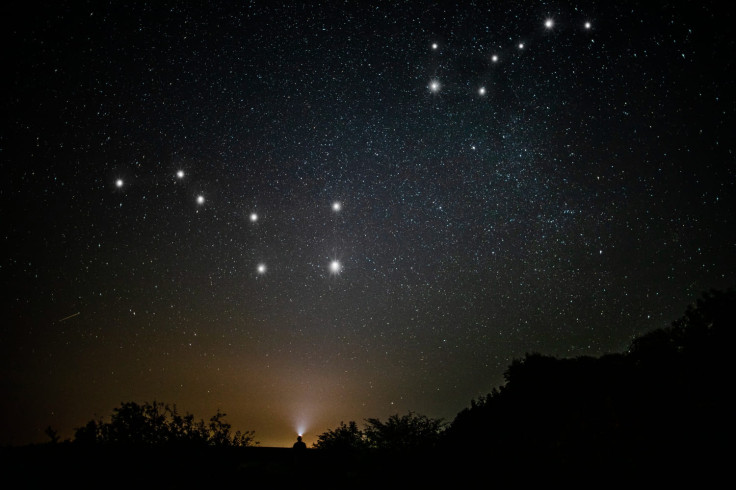
The Celestial Fireworks: The Colourful Geminid Meteor Shower
If locating an interstellar comet requires powerful equipment, the same cannot be said for the month's second main event: the spectacular Geminid meteor shower. The Geminids will sparkle across the skies this December, peaking brilliantly on the evenings of Dec. 13 and 14.
Unlike many meteor showers caused by typical cometary debris, this meteor shower is known for being bright and colourful, made up of debris trailing the asteroid 3200 Phaethon. This difference often gives the meteors a slower, more deliberate, and more easily photographed appearance.
This shower is famously prolific. With the darkest possible skies — far from city lights — you could see up to 120 Geminid meteors per hour! This incredible hourly rate makes the Geminids one of the most reliable and rewarding meteor showers of the entire year. To catch the Geminids peak, look to the eastern sky all evening on Dec. 13 and Dec. 14. They will appear to radiate from the constellation Gemini, near the bright planet Jupiter.
A Heavenly Meeting: The Jupiter and Moon Conjunction
Rounding out the magnificent month of viewing is a picturesque alignment that requires no specialised equipment whatsoever. The evening of Dec. 7, the moon will have a friend in the night sky as the moon and Jupiter get close for a conjunction.
This event offers a fantastic visual experience. During a conjunction, objects in the sky — like planets and moons — appear close together even though they're actually far apart. For example, while the moon and Jupiter will buddy up this month from our view, in space, they're actually hundreds of millions of miles apart.
This apparent closeness is a wonderful reminder of the perspective gained from our viewpoint on Earth. To see the pair together, simply look up to the moon in the eastern sky on Dec. 7, and Jupiter will be just above and to the right. It's the perfect target for casual stargazers and a great photo opportunity.
While the Geminid meteor shower offers a glorious, naked-eye spectacle for all, the chance to view the interstellar Comet 3I/ATLAS is truly a scientific privilege reserved for the dedicated observer. This faint, fleeting visitor from another star system is a celestial time capsule, offering secrets on the cosmos's formation that we cannot acquire any other way.
© Copyright IBTimes 2026. All rights reserved.
- MOST POPULAR IN Trending