

New Observations Show 3I/ATLAS's Anti-Tail Changes Direction as It Approaches Perigee
Astronomers track a rare anti-tail on interstellar object 3I/ATLAS as it evolves during its closest approach to Earth
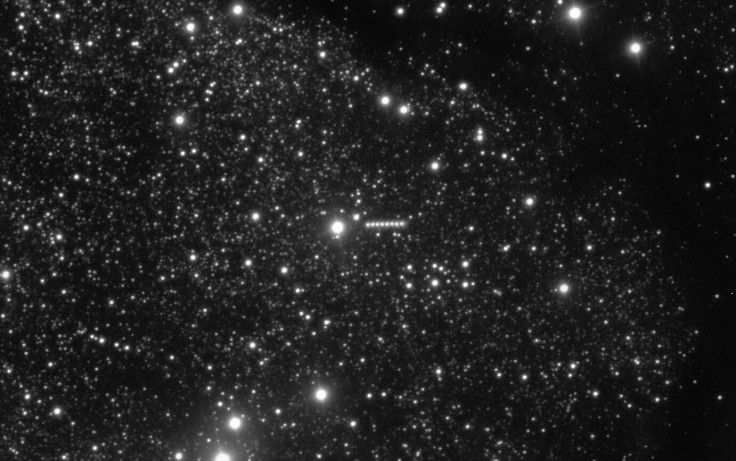
Astronomers tracking the interstellar visitor 3I/ATLAS have detected a fresh and unexpected shift in the direction of its rare anti-tail, intensifying debate over how the object is behaving as it approaches its closest point to Earth.
Observations from both professional and amateur observatories suggest the dust structure pointing towards the Sun has altered orientation in a way that challenges conventional comet physics.
While most researchers maintain that 3I/ATLAS is a natural interstellar comet, the evolving anti-tail has drawn renewed scrutiny from scientists studying how dust, ice and radiation interact in objects formed beyond our Solar System.
A Rare Anti‑Tail And Now A Moving One
Surprisingly, 'anti-tail' is no new phenomenon in cometary science, although they are rare and typically caused by perspective effects: the observer's point of view with respect to the dust plane of the comet may result in an apparent tail pointing towards the sun. The anti-tail behaviour of 3I/ATLAS, however, indicates recent observations are acting contrary to the work of geometry.
The Nordic Optical Telescope has reported that the dust trail, which was once facing the Sun, has changed orientation as the object approaches perigee. Several observatories, including Hubble and Gemini, have been tracking the object's approach, and this change in direction has been confirmed.
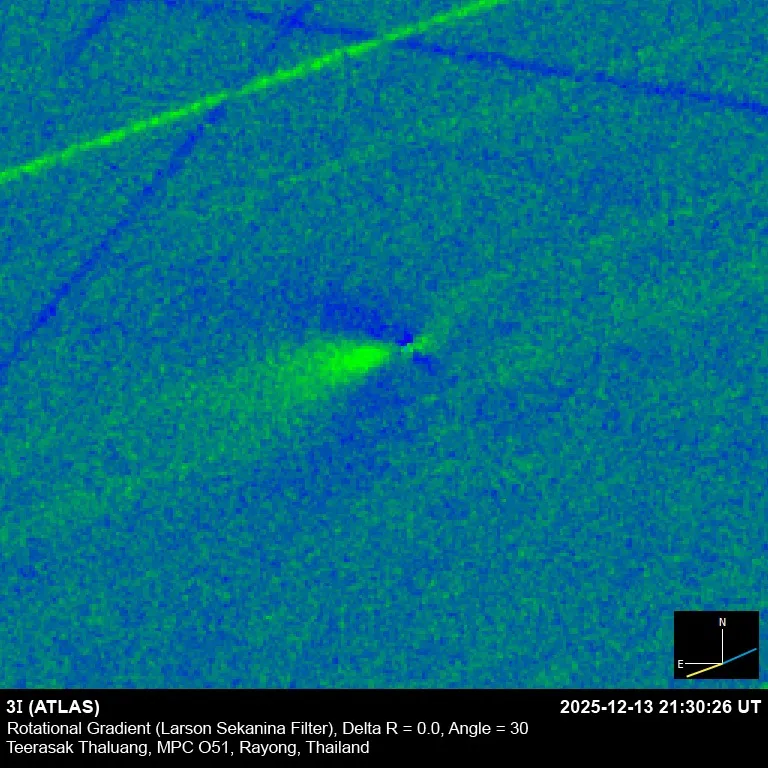
In a recent post, Harvard astrophysicist Avi Loeb claimed that the orientation of the anti-tail in the pre- and post-perihelion images is reversed relative to the direction of motion at perihelion. Loeb argues that such behaviour does not correspond to the predicted reaction of dust or gas to the pressure exerted by the solar radiation.
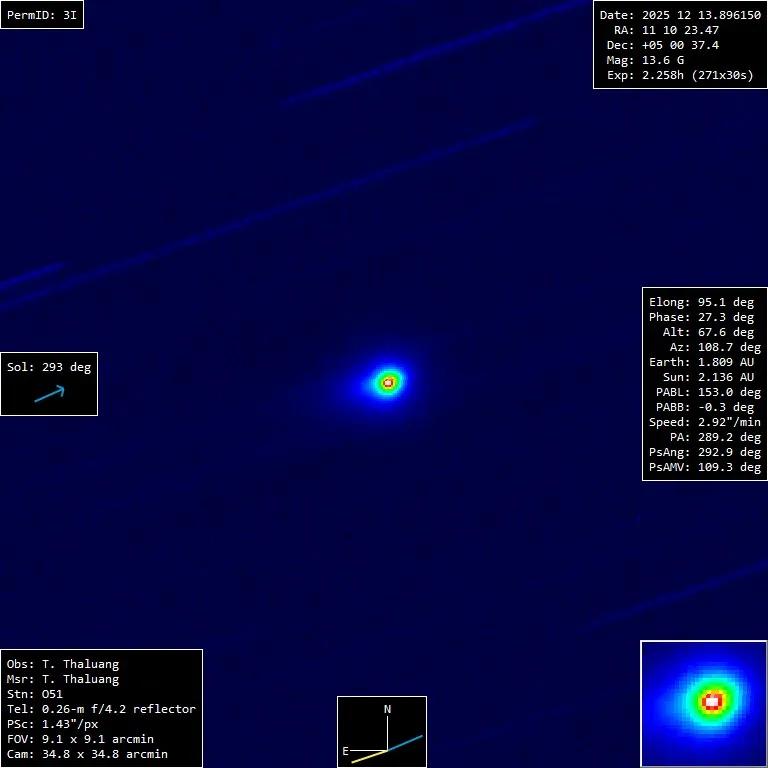
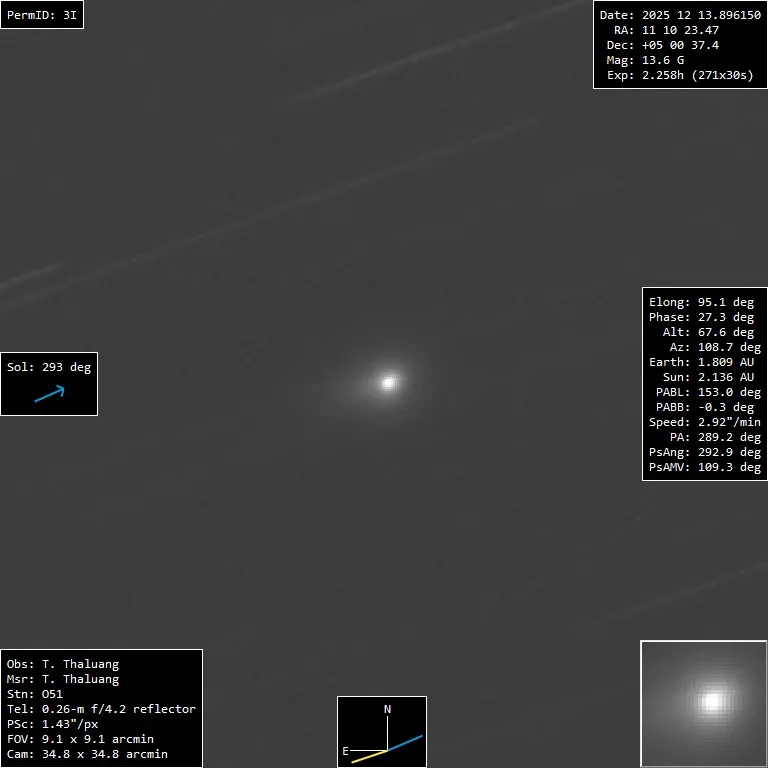
Closest Approach: A Safe But Scientifically Valuable Flyby
3I/ATLAS will fly closest to Earth at about 270 million kilometres, which will not endanger it. The flyby is a unique study of an object that is the result of another star system, though the safe distance allows it.
It is the third object to be proven as an interstellar visitor, after 1I/'Oumuamua in 2017 and 2I/Borisov in 2019. In contrast to Borisov, which behaved traditionally for a comet, 3I/ATLAS has exhibited a series of anomalies, the most notable of which is the anti-tail.
Loeb also notes that the object's rotational gradient brightness map indicates a significant anti-tail towards the Sun, even though the object is moving away from the Sun. This continuity, together with the more recent directional change, has spawned the theory of the composition and structure of the material which constitutes the tail.
Natural Explanation Or Something More Complex?
The majority of astronomers believe that the 3I/ATLAS is probably a dust-rich interstellar comet, and the anti-tail is composed of large and slow particles that are retained in the orbital plane. The apparent direction of the anti-tail can vary as the object rotates relative to the Earth.
Loeb himself, however, has argued publicly that the behaviour can be evidence of the existence of something else within the tail structure. In a recent study, he proposed that the anti-tail's failure to respond to solar radiation pressure and its abrupt change of direction could indicate non-natural material or an unknown process.
His remarks are reminiscent of previous conjecture on the topic of 'Oumuamua, which also exhibited non-cometary behaviour. Loeb underlines that it should not be assumed that an exotic explanation is incorrect, but it must not be rejected without thorough research.
What Observatories Are Now Seeing
The latest images of various telescopes reveal:
- The anti-tail remains directed towards the sun, despite the object's changing path.
- The tail's orientation has shifted, which defies predictions based solely on the geometry of dust planes.
- The object's brightness profile continues to change as it approaches perigee, suggesting it is still active or fragmented.
Such observations have sparked renewed interest in modelling the object's dust environment. Other scientists suggest that the anti-tail may be composed of large ice particles or trailing debris, which behave differently from regular dust in comets.
A Mystery Deepens As Perigee Approaches
Since 3I/ATLAS is only days away on its closest pass, researchers across the globe are in a scramble to record as much of it as they can. It is still uncertain to determine whether the changing direction of the anti-tail is a peculiarity of the interstellar comet physics or a sign of something stranger.
What is quite evident is that 3I/ATLAS is developing into one of the most scientifically intriguing visitors to our Solar System in recent history, with unusual behaviour that challenges long-established theories about how such cosmic objects are expected to behave.
© Copyright IBTimes 2026. All rights reserved.