

Avi Loeb Highlights 3I/ATLAS Anomalies Amid Sterile Neutrino Controversy in Physics
The Harvard astrophysicist uses failed particle experiments to defend why space anomalies deserve serious scientific investigation

Astrophysicist Avi Loeb has highlighted a set of perplexing anomalies in the interstellar object 3I/ATLAS, suggesting that some of our traditional ideas about comets, and perhaps even fundamental physics, may need to be revisited.
His argument is based on parallels with failed experiments recently conducted in search for 'sterile neutrinos,' a hypothetical ghost particle. The analogy highlights the scientific community's unwillingness to face actual anomalies, as Loeb would put it.
A Rare Visitor With Unusual Behaviour
3I/ATLAS, discovered in July 2025, is the third interstellar object to be detected to have traversed the solar system after 1I/Oumuamua and 2I/Borisov. It has a hyperbolic orbit, indicating it is not gravitationally bound to the Sun, which is clear evidence of an interstellar origin.
Telescopic observations such as the Hubble Space Telescope and terrestrial telescopes indicate that 3I/ATLAS has an estimated nucleus of up to 5.6 km and a pronounced coma — the cloud of gas and dust typical of comets. However, what really captures Loeb's interest are its 13 documented anomalies - features that do not align with conventional cometary physics.
The Anti-Tail, The Jet And The Scientific Headaches
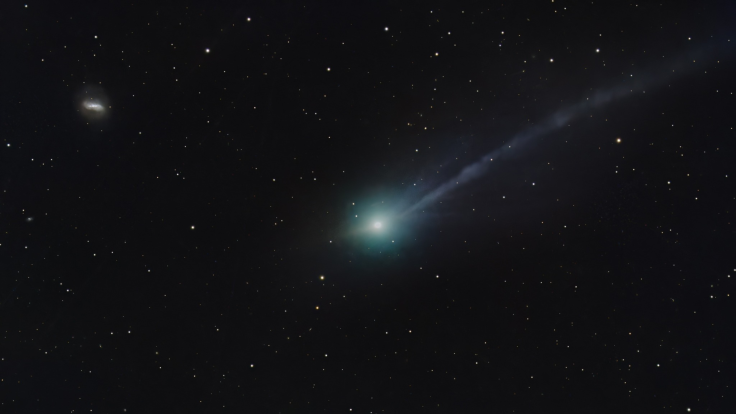
One of the most puzzling appearances of 3I/ATLAS is its sunward jet or 'anti-tail' projection. A comet is usually pointed away from the Sun due to solar radiation and the solar wind. However, with high-resolution images taken on 9 December 2025, one could see a jet pointing toward the Sun, which Loeb says cannot be well accounted for by standard dust or gas outgassing models.
Loeb and his group have come up with several possible causes, such as ice grains that evaporate and later recoil, or larger material that is resistant to radiation pressure, neither of which is common to known comet behaviour.
This is based on his claim that ruling out such anomalies by labelling them as either an observational error or a strange comet is indicative of the so-called arrogance of expertise, when such anomalies are only three in number.
From Sterile Neutrinos to Interstellar Mysteries — Why Loeb Draws the Parallel
Loeb makes a controversial comparison between 3I/ATLAS and the recent scientific search for sterile neutrinos — hypothetical particles proposed decades earlier to explain anomalies in neutrino-oscillation experiments. In late 2025, two extensive experiments announced findings indicating that no such particles exist, effectively ruling out the proposed parameter space.
However, most physicists accepted the entire field, despite the 'failure.' In other words, they acknowledged that although the null result was obtained, it is scientifically valid to search for new physics. In turn, Loeb inquires: why is the same openness not afforded to interstellar comets, such as the 3I/ATLAS?
According to him, scientific advancements are driven by anomaly-based studies. As physicists did with the Standard Model when faced with odd neutrino data, astronomers should now be willing to revise comet theory or even consider radical solutions to the data from 3I/ATLAS.
What the Scientific Community Says (So Far)
Ordinary comet scientists remain speculative. The traditional model of cometary behaviour is based on outgassing — the sublimation of ices in the heat of the sun, and the expulsion of dust in the same direction. For most comets, this works well. However, the community suggests that odd features such as anti-tails or variable tails can be explained by the dynamics of dust and gas, including geometry or uneven outgassing.
When the data appeared unclear or ambiguous, as Loeb himself later pointed out, some astronomers complained that he was exaggerating facts or confusing early elongation with the comet tail.
However, now that the data and observations are better, the anomalies remain — the debate continues.
Why It Matters — More Than Just Cosmic Curiosity
Should 3I/ATLAS prove to be impossible to get along with other known models of comets, it may indicate either:
Space science must be revised on a large scale — new physics of interstellar objects will have to be established.
Loeb argues that data — not ideology — should always guide science. He uses the sterile-neutrino precedent to caution against early discounting of anomalies merely because they undermine tradition's wisdom.
To the general public and future investigative studies, 3I/ATLAS will provide a unique opportunity to examine material external to our solar system and possibly increase our understanding of how planetary systems form, evolve, and vary throughout the galaxy.
© Copyright IBTimes 2026. All rights reserved.