

At Least 31 Dead After Russian Bombs Strike Ukrainian School Building Used as Shelter and Aid Centre
Ukrainian officials said five people were injured and nearly 50 remained missing as rescuers searched the rubble of the humanitarian aid centre
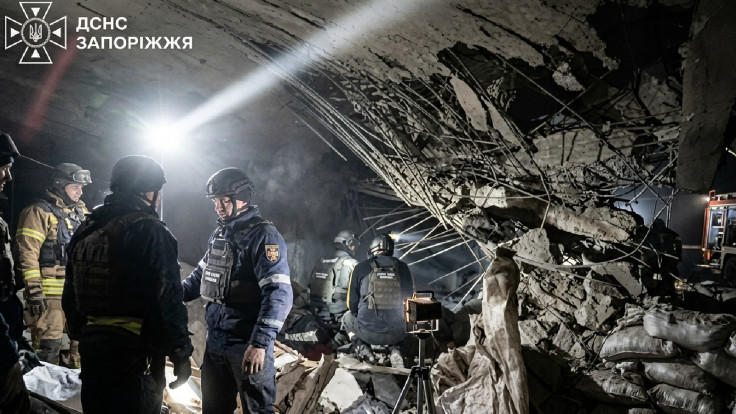
At least 31 people were killed when Russian aerial bombs struck a Ukrainian school building serving as a shelter and humanitarian aid centre in Komyshuvakha, south-eastern Ukraine, on Monday, 2 November 2026, according to Ukrainian officials.
Mykhailo Semikin, acting head of the Zaporizhzhia Regional Military Administration, said on Tuesday that five others were injured and nearly 50 people remained missing.
Rescue teams continued searching the rubble as authorities warned that the death toll could rise.
The building was no longer holding regular classes because of its proximity to the front line. Instead, residents used the site to collect humanitarian supplies, access administrative services and seek protection from Russian attacks.
The village also had an underground school facility at Dzherelo Gymnasium, which opened in October 2025 with European Union financial support.
Built to provide protected learning spaces during the war, the facility became part of the community's efforts to maintain essential services.
Russian Bombs Strike Ukrainian School Shelter During Aid Distribution
Ukrainian President Volodymyr Zelensky said Russian forces initially bombed the school before launching a second wave of nine aerial bombs at a shelter where residents had taken refuge.
The first strikes reportedly occurred as people gathered for their regular humanitarian aid distribution. According to Ukrainian authorities, subsequent explosions damaged the underground shelter and trapped people beneath collapsed concrete.
Semikin said Russian forces used several types of aerial bombs, beginning with KAB-500 weapons before deploying heavier FAB-3000 bombs.
A FAB-3000 weighs approximately three tonnes and carries around 1.5 tonnes of explosives. Such weapons are designed to penetrate heavily reinforced structures, including concrete fortifications and bunkers.
➡️ Ataque russo a centro de ajuda deixa 26 mortos na Ucrânia
— Metrópoles (@Metropoles) November 2, 2026
🤳 State Emergency Service of Ukraine pic.twitter.com/7Tk7Bko53X
According to Semikin, the bombardment caused reinforced concrete sections to collapse and started a fire. Emergency workers were left searching through debris for people believed to be trapped.
The underground school at Dzherelo Gymnasium had officially opened on 17 October 2025, supported through the EU's Ukraine Facility financing programme. The project was intended to provide a protected educational environment for children during the conflict.
The United Nations also condemned the attack. Matthias Schmale, the UN's humanitarian coordinator for Ukraine, said the strikes killed civilians who had gathered for assistance and emergency personnel responding to the initial bombing.
Russia's Defence Ministry, meanwhile, said its forces had targeted Ukrainian military units around Komyshuvakha and two other settlements. It claimed up to 25 Ukrainian servicemen were killed, although the assertion has not been independently verified.
Ukrainian School Strike Kills Police and Rescuers
Ukraine's State Emergency Service confirmed that two rescue workers and four police officers were among those killed following the initial bombardment.
The deceased rescuers were identified as Denys Konovalenko and Oleksii Sushchevskyi, both 44. Konovalenko had served in civil protection for nearly 12 years, while Sushchevskyi joined the emergency services in 2013.
Both had received state awards recognising their service. Two additional emergency workers were among those injured in the attack.
Ukrainian police also identified four officers killed while helping residents reach the underground shelter: Mykhailo Buzhenko, Mykola Balanda, Mykhailo Romanov and Dmytro Besedin.
Buzhenko and Balanda had each served for more than two decades. Romanov and Besedin had worked as community police officers for more than 10 years.
According to the National Police, the officers were assisting civilians when another Russian bombardment struck the area. The force said the subsequent explosions trapped people attempting to escape, including emergency personnel.
The reported sequence has not been independently verified by IBTimes UK. Ukrainian authorities have described the incident as a follow-up strike, although the precise circumstances and intent remain subject to further investigation.
Zaporizhzhia authorities declared three days of mourning, from 3 to 5 November, for those killed.
Deadly School Bombing Comes Amid Wider Russian Attacks
The Komyshuvakha bombing came shortly before another major Russian assault targeting Ukraine's energy infrastructure overnight on 2–3 November.
Zelensky said Russian forces launched 289 attack drones, 17 ballistic missiles and 59 cruise missiles during the separate barrage. The attacks damaged energy facilities and triggered power disruptions across several regions.
'It is very telling that all of this is happening on the day of the US congressional elections,' Zelensky said on Tuesday, 3 November.
He suggested Moscow expected Washington to be distracted by the elections, although that interpretation of Russia's intentions has not been independently established.
'Ukraine must be helped to defend its skies, otherwise Russia will never stop its missile strikes,' he added.
The latest deaths followed other major attacks on Ukrainian communities. On 8 October, a Russian strike hit two passenger buses in Kramatorsk, killing at least 33 people, according to Ukraine's State Emergency Service.
In August, a Russian drone attack near Kyiv triggered explosions at an ammunition storage facility. Ukrainian officials subsequently reported at least 38 deaths. A separate Russian missile and drone attack on Kyiv on 2 July killed 31 people, according to emergency services.
In Komyshuvakha, rescue operations remained underway on Tuesday, with families awaiting news of those still missing. Semikin's reported toll of 31 deaths and nearly 50 missing was provisional, leaving open the possibility of further casualties.
© Copyright IBTimes 2026. All rights reserved.