

3I/ATLAS Comet Returns: See The 'Visitor Older Than Our Sun' Over Egypt
Comet 3I/ATLAS: The ancient interstellar visitor with a baffling 250,000-mile X-ray cloud.
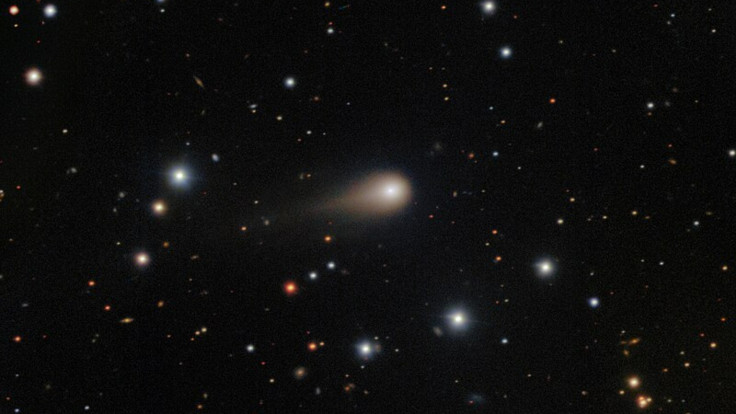
It is one thing for scientists to discover a cosmic anomaly, but it is another entirely when that anomaly outright defies their understanding of how the universe works. That is precisely the situation astronomers now face with the interstellar comet 3I/ATLAS.
This unwelcome visitor from a star system far beyond our own—a relic that experts believe is over seven billion years old, making it potentially billions of years older than our own Sun—has revealed a startling new feature: a colossal, faint X-ray cloud that sprawls out an incredible 250,000 miles (400,000 kilometres) around its icy core. For context, that glowing, ethereal halo is larger than the entire distance separating the Earth and the Moon.
The findings have been quickly, and quite accurately, branded 'puzzling' by the community. While we have known since the 1996 flyby of Comet Hyakutake that our own solar system's comets can emit X-rays, this is the first time we have confirmed this phenomenon on an object that did not originate around our Sun.
More critically, the scale, structure, and sheer existence of this diffuse X-ray glow are throwing every textbook assumption about these space rocks into disarray. It has been described as a mystery 'forged under alien conditions,' and the rush is on to decode what this means for the makeup of matter from across the galaxy.
The discovery was captured by the X-Ray Imaging and Spectroscopy Mission (XRISM), a groundbreaking collaboration led by Japan's JAXA, with crucial assistance from NASA and the European Space Agency (ESA). XRISM, which is purpose-built to observe high-energy phenomena, spotted the X-ray glow between November 26 and November 28, 2025.
The halo surrounds the comet's coma, the vast cloud of gas and dust that forms as the ice on its surface vaporises while it streaks through our system. As only the third interstellar object ever confirmed—following 1I/'Oumuamua and 2I/Borisov—every observation of 3I/ATLAS is a priceless chance to sample a genuine celestial outsider.

3I/ATLAS: A Chemical Composition That Defies Our Solar Norms
To understand the puzzle, you first need to understand the usual explanation. X-ray emissions from comets formed within our solar system are typically a result of charge-exchange reactions.
When the solar wind—the relentless stream of charged particles flowing from the Sun—smashes into the comet's neutral gas atoms, it creates a reaction. The solar wind ions effectively 'steal' an electron from the comet's gas atoms, and in doing so, they release energy in the form of X-rays.
The X-ray glow around 3I/ATLAS, however, is not playing by those rules. Its immense extent, reaching out nearly 400,000 kilometres, suggests an astonishingly sparse and diffuse cloud of gas is surrounding it.
The XRISM team has explicitly stated that they are still hard at work trying to untangle the full implications, noting that some of the blurring in the imaging might be down to instrument performance. Even with that caveat, a faint but real glow spanning several hundred thousand miles has been detected.
The fundamental complication is the comet's provenance. Since 3I/ATLAS hails from a distant, unknown star system and is currently hurtling away from the Sun at over 210,000 kilometres per hour, its chemistry is likely to be completely different from anything formed here.
The 'older than our Sun' estimate stems from the object's likely origin in the Milky Way's 'thick disk'—a region populated by stars that formed in the galaxy's earliest years, roughly 7 to 11 billion years ago.
This is supported by recent findings from the Atacama Large Millimeter/submillimeter Array (ALMA), which detected unusually large amounts of methanol and hydrogen cyanide streaming from the comet. Its chemical ratios simply do not resemble our own comets. The 3I/ATLAS observation, therefore, is not just a strange light show; it is a precious chemical snapshot of an icy world created somewhere entirely new.

Racing Against Time: Decoding the X-ray Structure of 3I/ATLAS
The significance of the XRISM X-ray detection cannot be overstated, especially given the ticking clock. 3I/ATLAS is now observable in the pre-dawn sky, but it is firmly on a hyperbolic, one-way trajectory out of our solar system. The comet's 'return' to prominence is due to it emerging from behind the Sun in late October, making it visible again to telescopes from Earth.
It will make its closest approach to Earth on December 19, 2025, but at a safe distance of 167 million miles (270 million kilometres), and is expected to be entirely out of range by next year. The pressure on scientists to gather data before this cosmic window slams shut is immense.
This latest development follows months of confusing behaviour from 3I/ATLAS. Discovered by the ATLAS telescope in Chile in July 2025, it was immediately identified as an interstellar visitor due to its extreme velocity. Despite being classified as a comet because it is active, it has exhibited multiple, inexplicable jets of material, a distinct redder colour, and an extreme negative polarization, all of which are unprecedented.
This massive X-ray halo adds a new layer to the mystery. The sight of the comet has recently been captured by photographers, with stunning images taken as it passed over sites like Egypt's Black Desert. The research team's immediate priority is rigorous data processing to definitively confirm the structure and source of the X-ray glow, ruling out any instrumental noise.
Unravelling how the comet's 'alien' gas interacts with our local solar wind is vital. It is a thrilling, rare moment to study matter from another star, and for now, the secrets of 3I/ATLAS remain tantalisingly hidden inside that mysterious, quarter-million-mile-wide X-ray cloud.
The journey of this ancient, billion-year-old cosmic intruder is nearing its end in our solar system, but its mysterious, quarter-million-mile X-ray cloud has only deepened one of the greatest space puzzles of our time. As scientists race to process this final, priceless chemical snapshot before 3I/ATLAS vanishes forever, its secrets remain tantalisingly hidden.
© Copyright IBTimes 2026. All rights reserved.