Interstellar Comet 3I/ATLAS Continues Its Grand Tour of Our Solar System
NASA and ESA capture the final, dual-tailed images of Comet 3I/ATLAS, a rare interstellar visitor leaving our system
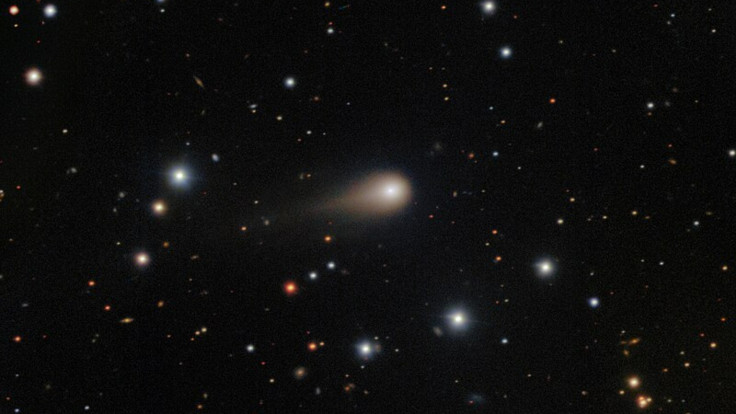
The cosmos has delivered a visitor, a silent, icy interloper from the darkest reaches of our galaxy, and the world's most powerful eyes are glued to its progress.
This is not a scene from a science fiction blockbuster, but the genuine, thrilling reality of Comet 3I/ATLAS, an interstellar traveller that has spent recent months touring our solar system. Its arrival has sparked a frenzy of activity among astronomers, generating a cascade of stunning imagery from nearly every satellite, space telescope, orbiter, and even the surface rovers currently operational across our cosmic neighbourhood.
The two most recent sets of photographs, released just last week from NASA's Hubble Space Telescope and the European Space Agency's Jupiter-bound Juice spacecraft, have added a sensational new layer to the mystery, capturing the comet's vivid glow against the streaking backdrop of distant stars and even hinting at the object possessing two separate, lengthy tails.
Why the intense excitement? Comet 3I/ATLAS holds the distinction of being only the third object ever confirmed to have journeyed into our corner of the Milky Way from another star system. This extraordinary rarity — only two previous such objects have been identified — explains why a global fleet of instruments is now focused on documenting its every movement. While a few dreamers have pondered whether this could be a sign of 'alien technology', scientists remain firmly focused on the cold, hard data this truly unique celestial object is providing.
First spotted back in July, the comet was detected by the aptly named Asteroid Terrestrial-Impact Last Alert System (ATLAS), a NASA-funded survey network whose primary mission is to scan for potentially hazardous asteroids. At the time of that initial sighting from the facility in Rio Hurtado, Chile, the comet was already a colossal distance away, clocking in at about 420 million miles away.
Before 3I/ATLAS, the only other confirmed interstellar tourists we've seen were the now-famous, cigar-shaped 'Oumuamua' in 2017 and the slightly more conventional Comet '2I/Borisov' in 2019. This new visitor offers an invaluable third sample, allowing researchers to compare the building blocks of other star systems with our own.

The Mystery of 3I/ATLAS: Decoding the Interstellar Drifter's Chemical Signature
The quest to understand what this interstellar object is made of has driven one of the most significant early discoveries. NASA's Spectro-Photometer for the History of the Universe, Epoch of Reionization and Ices Explorer, thankfully known by the punchier acronym SPHEREx, spent eight days — from Aug. 7 to Aug. 15 — focused on the comet.
These observations, taken when the object was around 290 million miles away from the sun, provided a critical look at the comet's 'coma'. The coma is the hazy cloud of gas and dust that forms an atmosphere around the nucleus as the ice begins to vaporise. The SPHEREx data showed that this atmosphere was rich in both ice water and carbon dioxide, a chemical composition remarkably similar to the chemistry of comets that were formed right here in our solar system. This finding challenges any simplistic notion that objects from other star systems would be wildly different from our own, suggesting a commonality in the basic materials floating across the galaxy.
As 3I/ATLAS continued its solar approach, its activity visibly intensified. In late August, the Gemini South telescope in Chile captured what were then the most detailed images available, releasing them in September. These photos already showed an extended coma of dust and gas surrounding the icy core. Crucially, astronomers noted that the object's tail appeared more elongated compared to earlier sightings, a clear sign that the warming rays of our sun were causing the comet to become more 'active'.

The Global Stalking of Comet 3I/ATLAS: What NASA's Fleet Has Revealed
The space agencies of the world have treated 3I/ATLAS like a celebrity, marshalling every available resource to document its close passage. Observations have come from a dizzying array of missions, including the sun-watching PUNCH satellites, the venerable Solar and Heliospheric Observatory, the Lucy space probe, and even the Mars Atmosphere and Volatile EvolutioN (MAVEN) mission. The plucky Perseverance Rover on the surface of Mars was also tasked with turning its camera skyward.
In October, the European Space Agency (ESA) released its own stunning photographs. These were taken by the ExoMars Trace Gas Orbiter, which began observing the comet for a full week starting on Oct. 1. The images — showing a fuzzy white dot moving against the black expanse of space — were taken when 3I/ATLAS was approximately 18.6 million miles from the orbiter itself.
More recently, NASA's legendary Hubble Space Telescope tracked the comet late last month, when it was approximately 178 million miles away from Earth. Hubble's instruments recorded the moving comet as a luminous point, a powerful visual testament to its speed, as the background stars appeared as light-streaks in the same exposure.
Adding to this treasure trove of information, ESA's Jupiter-bound spacecraft, Juice (Jupiter Icy Moons Explorer), provided a recent spectacular: images revealing the possibility that the comet has not one, but two distinct tails. Juice gathered this data shortly before its closest approach to the comet on Nov. 4, when it flew within about 41 million miles. The photos showed the glowing halo of the comet's coma and differentiated between the 'plasma tail' — made of electrically charged gas and extending upwards — and the 'dust tail', composed of tiny solid particles that stretched out to the lower left.
The comet reached its closest point to the sun at the end of October and, while it will fly by Earth on Dec. 19, there is no need to worry about a close call. The object will remain at a completely safe distance of about 170 million miles away. As it begins its long journey back out of our solar system, ESA expects to retrieve additional data from Juice's science instruments in February, ensuring that the final chapter of this historic, high-speed flyby is documented for posterity.
The brief, thrilling passage of Comet 3I/ATLAS marks a historic moment in astronomy, giving us an unprecedented glimpse into the composition of a star system light years away. As this third-ever confirmed interstellar object speeds out of our neighbourhood, the real work for scientists begins. They will now pore over the terabytes of data gathered by the global fleet of missions, from the Perseverance Rover on Mars to the Hubble Space Telescope in orbit. The universe has given us a unique sample; now it is up to us to decode its secrets.
© Copyright IBTimes 2026. All rights reserved.
- MOST POPULAR IN Trending