

China's Alleged 'Find And Kill Them All' AI System Sparks Fresh Concerns Over Drone Warfare
China has reportedly developed an AI system, HG-STR, enabling drone swarms to autonomously identify and eliminate targets, even when communication is disrupted.
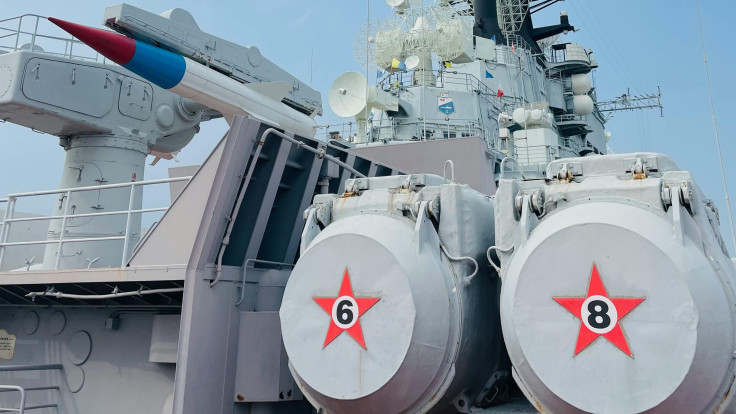
Chinese scientists have unveiled a new artificial intelligence system, which they say could reshape how drone swarms identify and eliminate targets on the battlefield.
The technology, known as Heterogeneous Graph Spatio-Temporal Reasoning (HG-STR), is designed to help groups of drones continue operating effectively even when enemy jamming systems disrupt the communication links.
According to researchers, the system could enable drones to carry out missions across vast areas while still locating and destroying every designated target. The development has drawn attention because it moves autonomous drone warfare a step further, allowing machines to make decisions using incomplete information while maintaining coordination with other drones in the swarm.
The study, published in the journal Acta Aeronautica et Astronautica Sinica, outlines how the AI overcomes one of the biggest challenges facing drone swarms today: the loss of communication between individual units during combat operations. Its reported ability to pursue a single mission of finding and eliminating all enemy targets has sparked fresh discussion about the future role of AI-driven weapons.
How The New AI System Works
Under normal battlefield conditions, each drone within a swarm can observe only a limited portion of the area around it. As a result, communication between drones is essential for building a complete picture of the battlefield. When enemy jamming systems interfere with those communications, drones can struggle to maintain awareness of targets, which may appear and disappear from view.
To address this problem, Chinese researchers reportedly developed HG-STR, an algorithm that allows drones to continue making effective decisions even when information is incomplete. The system is built around what scientists describe as a 'heterogeneous graph', a network in which every object is mapped onto a web and connected through links that convey its meaning and relationship to other elements.
Within this structure, each drone serves as an information node, carrying details such as its position, speed, remaining ammunition, and previous assignments. Enemy targets are also represented as nodes, containing information about their location and the remaining damage required to destroy them. The surrounding environment forms another set of nodes, providing information about areas that remain unsearched.
Researchers also created a compressed memory system that allows drones to retain observations gathered earlier in a mission. This means that if communication systems are disrupted, the drones do not have to start over. Instead, they can continue reasoning and making decisions using information stored from previous observations.
The AI is also designed to recognise the importance of different types of information. Researchers say existing autonomous killer drone algorithms often treat information about friendly forces, enemy targets, and terrain in the same way, which can create confusion. HG-STR seeks to avoid this by learning which connections deserve the most attention. For example, when a drone equipped with the system detects an enemy target, the AI immediately treats that information as a high-priority threat.
Researchers Claim Unprecedented Battlefield Performance
According to the research team from Northwestern Polytechnical University in Xian, HG-STR is the first AI algorithm with the potential to achieve a 100 per cent kill rate. In tests described in the study, a swarm of 10 drones operating across a 100 km by 100 km area was able to locate and eliminate all assigned targets while travelling a shorter overall flight distance.
Researchers say the system's efficiency stems from its ability to coordinate drone actions despite communication interruptions. Rather than relying entirely on constant links between swarm members, the AI combines stored memories, current observations, and its understanding of relationships between battlefield elements to make decisions independently.
Speed is another feature highlighted in the study. Using the HG-STR system, drones were reportedly able to make decisions in just 6.6 milliseconds. In battlefield situations, where conditions can change rapidly, such response times could play a crucial role in determining mission outcomes.
The researchers argue that the technology could eventually support the development of drone fleets capable of entering areas completely cut off from human command. Once given an objective, such swarms could continue operating autonomously despite losing contact with operators.
This marks a notable contrast with current battlefield operations. Even in conflicts such as those involving Ukraine and Russia, drone manoeuvres are still largely directed by remote human pilots. The new AI system points towards a future in which swarms may be able to continue missions with far less reliance on real-time human control.
The study's most striking claim is that HG-STR could allow autonomous drone fleets to carry out a single order of 'seeking and killing all enemy targets' even in contested environments where communication networks have been disrupted. By combining battlefield memory, rapid decision-making, and prioritised threat recognition, the system represents a new approach to autonomous drone operations, one that researchers believe could dramatically improve the effectiveness of future drone swarms.
© Copyright IBTimes 2026. All rights reserved.
- Recommended For You


