

Is Donald Trump's Comment About Smiling Offensive? Here's What Female Professionals Are Saying Now
Experts analyse the gender dynamics behind Trump telling journalists to smile.
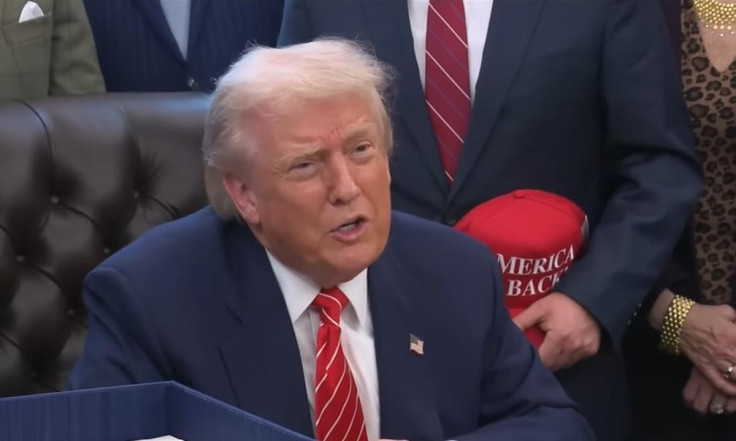
The atmosphere within the Oval Office is notoriously high-pressure, yet a recent press briefing shifted rapidly from political scrutiny to a critique of personal demeanour. While fielding questions regarding the Justice Department's ongoing investigation into convicted sex offender Jeffrey Epstein, President Donald Trump paused the policy discussion to address the facial expression of the journalist asking the questions.
Addressing CNN's Kaitlan Collins from behind the Resolute Desk, the President expressed dissatisfaction not with her inquiry but with her lack of visible joy. 'I've known you for 10 years,' Trump remarked. 'I don't think I've ever seen a smile on your face.' This interaction has since reignited a fierce cultural conversation about gender expectations in professional settings.
President Trump's Remarks Spark Debate
This recent exchange involving Collins is not an isolated event in the President's interactions with the press corps. It echoes a confrontation from last year involving a Bloomberg News reporter who also attempted to question the President regarding the Epstein files. That interaction ended abruptly when Trump cut off the journalist, snapping, 'Quiet! Quiet, piggy.'
These moments have drawn sharp criticism from women across various industries who argue that policing facial expressions is a grievance specific to the female experience. Caroline Dettman, the chief marketing officer and head of growth operations at World Business Chicago, took to LinkedIn to voice a sentiment shared by many professionals.
'It has never been a good idea to tell women to smile more,' Dettman wrote. 'Even if it isn't intended, the way it lands is both disrespectful and misogynist. I know because I've been told to smile more my entire career by bosses, clients, partners and colleagues.'
Why Vice President JD Vance Calls the Critique 'Perceptive' Rather than Sexist
Despite the backlash, the administration maintains that the comment was an observation on attitude rather than gender. Vice President JD Vance, who was present in the West Wing during the exchange, defended the President's stance during an appearance on SiriusXM. Speaking to host Megyn Kelly, Vance argued that the remark was 'so perceptive'.
'Even if you are asking a tough question, even if you take your job very seriously, why does it always have to be so antagonistic?' Vance asked.
Megyn Kelly, a former Fox News anchor, agreed with the Vice President's assessment. She recalled that former Fox News Chairman Roger Ailes frequently prompted her to adjust her demeanour on camera.
'I saw online that everyone is calling him sexist for saying that,' Kelly said. 'I literally said the same thing about Kaitlan Collins a year ago on my show. She never smiles. Every once in a while, you have to smile.'
Double Standard in Workplace Demeanour
While some view the comments as innocuous advice, data suggests a significant disparity in how men and women are expected to present themselves. Research indicates that 98% of women report being told to smile at work at some point in their lives.
About 15% of these women say they get told to smile every single week. This pressure continues even though the data shows women already smile far more than men do. Studies indicate the average woman smiles around 62 times a day, while the average guy only smiles eight times.
No amount of success protects you from it. Hillary Clinton faced the same criticism during her 2016 campaign. People even questioned why Serena Williams wasn't beaming after an exhausting match against her sister.
The trend is just as bad in the entertainment world. When a photographer on the Stranger Things red carpet tried to order Millie Bobby Brown to smile, she didn't hesitate to reply, 'Smile? You smile.'
Kaitlan Collins: What would you say to Epstein survivors?
— Brian Allen (@allenanalysis) February 3, 2026
Donald Trump: “You are so bad. You’re the worst reporter. No wonder CNN has no ratings. She’s a young woman. I don’t think I’ve ever seen you smile. They should be ashamed of you.”
Asked about Epstein survivors.
He… pic.twitter.com/ZMsFQ408qv
How the 'Smile Mandate' Reinforces Hidden Power Dynamics
Workplace experts warn that what may seem like a friendly suggestion often serves to undermine female authority. Ruchika Malhotra, author of Uncompete and Inclusion on Purpose, describes the expectation to be amicable as a trap that forces women to conform to narrow gender norms.
'Not only is it sexist, but it is also a hidden way to reinforce a power imbalance for women at work,' Malhotra stated. She noted that men are rarely told to smile, and their facial expressions do not typically impact their hiring potential or perceived leadership competence.
This double standard requires women to navigate a complex set of contradictory behaviours: be confident but not arrogant, and be respected but likeable. According to Lauren Howard, who runs the advocacy firm ElleTwo, these comments serve a specific purpose. They act as a quiet reminder that office culture was not originally designed with women in mind. 'You need to modify who you are to exist,' Howard explained.
Workplace Experts Weigh In on How to Handle Policing of Facial Expressions
When faced with a request to smile, the immediate instinct for many is to comply and apologise. However, experts suggest that women should feel empowered to resist this pressure. Lauren Howard, who also hosts the Different, Not Broken podcast, advises a direct approach.
'No one should get to police the involuntary movements of your face,' Howard said. She suggests politely declining the request and affirming that one's current expression is appropriate for the workplace.
For those who prefer a softer tactic, humour can be an effective shield. Malhotra suggests making a joke about smiling more if male colleagues join in. While the commentary from the Oval Office may be dismissed by some as casual banter, it resonates deeply with women who have spent their careers balancing competence with likeability.
© Copyright IBTimes 2026. All rights reserved.