'God of Chaos': Mysterious Asteroid That Worried Scientists Over a Chance of Impact Is Nearing Earth
The 'God of Chaos,' a mysterious asteroid, is set to pass Earth in 2029
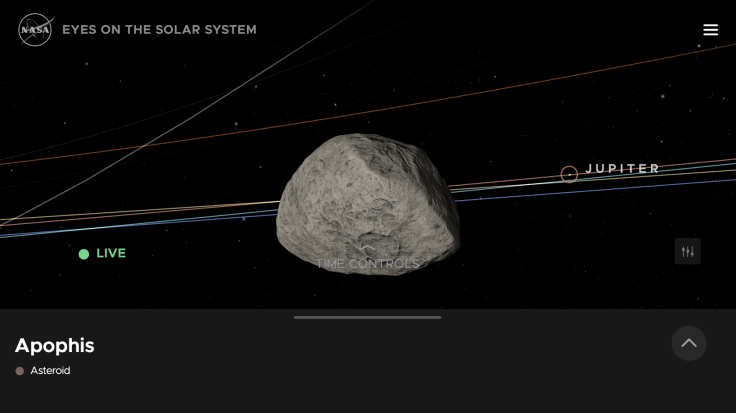
The 'God of Chaos,' a large near-earth asteroid otherwise named 99942 Apophis, is expected to share a close encounter with Earth on 13 April 2029. This has drawn attention from astronomers due to its size and earlier uncertainty about its orbit.
According to the National Aeronautics and Space Administration (NASA), the mysterious asteroid has been confirmed to safely pass our planet in three years' time, posing no impact threat to Earth, despite the rare occurrence.
When it was discovered in 2004, Apophis gained widespread attention due to its size and proximity to Earth's orbit. It reportedly measures roughly 340 metres across, while its long axis measures at least 450 metres. Long-term observations and radar data have steadily refined the asteroid's trajectory, ruling out any collision risk for at least the next 100 years.
Former Impact Concerns Prompted Scientific Attention
Initial calculations in 2004 briefly suggested a small chance the asteroid could strike Earth in 2029 or in a later return pass. Those early concerns led to extensive monitoring efforts and detailed orbital analysis by international space agencies. It was expected to impact Earth by 2029, 2036, or 2068.
Subsequent observations, including radar tracking, significantly improved predictions of its path, eliminating the possibility of impact and reducing uncertainty in its future flybys. Scientists now describe the 2029 approach as a rare but rather safe event, instead of a threat scenario, according to The Planetary Society.
The International Asteroid Warning Network (IAWN) was coordinated by NASA with the purpose of overseeing 'Earth-based telescopic observing campaigns before and around the time of the asteroid's flyby with our planet.'
Extremely Close Approach in 2029
Apophis is expected to pass Earth on 13 April 2029 at 20,000 miles (36,000 kilometers), a distance closer than some geostationary satellites, making it one of the closest predicted flybys of a large asteroid in recorded history. During this approach, according to NASA, it will be visible from Earth without telescopes under favourable conditions.
Scientists note that while the encounter is not expected to pose any danger, Earth's gravity may slightly alter the asteroid's orbit, providing a valuable opportunity to study how near passes affect large space objects. This makes the event important for planetary defence research and long-term asteroid tracking models.
NASA cites Apophis getting warped as it approaches Earth, stating, 'The most important thing happening in this event is that Apophis will be pulled, twisted, stretched, and squeezed by the gravity of Earth as it goes by, in a way that happens only during a very close encounter.'
Space Agencies Prepare for Scientific Observations
The 2029 flyby is expected to be closely observed by multiple space missions, including planned spacecraft designed to study how Apophis behaves during its passage. Researchers aim to collect data on its structure, rotation, and response to Earth's gravitational pull.
Among these are NASA's OSRIS-APEX and ESA's Ramses spacecraft, which NASA states will be making 'high-resolution observations, measuring the detailed gravity field around Apophis and looking for any surface movements.'
Experts say the event will offer a rare chance to improve understanding of near-Earth objects and refine future impact prediction systems. While earlier fears gave the asteroid its dramatic nickname, the 'God of Chaos,' current science confirms it will pass Earth safely, offering insight rather than danger.
© Copyright IBTimes 2026. All rights reserved.
- Recommended For You