Did Anyone Die in Blue Origin's New Glenn Fireball Explosion? Extensive Damage Feared
The explosion of Blue Origin's New Glenn rocket at Kennedy Space Centre impacts NASA's lunar ambitions.

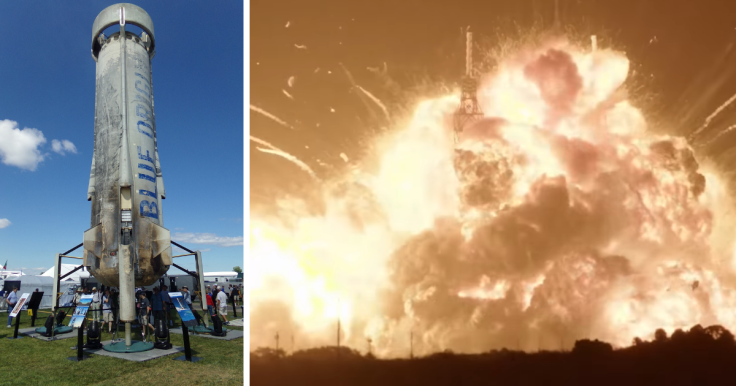
Amazon Blue Origin's New Glenn fireball explosion last night could delay NASA's moon base plans for 2028.
The sky over Florida's Kennedy Space Centre was lit up by an intense fireball on Thursday night, after Blue Origin's New Glenn rocket exploded. Footage of the blast showed one of the pad's lightning protection towers collapsing in the immediate aftermath.
Blue Origin's New Glenn just blew up at LC-36 while attempting to Static Fire ahead of NG-4.https://t.co/tANS0dWyIH pic.twitter.com/PztxFoBqIw
— NSF - NASASpaceflight.com (@NASASpaceflight) May 29, 2026
We experienced an anomaly during today's hotfire test. All personnel have been accounted for. We will provide updates as we learn more.
— Blue Origin (@blueorigin) May 29, 2026
The good news is that no one died from the accident. 'We experienced an anomaly during today's hotfire test,' Blue Origin posted on X Friday morning. 'All personnel have been accounted for. We will provide updates as we learn more.' Per the BBC, the rocket was undergoing routine testing before 4 June, when it was scheduled to launch 48 satellites for Amazon's Leo broadband network.
SpaceX CEO Reacts to Thursday's New Glenn Incident
Most unfortunate. Rockets are hard.
— Elon Musk (@elonmusk) May 29, 2026
Elon Musk responded to the blast footage with a brief comment: 'Most unfortunate. Rockets are hard.' SpaceX currently has more than 10,000 satellites deployed, while Amazon has just over 300, all launched via SpaceX, United Launch Alliance, and Arianespace.
All personnel are accounted for and safe. It’s too early to know the root cause but we’re already working to find it. Very rough day, but we’ll rebuild whatever needs rebuilding and get back to flying. It’s worth it.
— Jeff Bezos (@JeffBezos) May 29, 2026
The blast caused extensive damage to Space Launch Complex 36, the only facility in the world capable of launching the New Glenn rocket. The explosion set back launch plans by months, as the launch pad is rebuilt and re-certified. 'Very rough day, but we'll rebuild whatever needs rebuilding and get back to flying. It's worth it,' Amazon CEO Jeff Bezos wrote on X.
NASA is aware of the anomaly that occurred tonight at Launch Complex 36 involving Blue Origin’s New Glenn rocket at Cape Canaveral Space Force Station. ⁰⁰Spaceflight is unforgiving, and developing new heavy-lift launch capability is extraordinarily difficult. We will work with…
— NASA Administrator Jared Isaacman (@NASAAdmin) May 29, 2026
The mishap also delays NASA's plans to build a lunar base. 'Spaceflight is unforgiving, and developing new heavy-lift launch capability is extraordinarily difficult,' NASA Administrator Jared Isaacman stated. NASA initially intended to land astronauts on the lunar surface by 2028, and the rover deliveries for the base's construction depend on New Glenn rockets.
Blue Origin in a Tight Spot with NASA and FCC Compliance
The robotic Blue Moon Mark 1 'Endurance' lander, targeted for autumn 2026 launch, was also supposed to ride atop New Glenn to the Moon's south pole. This lander will carry two NASA science payloads and demonstrate precision-landing techniques for future crewed missions. This week, NASA handed Blue Origin a £348 million ($468 million) contract, commissioning the latter to deliver two lunar vehicles to the Moon by 2028.
Amazon also faces a critical FCC deadline of 30 July to have half its 3,236-satellite constellation in orbit. As of late May, the company was already more than 1,300 satellites short of that target due to launch delays.
NASA's Artemis III crewed Moon mission is scheduled for next year, pending commercial lunar lander tests with Blue Origin and SpaceX. Blue Origin's Mark 1 demonstrator was already in final stacking before Thursday's explosion, while SpaceX's Starship had not yet completed an in-space propellant transfer.
China Gains Advantage in Modern Space Race
Meanwhile, China is proceeding with its own plan to land astronauts on the Moon by 2030. NASA is reportedly committed to its own 2028 target despite the setback, though this had been questioned even before the New Glenn accident.
Bezos founded Blue Origin in 2000 with about £7.4 million ($10 million) of his own money, aiming to make space exploration affordable and accessible to everyone through reusable rocket technology. He scaled that initiative over the next 25 years through large-scale projects like the New Glenn and human lunar landers.
Blue Origin has since surpassed major milestones, including the launch of the Goddard and New Shepard rockets in 2006 and 2011. Blue Origin also achieved its first successful orbital rocket landing in 2015, followed by its first crewed suborbital mission in 2018.
© Copyright IBTimes 2026. All rights reserved.
- Recommended For You