

'F**k You, Trump!' Thousands of Protesters Chant in Manila as Trump Meets Philippine President Marcos Jr.
Demonstrators protested against US military and economic influence in the Philippines as the two presidents held talks
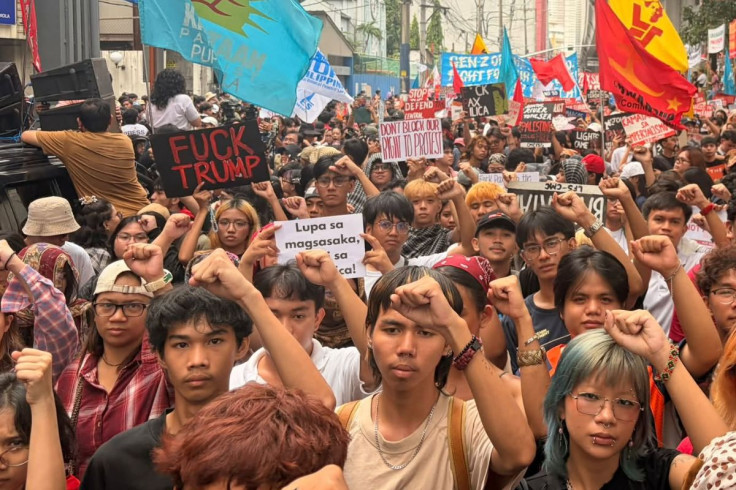
Thousands of protesters chanted 'F**k you, Trump!' during a demonstration in the Philippine capital on Wednesday, 18 November, as US President Donald Trump met Philippine President Ferdinand Marcos Jr. at the presidential palace in Manila.
More than 2,000 people joined the 'Trump Out' demonstration, according to Bagong Alyansang Makabayan (BAYAN), a coalition of activist organisations. Protesters denounced Trump's visit, expanding US military influence and a proposed American-backed industrial project.
The crowd erupted into chants of 'F**k you, Trump!' during a protest programme held after police blocked demonstrators from approaching the presidential palace, where the two leaders were holding talks on defence and economic cooperation.
Police Block Protesters From Reaching Presidential Palace
Police prevented demonstrators from approaching the presidential palace, deploying barricades, razor wire and a shipping container to block their route.
The blockade sparked a confrontation between protest leaders and officers, with activists accusing authorities of suppressing their right to peaceful assembly.
BAYAN president Renato Reyes challenged the police response, arguing that the heavy security presence was creating unnecessary tension.
'There would be no chaos if the police with barbed wires and shields were not here,' Reyes said.
Jerome Adonis, who chairs the labour organisation Kilusang Mayo Uno, also defended the demonstration, declaring: 'Freedom of expression has no limits.'
Police Colonel Emil Tumibay, a senior Manila police official, defended the security measures, insisting officers were there to maintain peace and order.
'We will not initiate any trouble,' he said.
Police maintained that allowing protesters to reach the area near the presidential palace was non-negotiable.
Protesters Demand Philippines Withdraw From US-Led Pax Silica Initiative
Beyond opposing Trump's visit, protesters demanded that the Philippine government abandon Pax Silica, a US-led initiative aimed at securing critical minerals, semiconductor production and supply chains supporting artificial intelligence.
The initiative has faced opposition from Filipino activist groups concerned about the potential displacement of communities and growing American control over the country's economic resources.
A proposed industrial hub north of Manila has become a particular source of controversy.
Marcos announced that no new Pax Silica agreement would be signed during Trump's visit, a decision BAYAN described as a temporary victory for the protest movement.
However, the group argued that the announcement was misleading because the Philippines had already joined the coalition in April and signed a separate critical minerals agreement with Washington in February.
BAYAN demanded that Marcos withdraw the Philippines from Pax Silica, halt activities related to the proposed industrial hub and publicly release documents concerning negotiations with Washington.
Trump Announces More Than $5 Billion in Approved US Arms Sales
While protesters condemned Washington's influence outside, Trump announced plans to deepen military and energy cooperation with the Philippines.
During his meeting with Marcos, Trump said his administration had approved more than $5 billion in US arms sales to the Philippines, reaffirming Washington's defence commitments to its longtime treaty ally.
He also discussed potential American involvement in a major civilian nuclear energy project and Philippine participation in a proposed Alaska natural gas export venture.
Asked about tensions in the disputed South China Sea, Trump dismissed concerns.
'I am not concerned at all. That'll be taken care of,' he said.
Trump's visit followed the ASEAN summit hosted by Manila earlier in the week, with the US president scheduled to travel to China for the APEC summit.
© Copyright IBTimes 2026. All rights reserved.