7 Photos of Hudson William's Girlfriend, Katelyn Rose Larson: Heated Rivalry Star Confirmed Long-Term 'Straight' Romance Amid Gay Rumours
Hudson Williams' Valentine's Day post sparks debate over queer representation and personal privacy.


The photo that lit the fuse is, on the face of it, innocuous. Hudson Williams, the breakout star of Heated Rivalry, leans into his girlfriend, Katelyn Rose, in a series of soft, scruffy snaps: a car park here, a café there, the kind of ordinary, grainy intimacy that rarely survives fame.
Underneath, a caption that sounds like it was written for one person, not millions of followers: 'With me since my 2000 gold Mazda protege smoked and squealed and I had no job.'
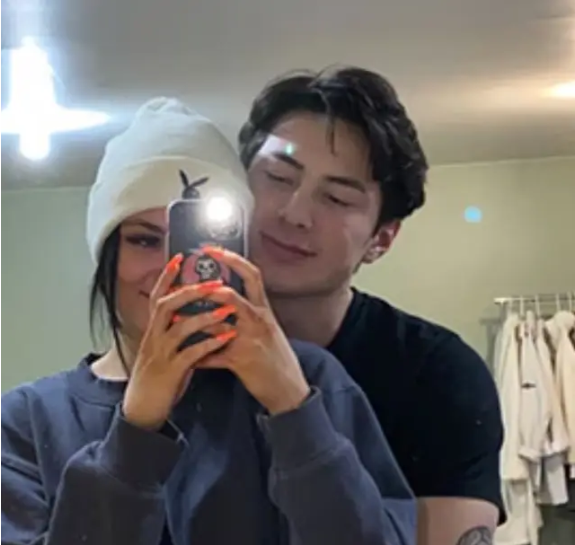
It was a Valentine's Day hard launch, of sorts, posted on Saturday 14 February. And for most people, it was exactly what it looked like, a 25‑year‑old Canadian actor celebrating the woman who knew him before his big break.
For a loud, if numerically small, corner of the internet, it became something else entirely: alleged 'queer-baiting,' betrayal, even proof that they were done with him.
That's the surreal world Williams now inhabits, where playing a gay character on television apparently means some viewers feel entitled to a say in your real‑life love life.
Heated Rivalry, Real-World Expectations
Williams shot to prominence in Heated Rivalry, the six‑episode sports romance that landed on NOW TV and Sky Atlantic last month and quickly morphed into a word‑of‑mouth phenomenon.
Based on Rachel Reid's popular books, the series hinges on the on‑ice feud and off‑ice secret relationship between professional hockey stars Shane Hollander, played by Williams, and Ilya Rozanov, portrayed by Connor Storrie.

It is unmistakably an LGBTQ+ show, unapologetically romantic, rooted in queer desire rather than side‑plot tragedy. That, in part, is why the reaction to Williams' relationship reveal has been so charged.
Some fans, collapsing the gap between actor and role, had simply assumed, or at least strongly hoped, that the on‑screen chemistry reflected real life.
Williams has never publicly defined his sexuality. He has also, notably, never claimed to be queer. Yet according to US outlet Parade, a minority of viewers leapt from disappointment to accusation, charging him with 'queer-baiting' because he plays a gay character while apparently dating a woman.
The term originally belonged to fiction. As PinkNews has outlined, 'queer-baiting' referred to creators hinting at same‑sex relationships between characters to attract LGBTQ+ audiences, only to pull back before any real representation materialised.
It was, at heart, a critique of cynical marketing and cowardly storytelling.
More recently, the meaning has been stretched, sometimes lazily, to accuse real people of 'hinting' at queerness to build a fanbase they don't 'deserve.' It is a leap that many LGBTQ+ advocates, and not a few queer fans, find deeply troubling.

Heated Rivalry Star Caught In The Queer-Baiting Crossfire
You don't need a PhD in media ethics to see the problem. Sexuality is not a press line to be clarified on demand. People are allowed to be private, or questioning, or simply uninterested in offering a tidy label to strangers on social media. Yet the pattern is depressingly familiar.
Heartstopper's Kit Connor was effectively hounded into coming out as bisexual in 2022 after relentless speculation and accusations of queer‑baiting. He later said he felt 'forced' into making a statement, a stark example of how online moralism can end up reproducing the very invasiveness queer people have historically suffered.
The same script is now being dusted off for Williams. 'Good thing I never watched it. I have no interest in straight actors in queer roles anymore. You all enjoy it,' one commenter declared, folding his personal disappointment into a sweeping rule: queer roles for queer actors only.
Others, thankfully, pushed back. Not just to defend Williams, but to defend his partner from becoming collateral damage.
'Real talk I hope she has a lovely day,' one fan wrote, 'and fans of fictional television shows figure out that the actors are not the characters and are actually real people with real relationships they deserve to have with no concern for random ass peoples parasocial behaviour towards them.'

Another cut straight to the heart of the matter: 'It's called acting. It's ok for straight actors to act gay, and it's ok for gay actors to act straight. I don't only want to be cast in straight roles. They very clearly said they wouldn't talk about their sexuality in the run‑up and press tour. You don't want to stigmatise straight actors.'
That last line is telling. The original demand for queer actors in queer roles emerged from a very real frustration: decades of straight performers scooping up awards for 'bravely' playing gay while out queer actors struggled to get cast at all.
But it was meant as a push for equity, not an invitation to police the private lives of anyone who dares to play a queer character.
Fans themselves articulated the distinction succinctly. 'Queer-baiting is when a piece of fiction teases the possibility of a queer relationship that is never consummated or confirmed,' one person wrote.
'At its worst, it's a cynical bone thrown to an audience looking for progressive representation that the artist never planned on portraying.'

'At its best, it's simply an unintended dynamic or characters/actors having chemistry. Real humans cannot queerbait, because real people do not owe you a specific sexual act, identity, or encounter.'
Another put it even more bluntly: 'Real people can't queerbait. Queerbaiting is trying to make you think a gay ship is going to happen and never intending to actually go through with it.'
Williams himself has been careful, almost studiously so, when asked about all of this. Speaking to Deadline in December, before the Valentine's furore, he acknowledged the speculation without feeding it.
'I think there's never a question for me, when I would dream of becoming in the public eye, that I would want just a level of privacy,' he said. 'But of course, I agree. I want queer people telling queer stories, but also, there's the element of Connor and I, we're best friends, and we love expressing that physically. You see people who infer or assume, and you kind of have to let that go.'

It is a disarmingly adult answer for a 25‑year‑old at the start of his career. He wants queer stories told by queer people; he also believes in acting as an art form that occasionally involves crossing that line. He wants to be allowed physical affection with his best friend without it becoming Exhibit A in a sexuality trial.
What this episode reveals, more than anything, is how badly audiences want authentic queer stories, and how easily that longing can tip into entitlement.
Representation matters. So does remembering that the man posting Valentine's photos from his battered 2000 gold Mazda days is not a character we are owed, but a person we are watching from a distance.
© Copyright IBTimes 2026. All rights reserved.
- MOST POPULAR IN Entertainment