Here's What Happened to US Navy's 'Doomsday Plane' That Vanished During Secret Atlantic Mission
'Doomsday Plan' Vanished After Crossing Virginia Beach
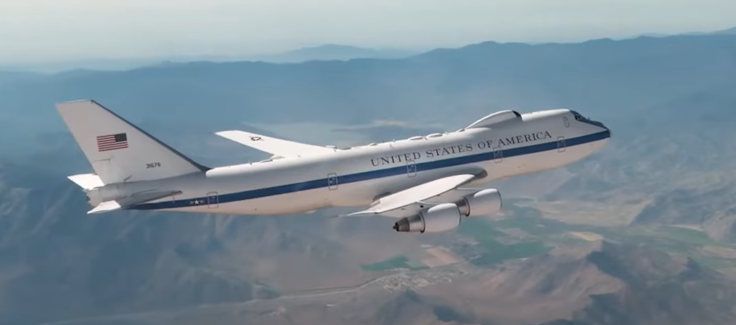
The Boeing E-6B Mercury, also known as the US Navy's 'Doomsday Plane,' recently carried out a covert transatlantic mission that ended with the aircraft simply disappearing from public tracking systems.
According to flight tracking data, the plane took off from Naval Air Station Patuxent River in Maryland, flew southeast over the Chesapeake Bay, passed the naval complex near Norfolk, then ventured out over the Atlantic. Roughly 60 miles east of the Virginia Capes, its transponder was switched off, which is a standard procedure for classified operations.
What is the 'Doomsday Plane'?
The E-6B Mercury is not a conventional aircraft. Built on a modified commercial Boeing 707 airframe, it serves as a flying command and control centre for the US military's highest authorities. In times of crisis, the Mercury ensures communication links between the president, defence leadership, and strategic nuclear forces remain intact.
The Mercury also plays a central role in the Take Charge and Move Out (TACAMO) mission, which keeps ballistic-missile submarines and other strategic assets connected even if ground-based centres are destroyed. It's part of a broader command infrastructure under Operation Looking Glass—the airborne fallback for nuclear command and control.
There are 16 aircraft in the US fleet. Mercury's systems are hardened against the effects of nuclear electromagnetic pulses (EMPs), relying on robust, analogue-based technology rather than vulnerable digital systems. This ensures the plane remains operational even in worst-case scenarios.
Should the Public be Concerned?
Despite the public concern, it seems that the vanishing of the 'Doomsday Plane' is not something that people should worry about. After all, it is common practice for the public transponder to be switched off during secret missions.
Once over international waters, the aircraft deploys a multi-mile trailing-wire antenna and flies racetrack or circular patterns for hours, maintaining secure, low-frequency communications with submarines and ground stations. This is standard protocol during TACAMO or other classified operations and not necessarily a sign of trouble.
In this latest flight, the disappearance took place roughly at 8:30 a.m. Eastern Time, east of Virginia Beach. Observers on tracking platforms flagged the plane as 'vanished,' but military officials and experts understand this as part of its normal mission profile.
What it Means in the Bigger Picture
This mission reinforces the strategic readiness of the US. Even in uncertain global conditions, airborne command posts like the Mercury ensure that the nuclear command and communication infrastructure remains intact.
The use of such aircraft underscores how the US maintains a resilient 'backup' for its nuclear command system. In the event of ground-based incapacitation, aircraft like the E-6B or its eventual successor, the E-130J Phoenix II, guarantee continuity.
Public disappearance from radar often triggers speculation—but in this case, it appears to have been nothing more than a routine classified operation, not an indication of crisis.
Mystery Solved
The latest vanishing act of the 'Doomsday Plane' over the Atlantic stirred intrigue and concern among aviation watchers and defence analysts alike. But beneath the mystery is a quietly complex system designed for absolute readiness, which ensures that no matter what happened on the ground, lines of command remain open in the skies.
© Copyright IBTimes 2026. All rights reserved.
- MOST POPULAR IN Trending