

Interstellar Comet 3I/ATLAS Makes Closest Flyby Tonight — NASA Reveals Exact Time
NASA pinpoints the exact time interstellar comet 3I/ATLAS will skim past Earth in a rare celestial event
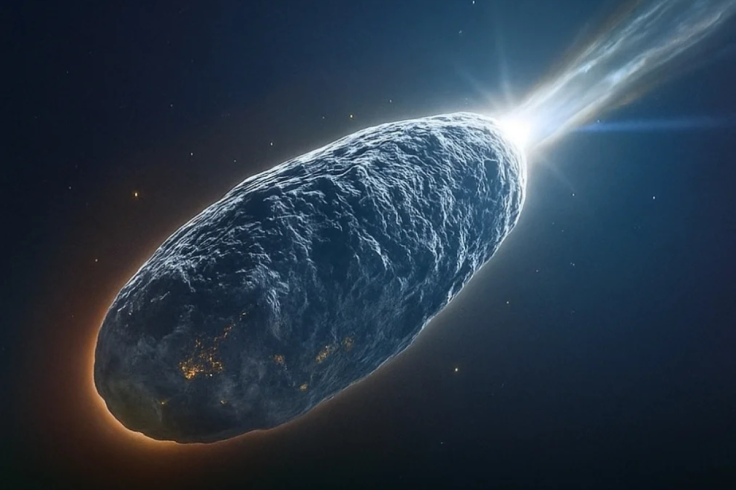
An unusual celestial phenomenon is scheduled to occur in the sky on Friday as the interstellar comet 3I/ATLAS approaches Earth at its closest.
Based on orbital estimates provided by NASA's Jet Propulsion Laboratory (JPL) Horizons system, the minimum distance of this comet and our planet will be achieved at 1 am EST (0600 GMT) on Friday, 19 December.
At that time, 3I/ATLAS will be about 1.8 astronomical units distant, that is, about 168 million miles (270 million kilometres). Although this is almost twice the average distance between Earth and the Sun, the flyby will be scientifically significant, as interstellar objects are very rare.
No Risk To Earth
Although dramatic headlines are made, professionals highlight that 3I/ATLAS is not a threat to the Earth. The vast distance of the comet makes it impossible to see it with the naked eye, as it is only visible as a small object using large telescopes.
NASA scientists observe that the comet going through is worth studying. A study of its composition and behaviour would help make more accurate predictions about how interstellar bodies move through space and interact with solar radiation.
Livestream For Skywatchers

For those willing to see the show, the Virtual Telescope Project will launch a live online stream at 11 pm EST on Thursday, 18 December (0400 GMT on 19 December). Around the world, the livestream will enable viewers to watch the comet's progress as it approaches its closest point, weather permitting.
The comet will still be too faint to see with the naked eye, but the livestream gives an exceptional opportunity to watch an interstellar visitor as it is.
Scientific Importance
3I/ATLAS is an essential object in astronomy because it transports material beyond our solar system. Scientists can understand how elements and compounds are built around other stars by examining their compositions.
Harvard astrophysicist Dr Avi Loeb, who has written extensively on interstellar visitors, has contended that such objects may even exhibit exotic physical characteristics. Although mainstream astronomers are reserved, the controversy reiterates the energy behind such rare encounters.
A Fleeting Opportunity
The flyby of 3I/ATLAS reminds us that the interstellar visit can be very short and random. One such object, Oumuamua, was spotted only after it flew past Earth, so scientists scrambled to collect data before it was lost in space.
However, 3I/ATLAS was spotted many months before its closest approach, allowing astronomers to prepare to observe it. Such preparation could provide valuable information about the structure and activity of jets, as well as about the possibility of non-gravitational forces influencing their trajectories.
Following the flyby of 3I/ATLAS this evening, the spacecraft will head out of the solar system and will never return. The point of its short reading is the relevance of international cooperation in astronomy, as telescopes around the world align to take readings within a brief observation period.
The comet's closest approach might not provide the general public with an impressive sight. Yet, for scientists, it will be a golden opportunity to study the contents of a different star system.
With advances in technology, visitors from interstellar regions can be detected sooner and studied in more detail, furthering knowledge of the universe.
© Copyright IBTimes 2026. All rights reserved.