

Avi Loeb Says 3I/ATLAS' Sunward Jet Defies Physics After 16° Gravitational Twist
Avi Loeb says interstellar object 3I/ATLAS' sunward jet challenges physics after 16° gravitational deflection
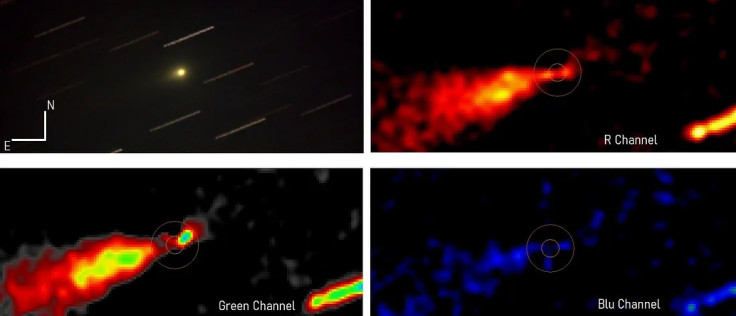
Harvard astrophysicist Avi Loeb has observed a perplexing anomaly in the behaviour of 3I/ATLAS, the third interstellar object spotted in our solar system since 1I/'Oumuamua in 2017 and 2I/Borisov in 2019.
Unlike typical comets, which develop tails pointing away from the Sun due to solar radiation and wind, 3I/ATLAS has maintained a narrow jet pointing towards the Sun even after its trajectory was bent by 16 degrees at perihelion.
In his article in Medium, Loeb says he considers this behaviour to defy known physics and calls into question traditional descriptions of cometary dynamics, speculating on whether natural explanations suffice.
The Physics Of Cometary Jets
In cases of ordinary comets, when heated by the Sun, the gases and dust fly off, forming a tail that lengthens away from the star. These jets are oriented by the pressure of the solar radiation and the solar wind, which is why they should always face outwards.
In the 3I/ATLAS, however, Loeb indicates that the jet remained sunward despite the sharp change in the object's orbit due to the Sun's gravity. This longevity suggests the presence of a mechanism that is not explained by conventional astrophysical theories.
A Catalogue Of Anomalies

Loeb has chronicled at least 14 anomalies with 3I/ATLAS, including its retrograde orbit, its unusual alignment with the ecliptic plane, and its arrival times precisely timed with Mars and Jupiter. He claims that the likelihood of such coincidences being natural is very low, including such low amounts as 0.2 per cent.
The most remarkable anomaly is probably the one directed towards the sun, since it seems to violate the fundamental principles of motion and thermodynamics. Loeb hints that either something natural is occurring without understanding, or that it has a technological background.
Implications For Astronomy
The variations in 3I/ATLAS indicate the difficulties of observing interstellar visitors, which are visible for only very short periods before fading into deep space. Every discovery offers, over the long term, the chance to test theories in planetary and cometary physics, and even to examine the presence of alien technology.
Loeb posits that we should not disregard such an oddity because of the danger of groundbreaking discoveries. He has demanded increased investment in rapid-response telescopes and missions capable of capturing interstellar objects before they disappear.
What Comes Next?
It should be noted that 3I/ATLAS will arrive in the next few months, making its nearest approach towards the Earth, after which it will keep on moving out of the solar system. Astronomers around the world are racing to gather as much information as possible in the hope of shedding light on its peculiar nature.
Not knowing when the sunward jet, now possibly expounded upon by the laws of nature, or rather left as a suggestive clue to something greater, will be solved, the case of 3I/ATLAS makes the lesson of an open mind in science quite obvious. According to Loeb himself, extraordinary claims need extraordinary evidence, but extraordinary anomalies need extraordinary concern.
Finding 3I/ATLAS and its subversive sunward jet has once again raised questions about the frontiers of physics and the existence of alien technology. Whereas sceptics urge caution, Loeb recommends researching anomalies to the nth degree rather than sweeping them under the carpet.
The interstellar traveller is speeding away, leaving a trail of questions that can help us redefine our knowledge of the world, or perhaps prove that the world around us is stranger than we have imagined.
© Copyright IBTimes 2026. All rights reserved.