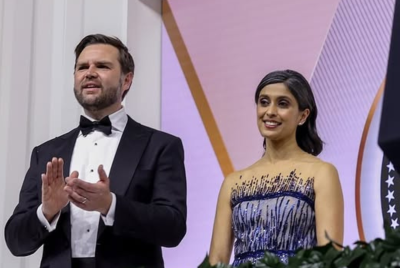
JD Vance Admits Hindu Wife Usha Is Unlikely To Convert To Christianity, Unveils Her 'Vicious' Role
Vance's faith memoir puts his wife Usha at the centre, as editor, critic and partner in an 'uneasy' interfaith story.

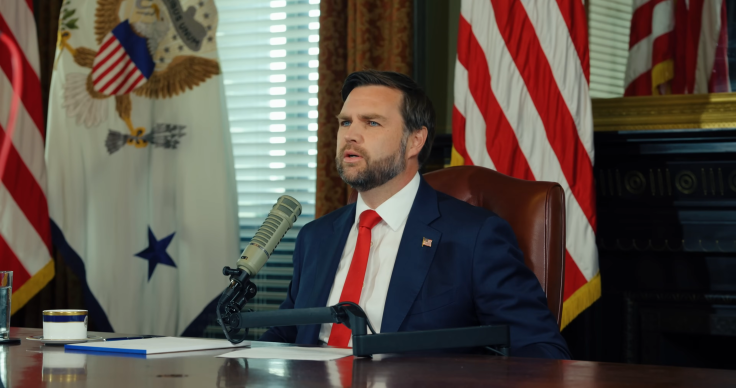
JD Vance has disclosed that his Hindu wife, Usha, is unlikely ever to convert to Christianity, even as she has taken on what he calls a 'vicious editor' role for his new faith-centred book, Communion: Finding My Way Back to Faith, due for US launch in June.
Speaking to NBC News on Tuesday, the US Vice-President said Usha was deeply involved in shaping the manuscript, while he sought to clarify earlier remarks that he had hoped she might one day share his religion.
Vance came under fire last autumn after publicly acknowledging that, as a practising Christian, he wished his wife would convert. Critics accused him of pressuring a Hindu spouse to abandon her own beliefs. He has now tried to reframe that discussion, insisting his comments were simply an honest reflection of what many believers feel about the people closest to them, rather than a demand for religious conformity within his household.
The Book And 'Vicious Editor' At Home
The 304‑page Communion, to be published by HarperCollins on 16 June, is pitched as a sequel of sorts to Vance's bestselling 2016 memoir Hillbilly Elegy. This time, instead of charting his rise from a troubled Appalachian upbringing to Yale Law School, Vance revisits a spiritual arc that runs from childhood Protestantism, through a period of atheism, to his eventual conversion to Catholicism as an adult.
According to Vance, the person who pushed him hardest on the page was not an editor at the publisher, but his own wife. Usha, who is pregnant with the couple's fourth child, 'doesn't sugarcoat things' and is 'very direct,' he told NBC.
He described her as 'vicious' in the best professional sense: the one who cut passages that 'didn't add anything of value' and helped 'harmonise different chapters' when the narrative threatened to sprawl.
She was not just shaping the structure, he said, but also inhabiting the story itself. The book recounts how Usha, who remains a practising Hindu, supported him through his zigzagging religious journey rather than trying to pull him away from it. Vance goes so far as to argue that 'the book ultimately would not exist without her,' adding that he doubts he 'would be a Christian today were it not for my wife.'
There is, as he concedes in the text, a certain irony in a Catholic conversion memoir being midwifed by a Hindu spouse. That irony lies at the heart of the controversy now surrounding the project, and Vance appears keen to manage expectations early, even before the book hits the shelves.
Vance Addresses Wife Conversion Remarks
Pressed again this week on those earlier remarks about hoping his Hindu wife might become Christian, Vance insisted he had been stating what he saw as a 'pretty simple observation.' In his view, anyone who takes their faith seriously will naturally want to share it, especially with a partner. Yet he also acknowledged something he had been less explicit about before: that Usha is unlikely to convert, and that he has come to terms with that.
He pointed to her personality as the decisive factor. 'What I'd say about Usha is that one of the things I love about her is that she's brilliant, but she's also fiercely independent,' he said. That independence, he implied, extends to religion. She has accompanied him through periods of doubt, loss and renewed belief, but she has not simply followed him into the Catholic Church.
'Fundamentally, Christianity is a faith where, if you believe in it, you would like other people to believe in it, too,' Vance added. 'And that's going to be particularly true for those that you're closest to and those you love.' He framed the tension not as a domestic dispute but as an unavoidable edge to any interfaith marriage in which one partner experiences a decisive conversion.
The book itself has not had a seamless rollout. Vance acknowledged that Communion already contains a major error on its cover, though he did not elaborate on it in the NBC interview.
HarperCollins has said Vance wrote the manuscript himself, working on it 'off and on' since 2019, and that it will also touch on his time in politics.
In a statement issued when the book was announced in March, the 41‑year‑old said the 'interesting question' haunting the project was why 'the Christian faith of my youth failed to properly take root' in the first place.
All of this is unfolding against a political backdrop that Vance, at least in public, pretends to brush aside. The impending release of Communion has already fuelled speculation that he is eyeing a 2028 presidential run. He has said he is not focused on that, indicating he will wait until after the 2026 midterm elections before deciding whether to run for president. But in modern American politics, high‑profile office‑holders do not typically write introspective books about faith and identity for no reason.
© Copyright IBTimes 2026. All rights reserved.
- Recommended For You