'Thank a Democrat,' Homeland Security's Airport Post Sparks Fury, as Republicans Block TSA Pay Again
DHS, which oversees the TSA, posted was as blunt as it was provocative: 'Thank a Democrat.'
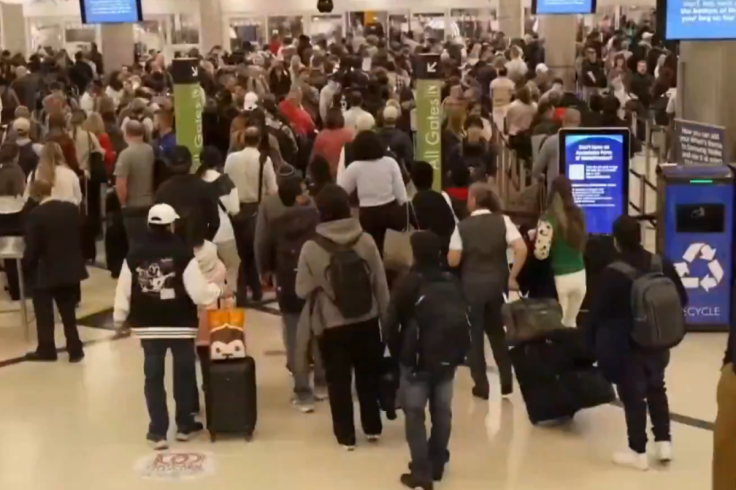
The line doesn't move for a while. Not properly, anyway. It inches, shuffles, stalls again. Somewhere near the front, a security officer gestures with quiet urgency; further back, a family recalculates how much time they have left before boarding. By mid-morning at Atlanta's airport, the queue has spilled beyond its usual confines—past retractable barriers, into open walkways, into that uneasy space where routine turns into frustration.
'Atlanta airport had a line out of the DOOR this morning!' Everything Georgia's post read, the capital letters doing most of the emotional work.
Atlanta airport had a line out of the DOOR this morning! pic.twitter.com/VPvIduJfsL
— Everything Georgia (@GAFollowers) March 23, 2026
It would be easy to file that under the usual grievances of modern travel. Except this time, the delays are not simply a matter of volume or poor timing. They are tethered to something more brittle: a political standoff in Washington that has left many TSA workers unpaid, even as passenger numbers swell.
The spark—if that's the right word—came not from Congress, but from a social media post. The Department of Homeland Security, which oversees the Transportation Security Administration, shared a message that was both blunt and provocative: 'Thank a Democrat.'
Thank a Democrat. https://t.co/9e0fMH2s3y
— Homeland Security (@DHSgov) March 23, 2026
When TSA Lines Become Political Theatre
It didn't land well.
Replies flooded in almost immediately, many of them dripping with irritation. 'Thank a Republican, you mean,' one user shot back. Others dispensed with restraint altogether, accusing the department of 'gaslighting' and blaming both the Trump administration and congressional Republicans in terms that veered sharply into the profane. It was messy, partisan, and entirely predictable.
Yet beneath the noise sits a more prosaic dispute—one that has been quietly escalating. Senate Democrats have, on multiple occasions, attempted to pass targeted measures to ensure TSA workers are paid while broader negotiations over Department of Homeland Security funding continue. Each time, those efforts have been blocked.
Senator Jacky Rosen tried again, framing the issue in practical terms rather than ideological ones. 'As we enter spring and schools across the nation approach their Spring Breaks, millions of families will soon be travelling,' she said. 'Unfortunately, they will be met with longer lines because Washington Republicans refuse to pay our TSA agents.'
Her proposal was hardly radical: pay the workers now, settle the wider argument later. Senator Roger Marshall objected. And just like that, the moment passed—another attempt folded into a growing stack of failed compromises.
The Uncomfortable Reality Behind TSA Funding Gridlock
To understand why such a straightforward fix keeps collapsing, you have to zoom out. Funding for the Department of Homeland Security lapsed on 14 February, and negotiations since then have been entangled with broader demands. Chief among them: Donald Trump's insistence that any deal be tied to the passage of his 'SAVE America Act'.
That linkage has effectively frozen the process. Democrats have tried to carve out smaller, more immediate solutions—funding individual agencies like TSA, FEMA, or the Coast Guard in isolation. Republicans, meanwhile, have resisted, arguing that such piecemeal approaches bypass the proper legislative channels.
Senate Majority Leader John Thune dismissed one such attempt as 'convoluted', suggesting it was less about solving the problem than scoring political points. There is, to be fair, a degree of theatre on both sides.
But the arithmetic is stubborn. Senate Republicans have now blocked pay for TSA workers eight times in a row. Broader funding bills covering DHS functions have been halted on 11 separate occasions. At some point, repetition stops being procedural and becomes deliberate.
The consequences aren't abstract. Airport security depends on consistency—on staff who are present, alert, and willing to endure long shifts that, at the best of times, are monotonous. Remove pay from that equation, and you introduce a different kind of pressure. Morale dips. Absences creep in. The system doesn't collapse overnight, but it begins to fray at the edges.
There is also something faintly absurd in the way the argument has been packaged. Both parties insist they are acting in the public interest. Both claim the other is responsible for the disruption. And somewhere between those competing narratives, a government agency posts a slogan that only sharpens the divide.
For now, the queues keep moving—slowly, unevenly, but moving nonetheless. The system holds, just about.
Whether that remains true if the stalemate drags on is a question Washington seems in no particular hurry to answer.
© Copyright IBTimes 2026. All rights reserved.
- MOST POPULAR IN Politics