

Sky Spectacle on 19 December: Interstellar Comet 3I/ATLAS Gives Astronomers an Early Christmas Miracle
The rare comet, only the third confirmed from beyond our solar system, promises a once-in-a-lifetime viewing opportunity.
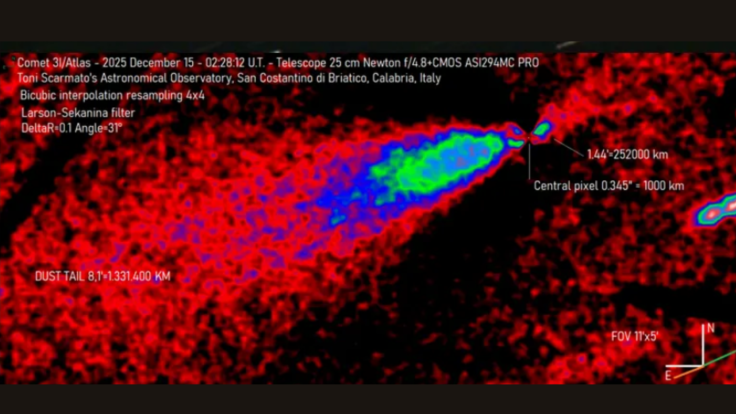
Just six days before Christmas, sky-watchers have a rare treat as the interstellar comet 3I/ATLAS passes close to Earth. Only the third confirmed object from beyond our solar system, 3I/ATLAS offers astronomers a unique opportunity to study material from another star system while providing an early Christmas spectacle visible to those with powerful telescopes.
How Close Will 3I/ATLAS Come and How to See It
3I/ATLAS was discovered in mid-2025 by the ATLAS survey. Observations reveal it has a bright coma and a visible tail, displaying activity typical of interstellar objects. Scientists have been particularly interested in its composition, as it may provide clues about the chemistry of other star systems. Early studies using the James Webb Space Telescope that the comet is enriched in carbon dioxide, suggesting it formed far from its original star, similar to the interstellar visitor 2I/Borisov.
Since its discovery, astronomers have been monitoring 3I/ATLAS closely. Images captured in December 2025 show a striking anti-tail extending half a million kilometres toward the Sun, larger than the distance from Earth to the Moon. Researchers are studying whether this tail is caused by sublimating ice or other forces acting on the comet.
3I/ATLAS will make its closest approach on 19 December, at a distance of around 167 million miles from Earth. While this is scientifically close, it poses no threat to our planet. NASA and the International Asteroid Warning Network are coordinating observations, using more than 80 observatories worldwide to track the comet's movement and activity.
For amateur astronomers, this is an exceptional opportunity. With a strong telescope or binoculars, 3I/ATLAS will be visible in the night sky, giving enthusiasts a chance to witness an interstellar visitor firsthand. The comet will continue its journey outward toward Jupiter after the close pass, making this viewing window particularly special.
Why Astronomers Are Excited
Interstellar objects are extremely rare, with only two confirmed prior to 3I/ATLAS. They carry material not formed in our solar system, offering a glimpse into the processes that shape distant planetary systems. Scientists hope to use the comet to learn more about the formation of planets, the distribution of ice and gas in other systems, and the chemical processes that occur beyond our own star.
Dr. James Bauer from the University of Maryland highlighted the significance of this observation campaign, stating that the data collected could be published in a peer-reviewed journal next year.
What to Expect in the Sky
Sky-watchers can expect to see a comet with a luminous coma and a tail stretching across the night sky. Its anti-tail, extending sun-ward, is particularly impressive and has never been observed at such a scale before. As the comet approaches, astronomers will be able to detect critical ice features that are otherwise difficult to observe, making this a rare chance to study an interstellar object up close.
The sight of 3I/ATLAS is a reminder of the vastness of our galaxy and the mysteries that lie beyond our solar system. This December, both professional astronomers and amateur stargazers alike can enjoy a front-row view of a visitor from another star, making 2025 a memorable year for sky-watching and an early Christmas present for the scientific community.
© Copyright IBTimes 2026. All rights reserved.