COLA 2027 Could Deliver the Biggest Social Security Increase in Four Years: Check Your Estimated Raise
Forecasters trimmed their numbers on 12 August, and the figure still exceeds anything paid since 2023

Social Security's 2027 cost-of-living adjustment (COLA) is now projected at between 3.4% and 3.6%, which would be the largest annual rise since 2023. Three separate forecasters lowered their estimates on 12 August, within hours of the July inflation figures landing.
Both halves of that are true at once. The projections are coming down, and the raise still beats anything paid since 2023, because the three years in between were unusually thin. Turning the percentage into a figure that means something takes one more step than it looks.
Three Estimates, One Direction
The Senior Citizens League, a non-partisan group for older Americans, cut its forecast to 3.6% from 3.8%. The over-50s organisation AARP moved to 3.5% from 3.6%. Mary Johnson, an independent Social Security and Medicare analyst, put the figure at 3.4%. Johnson said moderating inflation had brought her number down from higher peaks earlier in the year, and that even the reduced estimate sits above the long-run average adjustment of roughly 2.6%.
Any of the three clears the bar. The adjustment was 2.8% for 2026, 2.5% for 2025, and 3.2% for 2024, so even the lowest estimate on the table beats all of them, as the chart below shows.
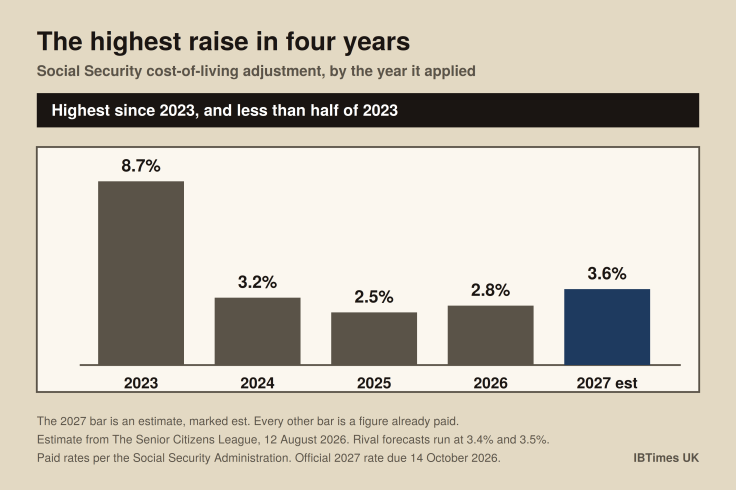
Set against 2023, it looks thin. That year's 8.7% came at the peak of post-pandemic inflation and is nowhere near being matched. A 3.6% raise can therefore beat everything since 2023 and still count as modest, which is roughly where more than 70 million recipients now find themselves.
The formula itself allows no discretion. The government averages the wage-earner inflation index across July, August, and September, compares it with the same three months a year earlier, and whatever comes out is the raise. Two of those three readings have not been published yet.
What It Adds to a Monthly Payment
Applied to the average retired worker's benefit of $1,937.53 (£1,435), a 3.6% adjustment adds $69.75 (£52) a month and takes the payment to $2,007.28. The 2.8% granted for 2026 added roughly $56 to the same benefit.
A percentage does identical work at every level, so anyone can find their own number by multiplying their current monthly payment by 0.036. The table below runs it at five common benefit sizes.
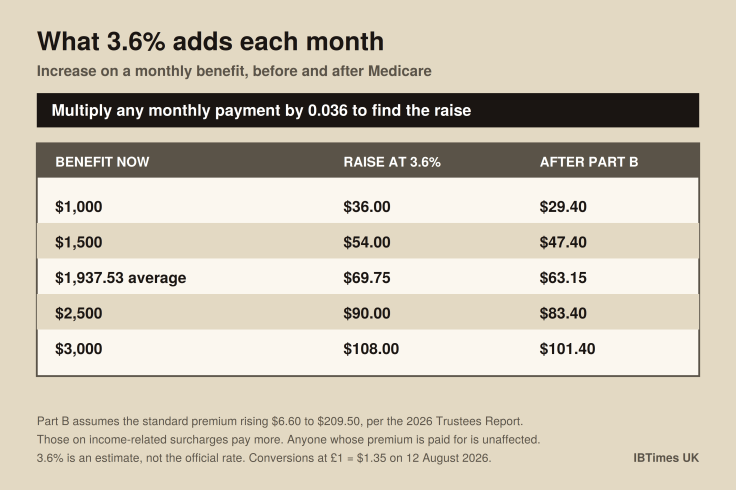
Medicare takes its share first. The standard Part B premium is deducted from most benefit payments before they reach a bank account, and the 2026 Trustees Report projects it climbing from $202.90 to $209.50 next year. That $6.60 removes about a tenth of the average raise before anyone sees it. Higher earners paying an income-related surcharge lose more, and the premium itself is not confirmed until the autumn.
Whether the remainder covers anything is the older complaint. Because the calculation runs on prices that have already risen, the money always arrives a year behind the costs it is meant to answer. A Senior Citizens League survey in June found 89% of respondents saying the 2.8% granted for 2026 had failed to keep up. The same group puts the share of seniors relying on the programme for every dollar of their income at about 44%.
What Could Still Move It
Inflation has been erratic this year, running at 2.2% in January, 4.4% in May, 3.5% in June, and 3.4% in July. Oil is trading around 24% higher than a year ago, and fuel costs feed into the price of producing and moving almost everything else.
The official figure lands on 14 October, once the September data is out, and applies to payments from January 2027. Until then, every number here is a forecast rather than an entitlement, and two more inflation readings stand between the estimate and the cheque.
© Copyright IBTimes 2026. All rights reserved.
- Recommended For You