Trump Accounts Could Receive $2,500 Tax-Free Employer Contributions Under New IRS Proposal
The break covers federal income tax but not Social Security or Medicare, which still come out of the same money
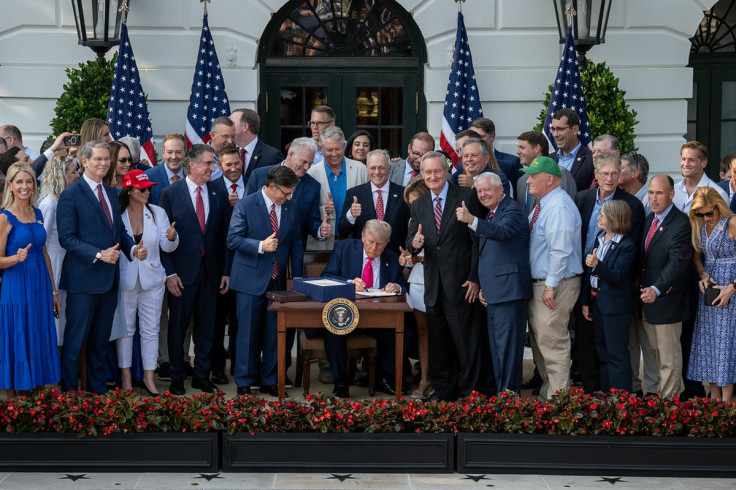
Trump Accounts could soon take up to $2,500 (£1,850) a year from an employer, with no federal income tax due on the money. The Treasury Department and the Internal Revenue Service (IRS) proposed the rules on 11 August. About 7 million American children now hold one of the tax-favoured investment accounts, which opened for contributions in July, and the proposal sets out what a company must do before paying in.
Employers already had the legal power to contribute, granted by the tax law Trump signed on 4 July 2025. What they lacked was the operating manual. More than 50 companies had announced schemes and then waited, unsure how to check a child's eligibility or what belonged in a plan document.
What the Exclusion Actually Covers
Section 128 of the tax code lets a company pay into the Trump Account of a worker or the worker's child, and keep that money out of the worker's gross income. The ceiling is $2,500 a year per employee, however many children they have, and it counts inside the $5,000 (£3,700) any one account can receive from every source combined.
The word 'free' is doing some work here. The proposal says the exclusion reaches federal income tax and stops: the same dollars remain wages for Social Security, Medicare, and federal unemployment tax. Only income tax withholding switches off, as the panel below sets out.
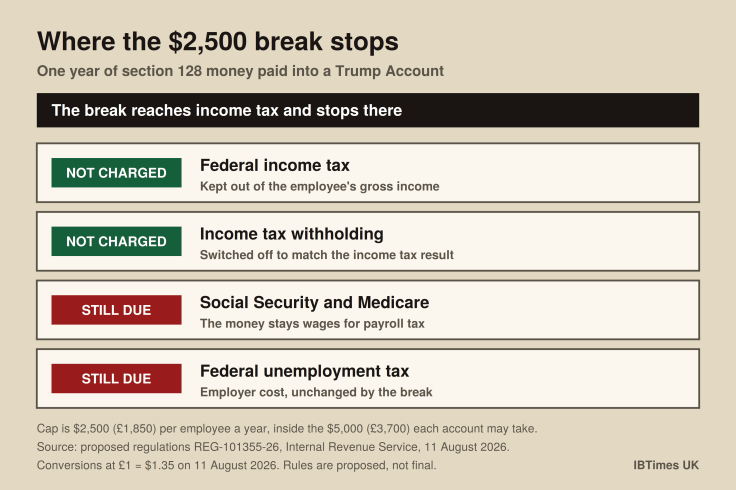
Payroll tax matters more here than it might sound, because a neighbouring benefit in the same workplace plan works the other way. Money routed to dependent care assistance is exempt from Social Security and Medicare tax by statute. Money routed to a Trump Account is not, and the proposal acknowledges the difference rather than closing it.
The rest of the plumbing is unglamorous and binding. A company needs a separate written plan, a signed certification of the child's date of birth, an annual statement to the worker, and a notice to the account's trustee on every payment. Miss one and the contribution stops being tax-free and reverts to ordinary wages.
The Same $2,500, Five Different Values
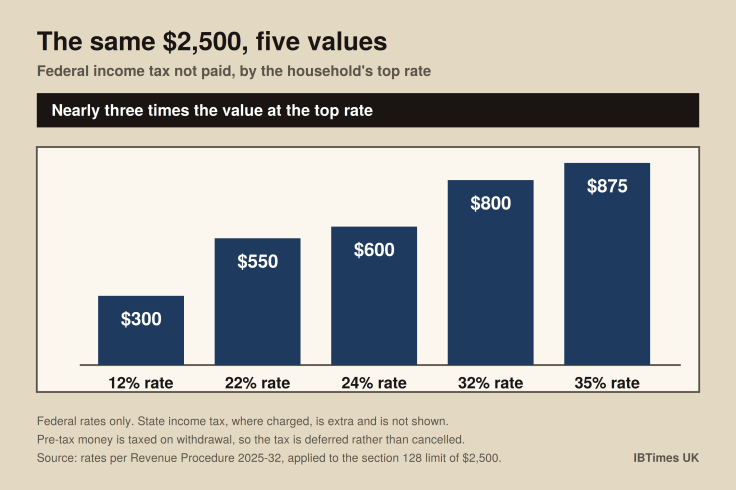
Because the break is an exclusion rather than a credit, its cash value tracks the household's top rate of tax. A family in the 12% bracket keeps $300 (£220) of federal income tax it would otherwise have paid on that money. A family in the 35% bracket keeps $875 (£650).
Treasury Secretary Scott Bessent told the Financial Literacy and Education Commission on 27 July that 86% of enrolled children come from households earning under $200,000 (£148,000). Those households mostly sit outside the top brackets, where an exclusion returns least, as the chart below shows.
Pre-tax money in a Trump Account is deferred tax rather than cancelled tax. The contribution and its growth both count as ordinary income when the child draws on the account. That cannot happen before the end of the year they turn 17.
What the money does in between is the case for the policy. Treasury's own impact analysis puts $100 paid into a newborn's account at roughly $620 by that child's eighteenth birthday, on median historical returns. Run the full $2,500 through the same arithmetic, and it arrives near $15,500 (£11,500).
Whether Anyone Will Offer It
Employer appetite is the open question. A Mercer poll of the audience at its April briefing found about 4% expected to run a Trump Account programme in 2026 or 2027. Two-thirds had already ruled it out, and the rest were undecided.
Vanguard says it will offer staff a $1,500 (£1,100) contribution from 2027, while Visa and State Street are matching the government's $1,000 (£740) starter payment.
Nothing is settled yet. Comments close on 25 September and a hearing follows on 15 October at the agency's Constitution Avenue headquarters, so the detail can still shift. Companies in a hurry may rely on the proposal in the meantime, which is probably the sentence in the document that gets used soonest.
© Copyright IBTimes 2026. All rights reserved.
- Recommended For You