

Did Trump Abandon Netanyahu? What His Israel Military Aid Announcement Means for Their Alliance
Israel may cut reliance on Washington; missile-defense and military aid could continue beyond the deal's expiration
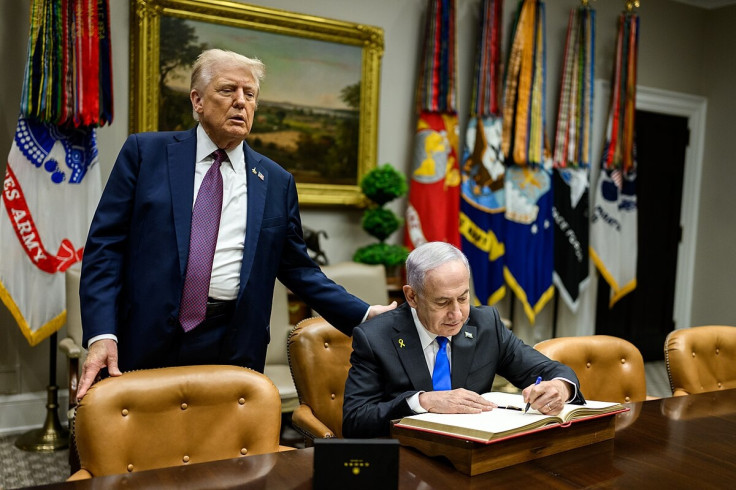
US President Donald Trump's announcement on 3 November that military aid to Israel would end this year raised questions about his alliance with Prime Minister Benjamin Netanyahu.
But subsequent reports suggest funding may continue, making an immediate break increasingly uncertain.
Speaking on Fox & Friends, Trump said Israel no longer needed roughly $4 billion (approximately €3.63 billion and £3 billion) in annual support. He claimed he and Netanyahu had agreed months earlier to stop the payments, although no final bilateral agreement was publicly confirmed.
The existing US-Israel arrangement provides $3.8 billion (approximately €3.45 billion and £2.9 billion) annually, $3.3 billion (approximately €2.99 billion and £2.5 billion) for military purchases and $500 million (approximately €453.58 million and £378 million) for missile-defence cooperation.
It runs until September 2028, with Congress responsible for appropriating funds.
Netanyahu Signals a Gradual Exit, Not an Immediate Cutoff
Netanyahu's office initially sought to play down suggestions of a rupture. On 6 November, it said a move 'from aid to partnership shows the strength and sophistication of our relationship'.
Its position became clearer on 11 November. The office said Israel planned to phase out US military assistance gradually, echoing Netanyahu's earlier remarks about reducing dependence over time rather than abruptly ending support.
U.S. military aid to Israel has always been a cross-the-aisle agreement. Israel has used it both to defend itself and to confront enemies who threaten America and the West.
— Prime Minister of Israel (@IsraeliPM) November 6, 2026
Today, Israel has a strong and stable economy. The move by PM Netanyahu and President Trump from aid to… pic.twitter.com/ssEaavMc0F
Others were less reassured. Israeli President Isaac Herzog said on 5 November that Trump's announcement 'hit me like a bolt out of the blue.'
The dispute also unfolded during Israel's post-election negotiations. On 8 November, Herzog tasked opposition leader Gadi Eisenkot with trying to form a government after parties representing 67 of the Knesset's 120 seats recommended him.
That endorsement was not a coalition deal, Netanyahu remains caretaker prime minister.
Talks Point to Military Funding Beyond 2026
On 9 November, Ynet and Yedioth Ahronoth reported that negotiators were discussing continued direct military financing for five years after the current agreement expires in 2028.
The proposal would preserve roughly $3.3 billion (approximately €2.99 billion and £2.5 billion) a year until 2033, totalling $16.5 billion (approximately €14.97 billion and £12.5 billion), rather than $33 billion (approximately €29.94 billion and £24.9 billion) over a decade. Separate US funding for joint missile-defence programmes could increase. None of those terms has been finalised.
On 13 November, The Times of Israel reported, citing three US and Israeli officials, that the Trump administration expected security assistance to continue beyond 2026. Officials also pointed to existing American defence contracts and the costs of cancelling them.
That money has supported purchases of American-made aircraft, ammunition and other equipment. An abrupt interruption could therefore disrupt procurement plans already agreed with US suppliers, not simply future payments between governments.
Congress remains crucial. The memorandum of understanding is not itself an appropriation, and lawmakers can decide how much money to provide.
Domestic Politics Complicate Trump's Decision
Trump made his announcement before the 3 November midterm results. In an 8 November 60 Minutes interview, he blamed Republican losses partly on the Iran war, petrol prices and 'a great dislike, incredibly, for Israel'. He also asserted that Israel 'would not exist except for Donald Trump'.
A March Pew Research Center survey found 60 per cent of Americans viewed Israel unfavourably. An October Chicago Council poll found 56 per cent supported reducing or ending US military aid.
Democrat Abdul El-Sayed won Michigan's Senate race despite independent spending against him by United Democracy Project, AIPAC's super PAC; James Talarico won in Texas.
The evidence points to political strain, not a severed alliance. Washington and Jerusalem remain engaged over future funding, but the scale, timetable and congressional support are unresolved.
© Copyright IBTimes 2026. All rights reserved.