Trump Wants To Rename AI 'Super Intelligence', Calling 'Artificial' Inaccurate as He Plans AI Force and Czar
The US president's proposal is a suggested rebranding, while his plans for an AI Force and AI Czar remain undefined
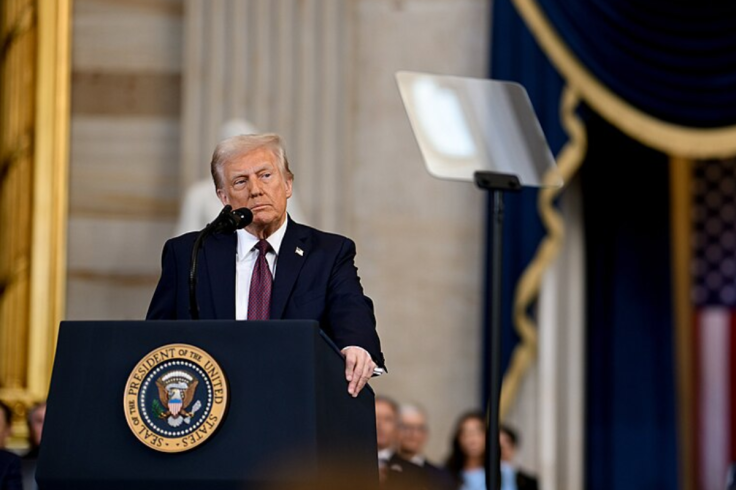
US President Donald Trump has proposed replacing the term 'Artificial Intelligence' with 'Super Intelligence', arguing that the word 'artificial' is inaccurate and 'very ineloquent', while also announcing plans for an 'AI Force' and an AI 'Czar'.
Trump made the proposals on Truth Social on 19 and 21 September 2026, as he promoted his administration's approach to the rapidly developing technology.
The latest proposal followed Trump's first poll asking followers to choose an alternative name for artificial intelligence.
He suggested 'Superior Intelligence', 'Extreme Intelligence' and 'Supreme Intelligence' as possible replacements, describing them as more 'elegant and accurate'. He later narrowed the choice to 'Superior Intelligence' and 'Super Intelligence', before adopting the latter in a subsequent post.
Trump Pushes 'Super Intelligence' as a New Name for AI
Trump's argument centres on the language used to describe AI rather than any formal change to the technology's established name.
'Many people think that the words 'Artificial Intelligence' are inaccurate, and very ineloquent, relative to AI, or Artificial Intelligence,' Trump wrote when launching his first poll. He invited users to select what he described as the best name for the 'ever growing 'Revolution''.
Many people think that the words “Artificial Intelligence” are inaccurate, and very ineloquent, relative to AI, or Artificial Intelligence. A far more elegant and accurate description of this new phenomena would be Superior Intelligence (SI) or, Extreme Intelligence (EI) or,…
— Donald J. Trump (@realDonaldTrump) September 19, 2026
'Superior Intelligence' received the largest share of responses in the first poll, according to the source report, although the 41.5 per cent figure cited by the original article could not be independently established from the primary-source material reviewed. The respondents should also not be treated as representative of the US electorate or Trump's political supporters.
Trump subsequently returned to the question on 21 September, asking users to choose between 'SUPER INTELLIGENCE' and 'SUPERIOR INTELLIGENCE'. He then began using 'Super Intelligence', or 'SI', in his own posts.
The phrase is not entirely new.
Philosopher Nick Bostrom was discussing the concept of superintelligence by the late 1990s, including in work published in 1998. His work describes a hypothetical intellect capable of substantially outperforming the best human minds across practically every field.
Superintelligence is an established concept in discussions about the future of AI, but that does not mean artificial superintelligence currently exists as an established technology. Bostrom's work has also examined the potential risks posed by future superintelligent AI.
Trump's proposed terminology therefore amounts to a suggested rebranding rather than an established technical redefinition of artificial intelligence.
His comments come as governments and technology companies continue to debate the opportunities and risks associated with increasingly capable AI systems.
Those concerns include potential effects on employment and questions about the consequences of developing systems that could eventually exceed human capabilities in some areas.
Plans for an 'AI Force'
Trump has also introduced another piece of terminology that currently has far less definition. In a Truth Social post, he announced plans to form an 'AI Force', comparing it with the Space Force, and said he would soon name an AI 'Czar'.
'I am forming the AI Force, much like I did Space Force, which has been a tremendous SUCCESS, in my First Term,' Trump wrote. He added that 'Only High I.Q. individuals need apply!' for the future role.
The announcement did not set out a detailed structure for the proposed force. Its precise authority, funding and responsibilities were not publicly established in the material reviewed, leaving its eventual role unclear.
Trump has separately linked his AI agenda to US technological leadership and competition with China. In his social media posts, he has argued that the US is ahead of China in AI and indicated that he wants to maintain that position.
The president has also pushed back against warnings about the potential dangers of advanced AI. His approach has generally emphasised continued development of the technology rather than restrictions that could slow the US industry.
Public concern remains part of the AI discussion.
A Reuters/Ipsos poll found that 73 per cent of 1,277 US adults surveyed said AI companies were not doing enough to prevent potential societal harm.
For now, 'Artificial Intelligence' remains the established term, while 'Super Intelligence' has a more specific meaning within discussions of hypothetical future systems. Trump's proposed AI Force is similarly still a proposal, with its eventual form yet to be publicly detailed.
© Copyright IBTimes 2026. All rights reserved.
- Recommended For You