

Trump Claims 99% Approval in Israel, Says He'd Move There and Become PM If US Gets Tired of Him
Israeli polling shows declining trust in Trump, while Israeli law requires the prime minister to be a member of the Knesset

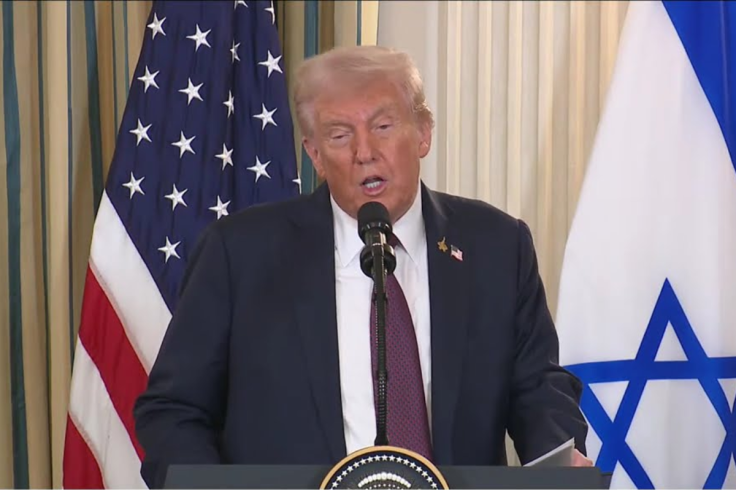
President Donald Trump claimed on 3 November that he had 99% approval in Israel and joked that he would move there and become prime minister if Americans grew tired of him.
'I'm at 99% approval rating in Israel, can you believe it?' Trump told Fox & Friends in a phone interview on US Election Day. 'In fact, if people ever got tired of me in the US, I'll move to Israel and become prime minister.'
Trump did not identify the poll behind his claim. The Jewish People Policy Institute (JPPI), an Israeli research organisation, recorded a sharp fall in the share of Israelis expressing a high level of trust in Trump during 2026. Its surveys also distinguish trust in Trump from Israelis' broader assessment of his relationship with their country.
Trump Repeats Claim of 99% Support in Israel
Trump made a similar claim on 20 May before the US Coast Guard Academy commencement, telling reporters he was at 99% in Israel and could run for prime minister. He said he had received a poll that morning but did not identify the polling organisation or provide its methodology.
Neither appearance identified the polling organisation, sample size or methodology needed to independently assess the figure. Trump repeated the claim on 3 November while discussing US-Israel relations and his administration's campaign against Iran, then joked about moving to Israel.
JPPI Data Show Sharp Fall in Trust in Trump
JPPI's Israeli Society Index found that the proportion of Israelis expressing 'a great deal of trust' in Trump regarding US-Israel relations fell from 34% in March to 7% in July. The figure rose to 10% in August. In July, 45% of respondents said they had no trust in him at all.
JPPI's October survey asked a different question: whether Trump was 'the friendliest president Israel has ever had'. About 69% said the description was 'very true' or 'fairly true', compared with 72% in November 2025. The findings measure perceptions of Trump's relationship with Israel, not a personal approval rating or trust in his handling of US-Israel relations.
Israeli Law Requires Prime Minister to Be a Knesset Member
Israel's Basic Law: The Government requires the prime minister to be a member of the Knesset, the country's 120-seat parliament. Ministers must separately be Israeli citizens and residents. Trump is not an Israeli citizen and therefore cannot currently stand for election to the Knesset.
Israel's Law of Return provides a route to citizenship for Jews and certain qualifying relatives. There is no established basis for Trump to qualify for citizenship under the Law of Return.
Non-Jews may apply for naturalisation through a separate process, which generally requires permanent residency, residence in Israel for three of the previous five years, some Hebrew proficiency and other conditions. Naturalisation is not automatic.
Even citizenship would not make Trump prime minister. He would also have to be elected to the Knesset and secure the political support required to form a government. Israel's parliamentary system forms governments through political parties and coalition negotiations, rather than a direct election for prime minister.
Trump's Netanyahu Endorsement Offers Political Contrast
Trump's remarks came less than three weeks after he publicly backed Israeli Prime Minister Benjamin Netanyahu ahead of Israel's 27 October election. On 18 October, Trump issued a 'complete and total endorsement' of Netanyahu, calling him a 'Great Warrior Prime Minister'.
Netanyahu has previously said he wants to reduce Israel's reliance on US military assistance over time. During the same Fox & Friends interview, Trump said Washington would stop providing about $4 billion in annual aid to Israel by the end of 2026, while continuing to sell it weapons. He said the two leaders had agreed to the change months earlier.
The announcement would precede the end of the existing military assistance arrangement. A 10-year memorandum of understanding signed in 2016 provides $3.8 billion annually through September 2028. Trump did not explain how his proposed cutoff would affect the agreement.
Reuters reported that it was unclear which funding he meant or how the change could be implemented, while annual US aid appropriations require congressional approval. Neither the White House nor Netanyahu's office had publicly confirmed details of a new arrangement.
© Copyright IBTimes 2026. All rights reserved.