

NASA's Voyager 1 Hits Historic One Light-Day Milestone, but a Sudden Data Glitch Raises New Concerns
A radio signal now takes 24 hours to reach the spacecraft, making troubleshooting a slow process
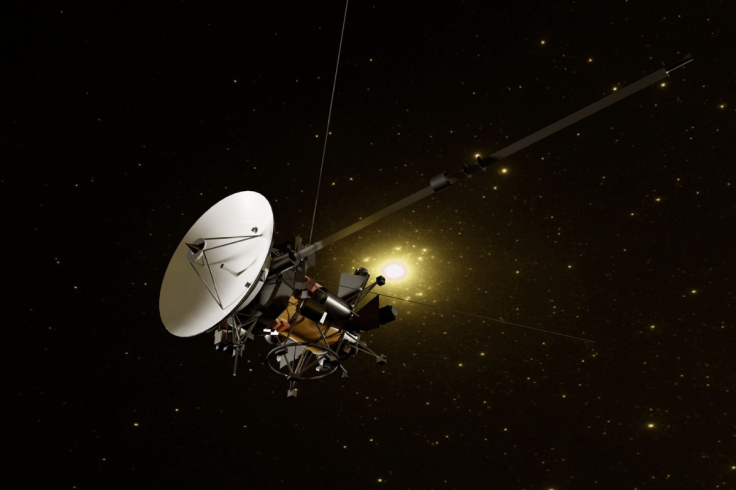
NASA's Voyager 1 has reached a historic distance of one light-day from Earth, but the milestone comes as engineers investigate why the nearly 50-year-old spacecraft stopped returning science and engineering data. Its carrier signal is still reaching Earth, but the probe is no longer delivering the measurements that make its journey scientifically valuable.
Voyager 1 Reaches One Light-Day From Earth
At 5:16 am EST on Wednesday, 18 November, Voyager 1 reached about 16.094 billion miles (25.902 billion kilometres) from Earth, NASA calculated. That is the distance light travels in 24 hours, making the spacecraft the first human-made object to reach one light-day from our planet.
Travelling at approximately 38,000 mph (61,155 km/h), the probe has taken more than 49 years to cover the distance since launching on 5 September 1977. Its position is about 173 times the average distance between Earth and the Sun. It is a distance milestone, not a physical change aboard the spacecraft.
NASA expected confirmation on 19 November. Engineers calculate the crossing from tracking measurements and its known trajectory.
NASA Investigates Sudden Data Failure
On 14 November, NASA's mission team became aware that a Deep Space Network antenna in Canberra, Australia, could receive Voyager 1's carrier signal but was no longer receiving science or engineering data.
The carrier signal indicates that the attitude-control computer is keeping the antenna pointed towards Earth and the broadcast equipment remains functional. NASA suspects a problem with a separate onboard computer that gathers information from the spacecraft's systems and scientific instruments, formats it and prepares it for transmission. For now, its future scientific output is uncertain.
The situation resembles a 2023 incident, when controllers also received a carrier signal without usable data. That fault was traced to an onboard computer. NASA is also investigating a possible connection with a 48-hour communications gap in October.
A 24-Hour Delay Complicates Repairs
Voyager 1's distance slows diagnosis. A radio signal takes about 24 hours to travel from Earth to the spacecraft, and another 24 hours for a response to return. NASA says identifying the cause could take weeks or longer.
'If you want to say "hello" to Voyager, you send your message and then you go home and you wait two days before you finally get a response', Suzanne Dodd, Voyager project manager at NASA's Jet Propulsion Laboratory, said in October.
The 1977 Spacecraft Is Exploring Interstellar Space
After studying Jupiter in 1979 and Saturn in 1980, Voyager 1 continued towards the edge of the Sun's influence. It crossed the heliopause in 2012, becoming the first spacecraft to enter interstellar space. Its twin, Voyager 2, crossed in 2018. The probes are the only spacecraft to study this region directly.
Voyager 1's instruments have measured magnetic fields, cosmic rays and plasma waves, providing direct evidence about conditions beyond the Sun's protective bubble.
NASA Works To Keep the Mission Alive
Voyager 1 runs on electricity from plutonium-powered radioisotope thermoelectric generators, whose output declines over time. In September, engineers completed a power-saving effort, switching off three devices and replacing them with lower-power alternatives. NASA has also shut down science instruments to conserve electricity, including its Low-energy Charged Particles experiment (LECP) on 17 April 2026.
Without the power-saving effort, NASA expected to switch off another instrument as early as summer 2027. The measures have not been linked to November's data failure.
© Copyright IBTimes 2026. All rights reserved.