Warren Buffett's Favorite Investment Costs Just 3 Cents per $100: Here's Why He Swears by It
You don't need complex Wall Street algorithms to build wealth; learn why Warren Buffett swears by simple, cheap index funds


For decades, the financial world has operated on a quiet assumption. Most people believe that the elite titans of Wall Street possess an edge hidden from the average household. They imagine rooms filled with proprietary algorithms, high-frequency trading desks, and exclusive insider networks driving immense fortunes.
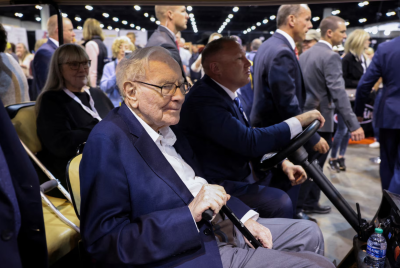
Yet, Warren Buffett has spent over six decades quietly dismantling that myth. The world's most successful investor did not build his wealth through hyper-complex trading strategies or constant market timing. Instead, his core message to everyday savers remains astonishingly simple, grounded in patience and low fees.
When people ask the Oracle of Omaha how to navigate the market, he points to a single vehicle that costs a mere three cents for every hundred dollars invested.
The Ultimate Recommendation for Everyday Savers
Buffett has never hidden his formula. Across decades of shareholder letters and public interviews, his core advice has remained remarkably consistent.
In his 2016 letter to Berkshire Hathaway shareholders, he wrote that his regular recommendation has been a low-cost S&P 500 index fund. He repeated that conviction during Berkshire's 2021 annual gathering, explicitly stating that owning an S&P 500 index fund is the single best path for most people.
His conviction is so absolute that he wrote it into his own estate instructions. In his 2013 annual letter, Buffett revealed his direct instructions for the trust dedicated to his wife. He directed the trustee to place 10 per cent of the cash in short-term government bonds and 90 per cent in a low-cost S&P 500 index fund, specifically pointing to Vanguard.
He was not offering polite humility. He was making a cold, calculated assertion that a simple, cheap index fund will outperform the majority of professional fund managers over time.
The Power of the Three-Cent Fund
The Vanguard S&P 500 ETF, known by its ticker symbol VOO, tracks 500 of America's largest public companies. It charges an annual expense ratio of just 0.03 per cent. That works out to exactly three cents per year on a hundred-dollar investment, or three dollars annually on a ten-thousand-dollar portfolio.
This modest fee provides broad exposure across every major sector of the US economy, encompassing global powerhouses like Apple, Microsoft, Nvidia, Amazon, and Alphabet. The mechanism self-corrects over time. Failing companies naturally fall out of the index, replaced by rising enterprise giants without the investor lifting a finger.
The long-term performance speaks clearly. Over the past decade, the fund has delivered average annual growth of roughly 15 per cent. While market drops like the 2020 crash tested the nerves of many, investors who held steady reaped remarkable long-term gains.
The Million-Dollar Bet That Proved the Point
Buffett's preference for index tracking over active management is backed by hard evidence. S&P Dow Jones Indices data shows that over a 15-year horizon, nearly 90 per cent of actively managed US large-cap funds failed to beat the benchmark index after accounting for fees.
To prove this reality, Buffett initiated a famous public wager in 2007. He put up 1 million dollars against Protégé Partners, betting that a basic Vanguard S&P 500 fund would outperform a hand-picked portfolio of five hedge funds over a 10-year period.
The hedge fund managers conceded defeat well before the 10 years were up. By 2017, the index fund had achieved a 125.8 per cent return. In contrast, the five active hedge funds lagged dramatically, returning an average of far less over the same decade. Buffett donated the full million-dollar winnings to the charity Girls Inc. of Omaha.
Time in the Market Beats Complex Trading
Buffett's own historic portfolio at Berkshire Hathaway reinforces this core principle. When Berkshire purchased its position in Coca-Cola between 1988 and 1994 for 1.3 billion dollars, Buffett simply held on. By 2022, the annual dividend alone paid Berkshire over 700 million dollars. His original stake in American Express tells a similar story of patient ownership over decades.
For regular investors attempting to build long-term security, the lesson is straightforward. High management fees and frequent trading routinely erode wealth over time. A broad-market index fund like VOO requires no complex market timing, no expensive management costs, and no daily stress.
By keeping costs to mere pennies and allowing the compounding power of the economy to work uninterrupted, ordinary investors can achieve extraordinary financial outcomes.
Disclaimer: Our digital media content is for informational purposes only and does not constitute investment advice. Please conduct your own analysis or seek professional advice before investing. Remember, investments are subject to market risks, and past performance does not guarantee future returns.
© Copyright IBTimes 2026. All rights reserved.
- Recommended For You