'The Market Has Voted': Michael Burry Warns Big Tech's AI Spending Is Harming Stocks While Apple Wins
Microsoft rose more than 15% three days later on an unchanged capital bill, and British retirement savings depend on the outcome

Michael Burry told his followers on 27 July that 'the market has voted and the results are clear.' His two charts compare AI spending to share prices since June, showing that the heaviest spenders are furthest in the red, with Apple standing apart. For a British worker whose workplace pension is in a global tracker, these firms represent a large portion of the pot.
Burry made his name betting against American subprime mortgages before 2008 and wound down Scion Asset Management in November 2025. He now publishes on Substack. His post came 48 hours before four of those companies reported.
What the Charts Actually Measured
The figures are not small: Amazon, Alphabet, Meta, and Microsoft are expected to spend roughly $725B (£543B) on capital projects this year, on analysts' consensus estimates, against about $410B in 2025. Almost all of it is data centres and chips.
Burry did not say what the market was voting on, and his own positions answer it: put options on Nvidia in size, plus shorts on Micron, Caterpillar, and a semiconductor fund since 24 July. He argues the demand is financed in a circle rather than bought by end customers. His post is below.
The market has voted and the results are clear. pic.twitter.com/Put0L55WsQ
— Cassandra Unchained (@michaeljburry) July 27, 2026
The chart reaches past those four. Oracle, Tesla, and Micron sit on the same axes, so the spending has pulled in companies outside Big Tech.
Alphabet's results show why investors flinched. It has guided to between $195B and $205B of capital spending for 2026, and its free cash flow turned negative by $5.9B in the second quarter, the first shortfall since it floated in 2004. The shares fell more than 7% on 23 July.
Then the Vote Changed
Three days after the post, the pattern broke. Microsoft reported revenue of $90.01B and said its Azure cloud business had passed $100B in annual revenue for the first time, growing 43%. The company kept its capital spending plans steady, and the shares rose more than 15% on 30 July, its largest single-day gain in market value.
Meta went the other way on the same day. It missed on earnings, guided third-quarter revenue below expectations, and would not commit to a 2027 capital figure, and the shares fell about 9%. The graphic below sets each plan against what the price did.
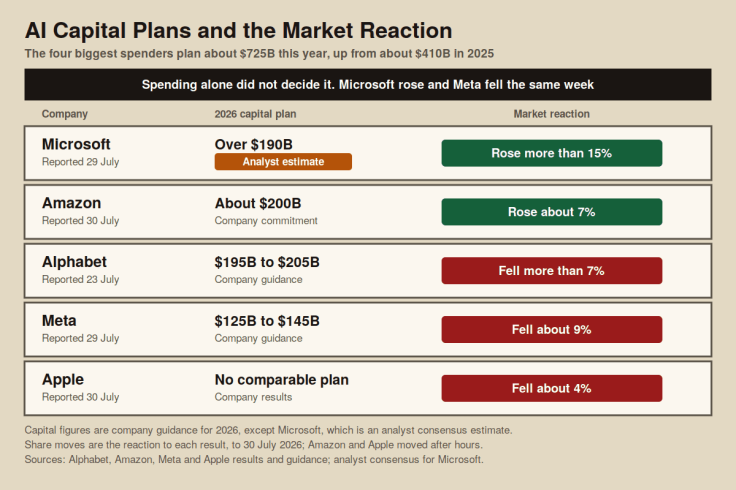
Amazon told the same story from the other end. The company has committed about $200B (£150B) and ran free cash flow of negative $7.6B for the year to 30 June. The shares still rose about 7% after hours, with cloud revenue ahead of forecasts.
Apple, the winner in Burry's chart, did not escape either. Revenue beat at $109.4B (£82B) for the June quarter, with iPhone sales up 22%. Its services arm came in at $30.74B against expectations nearer $31.2B, Greater China at $18.8B, and the shares dropped about 4% after hours.
The week suggests investors are not punishing the outlay itself, but outlay that cannot yet be traced to revenue. Microsoft produced the receipt. Meta had no equivalent.
What a Correction Would Cost British Savers
The Bank of England has already put numbers on the downside. Its July financial stability report modelled a repricing of AI profitability beginning in the United States, then traced what that would do to Britain.
Over six quarters, that scenario knocks 45% off US equity prices. None of it is a forecast, and the graphic below carries the rest.
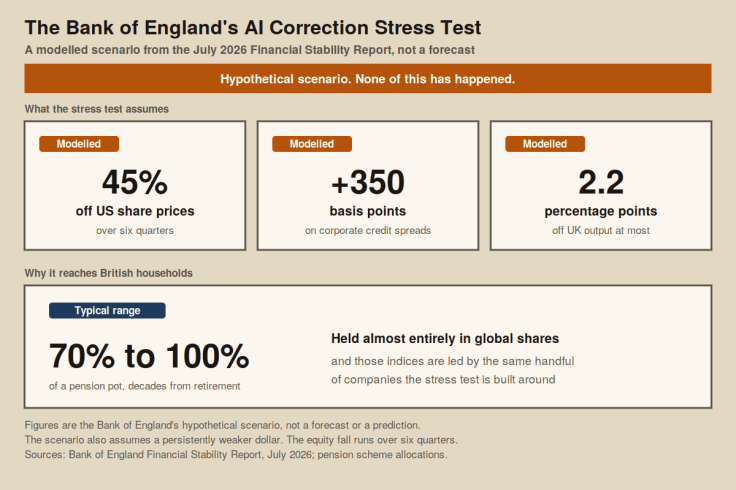
The cost to the United Kingdom gross domestic product (GDP) is put at up to 2.2 percentage points. That is the macroeconomic number. The household version is blunter, because savers decades from retirement commonly hold between 70% and 100% of their pot in global equities, and those indices are led by the same few firms.
Fitch Ratings named a possible AI correction one of two dominant global credit risks this quarter, alongside the Iran conflict. Moody's Ratings expects the heaviest spenders to issue around $175B of debt this year, against a five-year average nearer $30B.
Burry has been early before, and being early carries a cost. The market is still counting, and it wants the receipts.
Disclaimer: Our digital media content is for informational purposes only and does not constitute investment advice. Please conduct your own analysis or seek professional advice before investing. Remember, investments are subject to market risks, and past performance does not guarantee future returns.
© Copyright IBTimes 2026. All rights reserved.
- Recommended For You