

3I/ATLAS Displays Rare Features In New Study — Experts Question Its True Origin
With major anomalies, the 3I/ATLAS challenges current models of cometary behaviour

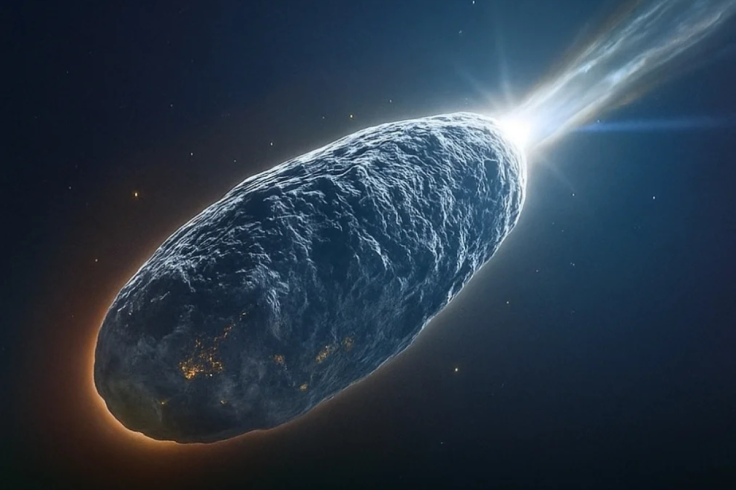
The universe constantly presents us with mysteries, and the object 3I/ATLAS is proving to be one of the most baffling.
A recent in-depth study has unveiled a series of anomalies in this cosmic visitor, leaving experts scratching their heads and prompting a critical re-evaluation of its true origins. What is this peculiar object, and where did it really come from?
The Unveiling: A Comet or Something New?
The interstellar visitor 3I/ATLAS showcased several unique characteristics in both its path and its physical conduct as it moved through the inner solar system. Recent examinations, including a detailed summary by Harvard Professor Avi Loeb, have revealed anomalies across several areas.
🚨 Avi Loeb on Danny Jones Podcast about the Anomalies of the Interstellar object 3I/ATLAS
— T R U T H P O L E (@Truthpolex) December 8, 2025
- Danny Jones Podcast#Ufotwitter #3IATLAS pic.twitter.com/EfaCacJ6pE
These range from changes in its behaviour that were extremely unexpected to relatively minor departures from what we would usually anticipate from a comet. These anomalies include its closest approach to Jupiter during the 2026 encounter, the mass of its core, the presence of jets facing the Sun, and an atypical gas mix.
The existing data indicate that these characteristics do not match those of any previously observed comet; consequently, this has led to careful recording of every deviation. PrimeTimer has since compiled a clear record of these specific features, presenting them just as they were found.
Key Irregularities Defy Ready Interpretation
One significant irregularity for which there is no easy answer is the anticipated distance of 3I/ATLAS' closest pass to Jupiter (perijove) on 16 March 2026. The estimated distance is 53.445 million kilometres, which is almost precisely the same as Jupiter's Hill radius of 53.502 million kilometres.
This distinct alignment is made possible by the non-gravitational acceleration observed near its closest approach to the Sun (perihelion).
Another characteristic concerns the object's arrival time: this placement brought 3I/ATLAS within tens of millions of kilometres of Mars, Venus, and Jupiter, yet it was simultaneously impossible to observe from Earth during its closest pass to the Sun (perihelion).
All eyes on #3I/ATLAS ☄️
— ESA Science (@esascience) October 1, 2025
Our Mars Express & ExoMars Trace Gas Orbiter will observe the comet around its closest approach to Mars on 3 October 2025, when 3I/ATLAS will be around 30 million km from the red planet.
Stay tuned and follow https://t.co/8KPnup4Aw6 pic.twitter.com/SZsclVXoXM
The core of 3I/ATLAS possesses a mass that is roughly a million times greater than 1I/'Oumuamua and a thousand times larger than 2I/Borisov. Furthermore, it is moving at a greater speed than both of these objects, as astronomer Jason Wright noted in his blog AstroWright.
Observations show that in July, August, and November of 2025, the object exhibited a jet pointing towards the Sun, sometimes called an anti-tail. This feature was verified using HiRISE images captured while near Mars.
The gas cloud surrounding 3I/ATLAS shows greater amounts of nickel when compared to iron, and it also exhibits an elevated ratio of nickel-to-cyanide. This contrasts with the thousands of comets observed, including 2I/Borisov.
Furthermore, the backward path (retrograde trajectory) of 3I/ATLAS maintains an alignment that is within 5 degrees of the ecliptic plane—the plane in which the planets orbit the Sun. These combined characteristics have been documented across various sources, including JPL Horizons data, HiRISE imagery, and spectroscopic analyses.
Medium Irregularities and Statistical Events
Several irregularities of intermediate significance have been recorded. For instance, the direction from which 3I/ATLAS arrived is found to be within nine degrees of the known source of the radio 'Wow! Signal,' as was noted in previously published observational data.
Is 3I/ATLAS Extraterrestrial Object Related to the WOW! Signal?
— Prof. Brian Keating (@DrBrianKeating) October 10, 2025
with Avi Loeb (@GalileoProject1) pic.twitter.com/5d5sNXedPD
Readings of its polarisation further reveal that 3I/ATLAS exhibits an exceptionally negative degree of polarisation. This is a characteristic never before witnessed in any interstellar comet, 2I/Borisov included. These specific figures regarding both its path of arrival and its polarisation have been made public in analyses of interstellar objects and surveys of comets that have passed peer review.
It is worth noting that these deviations are considered statistically rare compared with the general population of known comets. This suggests that 3I/ATLAS possesses traits not commonly seen in objects originating either within or beyond our solar system.
Minor Deviations Potentially Linked to Source
Minor deviations are related to the composition, luminosity, and activity level of 3I/ATLAS. The gas cloud only holds four percent water by mass, which is a much lower proportion than what is found in standard comets from our solar system.
🚨 BREAKING: NASA GOES DARK AS 3I/ATLAS DEFIES GRAVITY ☄️
— Ezee (@EzeemmaCraic) October 31, 2025
Harvard’s Avi Loeb just dropped a cosmic bombshell — new data shows 3I/ATLAS didn’t follow gravity at perihelion… it accelerated sideways. 🤯
Something pushed this interstellar object beyond sunlight and physics itself.… pic.twitter.com/bdggRCQ716
The jets observed extend both toward and away from the Sun (in the sunward and anti-solar directions). If these were explained solely by sublimation (the change from solid to gas), they would require a considerable surface area to operate. Furthermore, they keep their orientation over distances of roughly one million kilometres.
Non-gravitational acceleration was noted close to the object's perihelion (closest approach to the Sun), yet no signs of the object breaking apart were evident in the sequential imaging data. These specific measurements have been recorded in observational reports and the initial data analyses.
The Verdict: A Riddle Written in the Cosmos
The existing 3I/ATLAS data set provides a complete catalogue of irregularities, organised by likelihood and importance.
The deviations identified—categorised as major, medium, and minor—relate to its trajectory, mass, composition, and activity. The foundational documentation for all these findings is drawn from key sources, including JPL Horizons, HiRISE imaging, and dedicated spectroscopic surveys.
Ongoing monitoring of this object is essential, as it will allow these measurements to be further refined and enable a more detailed classification of its unique characteristics.
© Copyright IBTimes 2026. All rights reserved.