3I/ATLAS Update: NASA Image Confirms Anti-Tail, Why A Sunward Tail Should Not Exist
Hubble confirms 3I/ATLAS's sunward anti-tail, backing a theory that the object is not a comet. Closest approach is December 19.
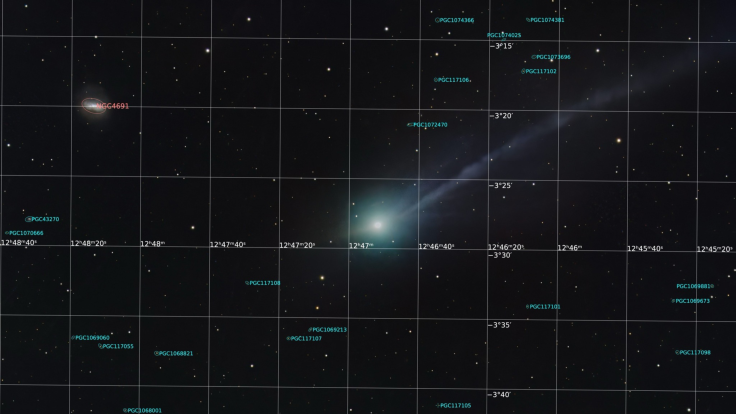
It is a basic, beautiful rule of the cosmos: when a comet, a dusty ball of ice, swings close to the Sun, its frozen heart begins to boil. The resulting plume of gas and dust is whipped violently backwards by the solar wind, creating a magnificent, curving tail that points away from our star. It is a predictable, natural, and messy process.
But the interstellar object 3I/ATLAS is proving to be neither natural nor messy. It is a mystery that is far too neat.
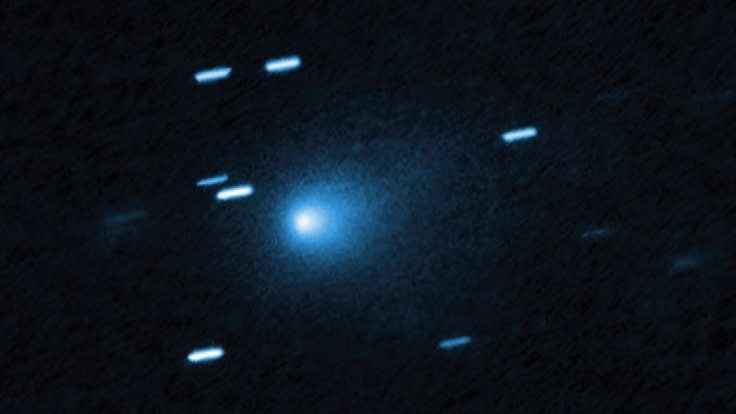
When the newest image from the Hubble Space Telescope was released—taken on November 30, 2025, using the F350LP filter aboard the Wide Field Camera 3—astronomers found themselves staring at an interstellar visitor that was almost perfectly structured.
A smooth, spherical glow extends outward some 40,000 kilometres in all directions from the object's centre. Crucially, from this perfectly formed shell emerges a narrow, elongated extension pointing directly toward the Sun.
This feature, known in comet science as an anti-tail, should not exist under the standard models of physics. And yet here it is: a coherent, sunward line of debris, sharper and more defined than in any previous observation.
When we consider how comets usually behave, the anomaly of the anti-tail becomes even more profound. Every motion, every plume, and every brightening event in a typical comet is chaotic.
They shed volatile ices that vaporise unevenly, causing unpredictable jitters in their flight path. Nothing remains stable. Nothing remains predictable. Under normal conditions, comets generate a dust tail that curves gently and an ion tail that is pushed straight away from the Sun by the solar wind.
Yet the new Hubble image shows a 60,000-kilometre sunward extension that is narrow and coherent. In other words, a vast trail of material is defying the intense pressure of the solar wind, organising itself neatly and pointing in the completely wrong direction.
The Perfect Disorder: Why The 3I/ATLAS Comet Defies Physics
The significance of this bizarre behaviour is now starting to crystallise, thanks in part to the analytical work of Harvard astrophysicist Avi Loeb. Loeb, who has been monitoring 3I/ATLAS with intense scientific interest, has proposed a radical alternative theory.
He argues that the teardrop-shaped halo is not composed of tiny, volatile dust or gas at all. Instead, he suggests it is made of 'macroscopic non-volatile fragments'—in plain English, solid objects, perhaps pebble-sized or larger, which are far too robust to be simply blown away by the solar wind.
These larger, solid fragments, he argues, were separated from the main body during perihelion by the object's measured non-gravitational acceleration away from the Sun. This acceleration—an unexplained burst of speed that cannot be accounted for by solar radiation alone—is what caused the object to shed its solid components.
This is the point where astrophysics reads like an investigative thriller. Loeb's model made a daring prediction: if these large fragments had indeed separated from ATLAS at perihelion, they should, by November 30, appear approximately 60,000 kilometres closer to the Sun than the main body.
Hubble's newly released image reveals the anti-tail extending almost exactly 60,000 kilometres.
In the world of investigative analysis, that degree of alignment between a prediction and a real-world observation is rare. In astrophysics, where models are often tested only against approximations, it is extraordinary.
Avi Loeb's 3I/ATLAS Theory: The 60,000-Kilometre Prediction That Came True
The image does far more than confirm a bold hypothesis; it reveals a repeating pattern. The spherical coma is unusually symmetric for a body that should be venting gas unevenly after its closest approach to the Sun.
The nucleus itself remains compact and stable in appearance. Even the straight white star streaks—produced by Hubble's precise tracking of ATLAS—remind us that the object's motion is smooth and steady, not jittered by chaotic sublimation.
The broader implication is that we are no longer just documenting an isolated anomaly; we are watching consistent behaviour that repeats across time, across instruments, and across viewing angles.
The fact that this consistent behaviour is confirmed across independent platforms, including ESA's Juice spacecraft, Hubble's pre-perihelion and post-perihelion images, and ground-based amateur telescopes, means the anomaly is no longer incidental—it is structural.
The clock is now ticking toward a crucial deadline. December 19, 2025, marks the close approach of 3I/ATLAS to Earth. That date will offer astronomers their best chance yet to capture high-resolution imaging and spectroscopy before the object moves outward into the colder, darker reaches of the solar system.

What scientists hope to learn is not just the colour or shape of the coma, but whether this sunward debris field continues to behave in a coherent pattern as the object cools.
Will the anti-tail elongate, or finally dissipate? Will the nucleus suddenly brighten or dim? And most fundamentally, will 3I/ATLAS continue to follow the non-gravitational acceleration profile already measured?
These answers matter because 3I/ATLAS is teaching us, in real time, that interstellar objects do not have to resemble the comets and asteroids we know. They can be built of materials we have not yet catalogued. They can react to sunlight in completely unfamiliar ways. And they can move according to forces our models are only just beginning to describe.
Hubble's newest image confirms that the anomaly was never subtle. It was always there, hiding in plain sight. Now, with December 19 approaching, the world has an opportunity not only to observe it, but to finally understand it.
The spectacle of 3I/ATLAS defying the laws of cometary physics, and the perfect alignment of the Hubble image with Dr. Avi Loeb's bold theory, mark a pivotal moment in our understanding of interstellar visitors.
As the object barrels toward its closest approach to Earth, the evidence that these celestial bodies are built differently and behave in ways our models cannot explain is overwhelming. The anomaly is confirmed as a structural reality, setting the stage for a critical observation window.
© Copyright IBTimes 2026. All rights reserved.
- MOST POPULAR IN Trending