

Armenian Parliament Erupts Into Massive Brawl After MP Mocks Opponent With 'Ministry to Satisfy Women' Remark
The confrontation has renewed debate over parliamentary discipline and new rules to curb disruptive behaviour
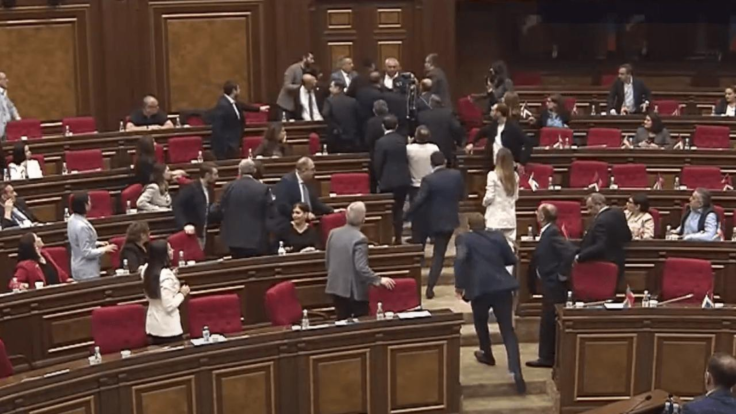
Armenia's parliament descended into a mass brawl on 29 October after ruling-party MP Taron Chakhoyan revived a controversial remark about creating a 'ministry to satisfy women,' prompting a confrontation with opposition leader Narek Karapetyan.
The clash erupted during a debate over the election of a member of the Audit Chamber, with lawmakers from the ruling Civil Contract party and opposition Strong Armenia faction exchanging blows. The violence reportedly spread beyond the chamber into a parliamentary corridor, where security personnel and other MPs tried to separate those involved.
The confrontation has put the Assembly's disciplinary procedures under renewed scrutiny, coming just weeks after a parliamentary committee presented eight principles intended to improve lawmakers' conduct.
The Remark That Triggered the Confrontation
Chakhoyan referred to an earlier statement by Sargis Karapetyan, Narek Karapetyan's cousin and the son of businessman Samvel Karapetyan. The controversial remark concerned a proposed 'ministry to satisfy women' if the opposition movement came to power.
According to Speaker Ruben Rubinyan, Chakhoyan reminded the opposition leader that his cousin had not apologised for the statement. Karapetyan initially responded from his seat before approaching the podium. The exchange escalated into a physical confrontation involving members of both political camps.
The original comment had attracted controversy months earlier, after Sargis Karapetyan made remarks about women's satisfaction in a discussion about the opposition movement's vision for Armenia. Chakhoyan's decision to bring it up during a parliamentary debate turned the earlier controversy into a fresh confrontation between rival factions.
Speaker Blames Opposition Leader as MPs Report Injuries
Rubinyan placed primary responsibility for the incident on Karapetyan, saying he had reviewed footage of the exchange during a break in proceedings. 'Mr. Karapetyan, you failed to control your emotions, made offensive remarks from your seat, and then stood up and attempted to hit Taron Chakhoyan,' Rubinyan said.
The Speaker also alleged that opposition MP Garnik Davtyan struck Chakhoyan during the fight. These claims reflect Rubinyan's account and should not be treated as an independent finding about who initiated the violence.
Footage and subsequent reports indicated that the confrontation continued outside the chamber. Opposition MP Andranik Gevorgyan was reported to have a bleeding nose, while fellow MP Ruben Mkhitaryan's clothes were reportedly torn.
An ambulance was sent to the National Assembly after a call was received at 10:51 a.m. However, the acting director of Ambulance Service CJSC, Harutyun Harutyunyan, said the request was cancelled while the crew was on its way, meaning no medical assistance was provided.
He added that the service had no confirmed information about whether anyone had been injured. Rubinyan said he had deliberately allowed the live broadcast to continue so the public could see what was happening inside parliament.
New Ethics Rules Face a Test After Repeat Clashes
The latest violence follows another confrontation between ruling-party and opposition lawmakers on 6 October, raising questions about whether the Assembly can prevent political disagreements from turning physical.
On 5 October, a temporary ethics committee chaired by MP Maria Karapetyan presented eight principles intended to promote orderly proceedings, respect for political opponents, and public trust. The ethics process allows complaints about MPs' conduct to be considered by the commission, which can determine whether a breach has occurred and recommend disciplinary action to the Speaker.
Possible measures include a warning, loss of microphone privileges for one sitting, removal from a sitting, or exclusion from the parliamentary chamber for up to seven days. The rules do not automatically impose penalties whenever a confrontation occurs. Their effectiveness depends on complaints being examined and recommendations being acted upon.
Thursday's brawl therefore presents a test for the Assembly's response to repeated disorder. How its leadership handles the latest incident could influence whether the new standards are seen as meaningful safeguards or simply another set of rules with limited effect.
© Copyright IBTimes 2026. All rights reserved.