China Joins the Nuclear Triad Club, but It's Still No Match for America's Stealth Bombers
The disclosure gives Beijing land-, sea- and air-based nuclear delivery options, but analysts say its bomber force remains less mature than those of the US and Russia
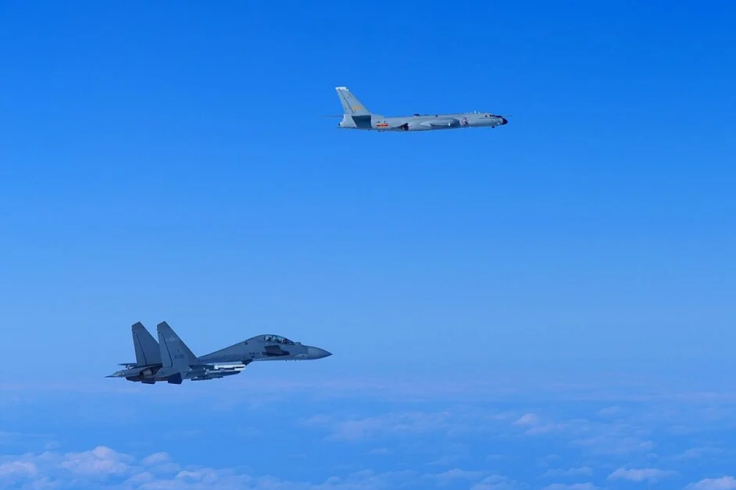
China has publicly demonstrated an air-based nuclear delivery capability after newly released footage showed an H-6N bomber carrying the Jing Lei-1 (JL-1) air-launched ballistic missile.
The development gives Beijing nuclear delivery options by land, sea and air, although analysts have long regarded China's triad as developing rather than equivalent to the mature US or Russian systems.
But for all the symbolism, the modernised bomber remains a world away from the stealth aircraft being developed for America's own nuclear forces. Analysts say the disclosure strengthens China's strategic deterrent without demonstrating technological parity with the United States.
Footage Shows H-6N Armed With Jl-1 Missile
The People's Liberation Army last month released footage showing its H-6N bomber flying with what analysts identified as the nuclear-capable Jing Lei-1 (JL-1) air-launched ballistic missile. The flight, carried out during a joint anti-ship exercise, appeared in a CCTV documentary marking the PLA's 99th anniversary.
The H-6N is a modernised variant of the H-6, an aircraft family based on the Soviet Tu-16 bomber design of the 1950s.
Its pairing with the JL-1, publicly displayed during China's September 2025 military parade, is regarded by analysts as the air-based component of China's nuclear triad, with the Center for Strategic and International Studies previously describing China's triad as nascent and the H-6N as its air leg.
🇨🇳J-20 Escorts H-6N with JL-1 for Strategic Strike
— GeoPaul626 (@Paull626) August 4, 2026
J-20 stealth fighters escort the H-6N bomber carrying the JL-1 (Jing Lei-1) air-launched ballistic missile. The nuclear-capable missile, with reported long range and high speed, forms a key part of China’s airborne strategic… https://t.co/r2mmuDYLNf pic.twitter.com/51deKo1M6c
Chinese Bombers Have Also Operated Near Alaska
The unveiling comes as China's H-6 fleet expands its activities well beyond its own airspace.
In July 2024, US and Canadian fighter jets intercepted two Chinese H-6 aircraft and two Russian Tu-95 bombers operating in the Alaskan Air Defense Identification Zone, although the aircraft remained in international airspace and did not enter US or Canadian sovereign airspace.
The joint patrol was the first such China-Russia bomber activity near Alaska, according to the Center for Strategic and International Studies.
The episode showed that China's bomber fleet can operate alongside Russian aircraft in the vicinity of Alaska and has drawn attention from defence analysts because of its implications for Chinese-Russian strategic cooperation and US air defence planning.
A Weapon Built for Survivability
The JL-1 has a reported range of up to 8,000 kilometres, with assessments cited by defence analysts describing hypersonic speeds and terminal manoeuvrability that could make it difficult to intercept. Those performance figures remain reported specifications rather than independently verified measurements.
Its role is chiefly linked to survivability, as the bomber's mobility could allow it to scramble following early warning, reducing the risk of destruction on the ground and preserving a potential retaliatory capability.
Chinese military commentary has argued that the H-6N and JL-1 combination could reinforce confidence in China's declared no-first-use nuclear policy, although this does not establish that the force would be immune to a first strike or guarantee a successful second strike.
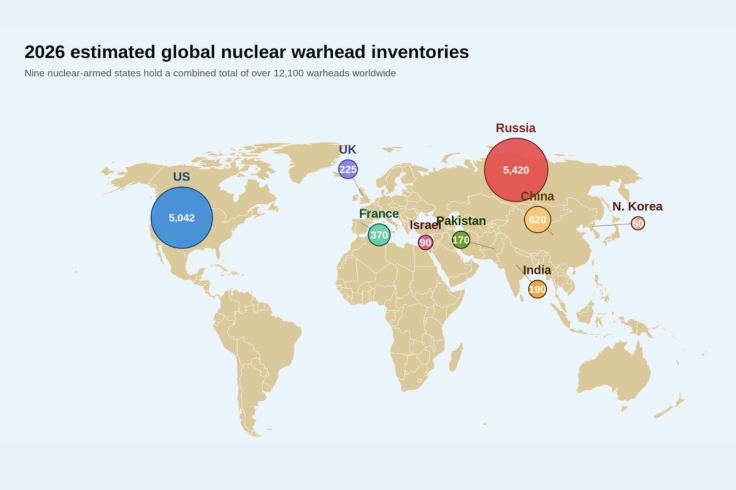
The world's nine nuclear-armed states possess an estimated 12,200 nuclear warheads, according to the Federation of American Scientists, with the United States and Russia possessing the largest arsenals. China has been expanding its nuclear forces, but its stockpile remains smaller than those of Washington and Moscow.
Why China Still Trails the United States
Despite the milestone, defence researchers describe China's triad as considerably newer and less mature than those of the US or Russia.
The Center for Strategic and International Studies has noted that Washington and Moscow have maintained full, credible nuclear triads for decades, while China's nuclear forces have developed more recently and remain smaller and less mature.
Unlike the US, which fields the stealth B-2 Spirit and is introducing the B-21 Raider, the H-6N is not a stealth aircraft and relies on aerial refuelling to extend its operational range.
The US is also undertaking a large-scale modernisation of its nuclear forces, with the Congressional Budget Office estimating in 2025 that current plans would cost $946 billion (£750bn) over 2025–2034, including $309 billion (£245bn) to modernise strategic and tactical nuclear delivery systems and their weapons.
A nuclear triad has historically been maintained by only a small number of nuclear-armed states.
The United States and Russia have long operated full, credible triads comprising land-based intercontinental ballistic missiles, submarine-launched ballistic missiles and strategic bombers, while China and India have developed less mature triads with land-, sea- and air-based nuclear delivery capabilities.
Other nuclear-armed states, including Britain, France, Pakistan, Israel and North Korea, maintain nuclear forces but do not operate a comparable three-leg nuclear triad.
For China, the public demonstration of the H-6N/JL-1 combination reinforces the shift from a predominantly land-based nuclear posture towards a more balanced set of delivery options, potentially influencing how Washington and its allies assess the strategic balance in the Indo-Pacific.
The gap in bomber technology and operational experience means the development is better understood as strategic diversification and survivability than evidence of parity with the United States, a distinction likely to remain important to military planners on both sides.
© Copyright IBTimes 2026. All rights reserved.
- Recommended For You