

Trump Was Briefed on Alleged Chinese Intelligence Operation Involving Nvidia CEO Jensen Huang, Report Says
US officials reportedly later questioned their initial assessment that Jensen Huang was unaware of the woman's alleged intelligence activities

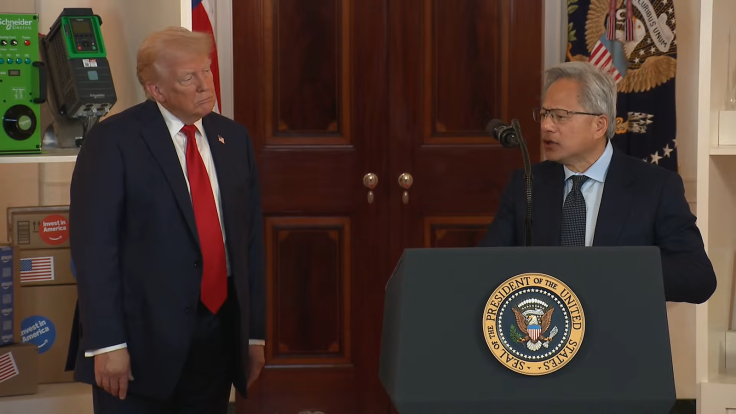
President Donald Trump was briefed roughly a year ago that US intelligence agencies had reportedly assessed a Chinese national with close ties to Nvidia chief executive Jensen Huang as an intelligence asset gathering information for Beijing. He took no action, according to an investigation published by The New York Times on 29 October 2026.
The woman, Alice Huang, also known as Huang Le, is not related to Jensen Huang. She was a former senior executive at Singapore-based Megaspeed, a cloud-computing company that buys Nvidia equipment and rents computing capacity to Asian customers.
Electronic surveillance showed that Alice Huang was in contact with an American citizen. An intelligence process known as unmasking later identified the person as Jensen Huang, according to people familiar with the classified findings. The reporting does not establish that he knowingly supplied confidential information or knew of Alice Huang's alleged activities.
What US Intelligence Found About Alice Huang
Officials feared she could use her relationship with Huang to obtain information about Nvidia's business and his views on US semiconductor policy. The investigation does not identify what information she allegedly passed to Beijing.
When Trump was briefed, officials initially assessed that Jensen Huang was unaware of her alleged intelligence activity. Some senior administration officials later questioned whether he could have remained unaware, although it is unclear whether intelligence agencies formally changed their assessment. The surveillance continued after the briefing.
Why Trump Took No Action
According to people familiar with the matter cited by The New York Times, Trump was wary of disrupting Nvidia's chip sales or complicating trade with China. Jensen Huang had lobbied for looser export restrictions, and officials said his close relationship with Trump had impeded some efforts to tighten controls. These commercial and political considerations were among the factors surrounding the administration's response, although their precise influence on Trump's decision remains unclear.
In August 2025, Nvidia and AMD were reported to have agreed to give the US government 15% of revenue from certain H20 and MI308 chip sales to China, according to a US official cited by Reuters. In December 2025, Trump announced that the government would receive 25% of revenue from approved Nvidia H200 sales to China. Officials may also have feared that warning Jensen Huang could alert Alice Huang to the surveillance. The reporting does not establish whether this concern influenced the decision not to give him a defensive briefing.
Megaspeed Was Already Under Investigation
The Commerce Department opened an investigation into Megaspeed in late 2024 after a US official found Nvidia equipment still boxed at a Malaysian data centre. Investigators suspected the facility could be used as a transit point for restricted equipment. The probe was transferred to the Justice Department in 2026.
Megaspeed buys Nvidia chips and rents computing capacity to customers including Alibaba, the Chinese technology company. Its Malaysian sister company purchased at least $4.8 billion (£3.6 billion) in advanced AI equipment containing Nvidia chips and technology between June 2024 and February 2026, according to ImportGenius, a trade data firm. The purchases do not establish that the equipment was illegally diverted to China.
On 13 October 2025, Republican Senator Tom Cotton of Arkansas urged Commerce Secretary Howard Lutnick to investigate Megaspeed. Cotton described it as a spin-off of 7Road, which he identified as a Chinese government-owned cloud company. His office published the letter the following day. Alice Huang's name was later removed from Megaspeed corporate documents, although the extent of her continuing ties to the company was unclear.
Nvidia and Megaspeed Reject the Allegations
Nvidia spokesman John Rizzo said Jensen Huang's interactions with Alice Huang were routine. 'Meetings with customers are part of a CEO's job; Jensen talks with thousands of customer executives every year,' he said. Rizzo said regional cloud customers received 'ordinary business information', not sensitive trade secrets or information relevant to national security. He also said Nvidia had investigated and debunked chip-smuggling allegations involving Megaspeed.
Jensen Huang separately described Nvidia's dealings with Megaspeed as 'normal and not unusual' in a Bloomberg interview reported by Reuters on 29 October. He said Nvidia had examined and counted the company's GPU deployments and that Alice Huang was no longer with Megaspeed. Megaspeed's current leadership said it had retained external legal counsel to investigate the allegations and would co-operate with US authorities.
Liu Chang, a spokesman for the Chinese Embassy in Washington, dismissed the allegations as 'groundless smears and slanders'. Alice Huang did not respond to requests for comment. The White House, CIA and National Security Agency declined to comment.
The investigation has not established that Jensen Huang knowingly shared sensitive information with Beijing or was aware of Alice Huang's alleged intelligence activities. Nor has it established that Megaspeed illegally diverted Nvidia equipment to China.
© Copyright IBTimes 2026. All rights reserved.