Australia Confirms F-35 Parts Went Missing in Hong Kong, Raising Fears Over Chinese Access
F-35 parts were diverted to Hong Kong as the Pentagon works to recover them and investigate the incident
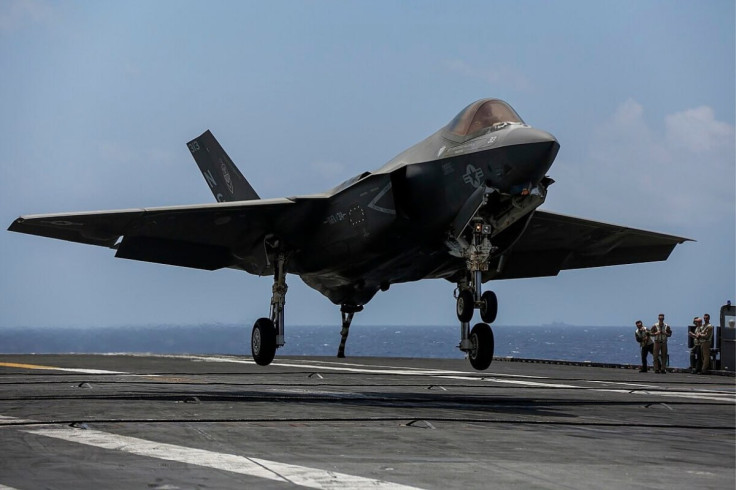
A shipment of F-35 fighter jet components sent from Australia to the United States for repairs was unexpectedly diverted to Hong Kong, triggering a US investigation and concerns about possible access to technology used in one of the world's most advanced combat aircraft.
The incident has attracted scrutiny because the F-35 programme involves tightly controlled technology. Defence Minister Richard Marles said his understanding was that the missing components were not sensitive, while the Pentagon's F-35 Joint Program Office is working with US authorities and industry partners to retrieve the parts, investigate the incident and introduce safeguards against a recurrence.
That leaves a key question over the F-35 parts Hong Kong incident: how did equipment moving through a tightly controlled military supply chain end up there in the first place?
Australia’s defense minister said Tuesday that F-35 fighter jet parts had been mistakenly diverted to Hong Kong, following reports US lawmakers were investigating the mishap.
— Kaitlan Collins (@kaitlancollins) September 22, 2026
https://t.co/cBDx5bJkHZ
F-35 Shipment Mystery
Politico reported that the shipment left Australia earlier this year and was meant to reach the United States for repairs, but was unexpectedly diverted to Hong Kong. ABC News subsequently confirmed that Australia was assisting the US investigation.
The reason for the diversion remains unclear, as does the current location of the components. Politico also reported that Lockheed Martin had used a third company to transport the parts.
It is not publicly known whether the shipment came from the F-35 Aircraft Sustainment Hub at Williamtown, north of Newcastle. The facility serves as an Asia-Pacific regional hub for F-35 spare parts, with components moving through the network to support allied aircraft.
Australia has 72 F-35s and is one of seven countries outside the United States sharing the programme's global spare-parts pool.
Why the Canopy Matters
The concern intensified after Politico reported that the shipment included an F-35 cockpit canopy containing radar-resistant technology. ABC News also reported the canopy claim, although the sensitivity of the specific components remains unclear.
That does not establish that the missing consignment contained the fighter's most closely protected secrets. However, the reported canopy adds a significant dimension to an incident already attracting scrutiny because the parts ended up in Hong Kong, a Chinese special administrative region.
The F-35's low-observable design relies on technologies intended to reduce its radar signature, making some physical components part of a wider security concern.
There is currently no public evidence that Chinese authorities obtained or examined the missing components. The concern is about the potential implications if sensitive material were accessed.
Defence analyst John Conway of Felix Defence said the F-35 has thousands of components, some routine and others more sensitive. He said that even if canopy parts had been sent to Hong Kong, it would not necessarily mean China could access secret technology it could exploit.
The 'Unserviceable' Question
The Pentagon has described the shipment as involving 'unserviceable' F-35 Lightning II components.
Exactly what that means in this case has not been publicly explained. The F-35 Joint Program Office has not disclosed the specific components or explained whether they were damaged beyond repair.
That matters because an F-35 part being unserviceable does not, by itself, establish how technically significant it is.
Conway said there are thousands of components in an F-35, with some routine and others more sensitive. Without knowing precisely what was in the shipment, the significance of each missing item cannot be established.
Australia and Washington Investigate
Marles confirmed on 22 September that Australia was assisting the United States and Lockheed Martin with the investigation.
'We are examining very much everything that has occurred at the Australian end,' Marles told reporters in Adelaide, while saying his understanding was that the shipment did not involve sensitive equipment or parts.
Lockheed Martin has declined to discuss the specific shipment or its shipping procedures, citing security reasons. The company said it follows US regulations governing aircraft-component shipments and uses safeguards intended to protect the F-35 programme and allied partners.
The US House Armed Services Committee is also looking into the incident. Committee spokesperson Heather Vaughan said it had received multiple briefings and was continuing its oversight.
The Pentagon's F-35 programme office said it was aware of a shipment issue involving unserviceable F-35 components and was working with US authorities and industry partners to retrieve them, investigate the incident and put safeguards in place to prevent a recurrence.
The Missing Pieces
The biggest mystery is no longer simply that F-35 parts ended up in Hong Kong.
Investigators now need to establish how the shipment was routed, who handled it, why it ended up in Hong Kong, where the components are now and exactly what was inside the consignment.
Until those questions are answered, the incident remains a major supply-chain investigation rather than proof that Chinese authorities obtained F-35 secrets.
With the Pentagon seeking to recover the components and the US House Armed Services Committee conducting oversight, a shipment apparently intended for routine repairs has become a significant security concern for the F-35 programme.
© Copyright IBTimes 2026. All rights reserved.
- Recommended For You