

Hubble's Wide-Field Camera Delivers New Images of Third Interstellar Comet 3I/ATLAS with Highly Unusual 'Streaky' Tail
Size estimates vary wildly, from 427–440 metres, but Hubble failed to resolve the nucleus, leaving room for doubt
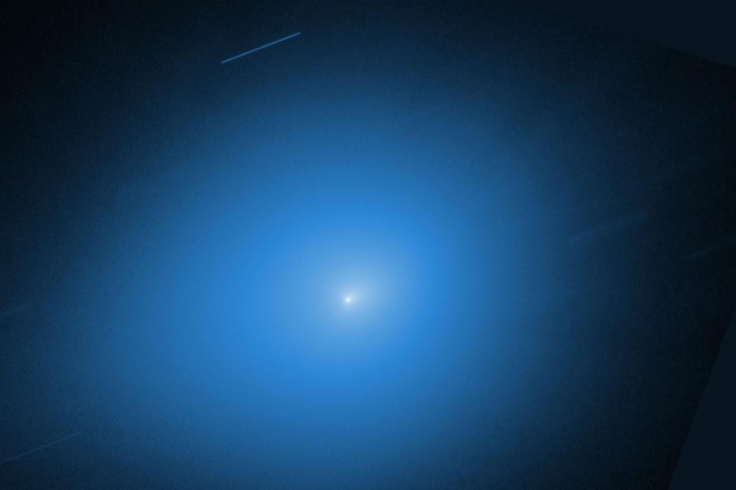
In a cosmic spectacle that has astronomers buzzing, the interstellar comet 3I/ATLAS streaks through our solar system, its highly unusual tail captured in fresh Hubble images. This third confirmed wanderer from another star system displays a streaky appendage that defies simple explanation, blending dust and gas in ways rarely seen.
As it nears its closest pass to Earth, scientists scramble to decode its secrets before it vanishes forever.
The Streaky Tail Phenomenon
Astronomers first spotted 3I/ATLAS on 1 July 2025, using the ATLAS telescope in Chile. Its hyperbolic trajectory quickly marked it as interstellar, the third after 'Oumuamua and Borisov. Travelling at breakneck speed, it reached perihelion on 29 October 2025, just inside Mars' orbit.
Initial observations showed a marginal coma and potential tail, but nothing prepared experts for what followed. Hubble's Wide Field Camera 3 snapped the latest images on 30 November 2025, when the comet was 286 million kilometres from Earth. The background stars appear as streaks because Hubble tracked the fast-moving comet, a standard technique that inadvertently highlights the object's velocity.
Yet the tail itself intrigues most – a teardrop-shaped coma with an anti-tail pointing sunward, likely from heavy dust too massive for solar radiation to repel. Two distinct tails stand out: one of ionised gas stretching upward, the other dust trailing leftward. Spectroscopic data reveals unusually high carbon dioxide-to-water ratios, alongside cyanide gas and atomic nickel vapour – compositions more akin to distant exoplanetary systems than our own comets.
Whispers of cryovolcanic eruptions circulate on X, with images suggesting ice volcanoes blasting jets post-perihelion, though such claims warrant caution amid limited data.
Mind-blowing capture by astrophotographer Michael Jäger the interstellar comet 3I/ATLAS, our solar system’s uninvited guest.
— Dr. Nuran Akgören (@nurunnisaRa) December 6, 2025
New images suggest 3I/ATLAS is erupting in “ice volcanoes”—cryovolcanic jets blasting from its surface as it hurtles away post-Sun flyby. NASA’s Hubble &… pic.twitter.com/vhoEbIFuSB
Another X Post pointed that the comet began outgassing at 3.8 AU, farther out than expected, turning from red to blue-green as it heated.
4/8 Why the link?
— 🚨MR. BOB DOBALINA (@DobalinaResourc) December 8, 2025
3I/ATLAS isn't your average comet. It started red, turned intensely blue-green as it heated up—outgassing at 3.8 AU, farther than most. NASA/Hubble images show its teardrop tail & coma, evoking a "dancing" spirit shedding its veil. https://t.co/owBvQCbhRz pic.twitter.com/rOJBlDD7oG
Size estimates vary wildly, from 427–440 metres, but Hubble failed to resolve the nucleus, leaving room for doubt. Non-gravitational forces hint at hidden activity, echoing but not mirroring 'Oumuamua's peculiarities.
Insights from Space Missions
NASA and ESA rallied an armada. The James Webb Space Telescope probed its chemistry in August 2025. ESA's Juice spacecraft, bound for Jupiter, glimpsed the coma and dual tails near perihelion. Even Mars-based assets joined: Perseverance rover paused its explorations for snapshots on 4 October 2025, while MAVEN captured ultraviolet views of the hydrogen halo.
Psyche, Lucy, and SOHO added perspectives, charting the tail's evolution. These collective eyes confirm methanol and carbon bursts, painting a portrait of an active, erupting worldlet – if one undersells the drama.
Public Fascination and Speculation
Social media hums with awe. The ESA Hubble account posted the image, noting: 'Hubble tracked the comet as it moved across the sky. As a result, background stars appear as streaks of light.
🆕 Hubble reobserved interstellar comet #3IATLAS on 30 November with its Wide Field Camera 3 instrument. At the time, the comet was about 286 million kilometres from Earth: https://t.co/XW6zLkOpG8
— HUBBLE (@HUBBLE_space) December 5, 2025
Hubble tracked the comet as it moved across the sky. As a result, background… pic.twitter.com/dRQAaV1t8p
WION shared a video report: 'NASA's Hubble and ESA's Juice spacecraft have captured stunning new images of comet 3I/ATLAS as it nears its closest approach on December 19.'
#Gravitas | NASA’s Hubble and ESA’s Juice spacecraft have captured stunning new images of comet 3I/Atlas
— WION (@WIONews) December 8, 2025
As it nears its closest approach on December 19, the world’s telescopes are watching one last time before this alien traveller disappears forever@MollyGambhir has more pic.twitter.com/p12G2mtfAN
Enthusiasts fuel theories of alien probes, but data leans toward natural, if odd, processes – a gentle reminder that the universe needs no embellishment.
Enthusiasts fuel theories of alien probes, but data leans toward natural, if odd, processes – a gentle reminder that the universe needs no embellishment. It swings closest on 19 December 2025, at 274 million kilometres – distant, yet intimate for such a traveller.
© Copyright IBTimes 2026. All rights reserved.