Melania Trump's 'Einstein Visa' Past Resurfaces After Pupils Guide Her Through Robot Arm Demo
Pupils at Mountain View Elementary demonstrated robotics, chatbots and other technology as the first lady announced new AI support for schools in Ashe County
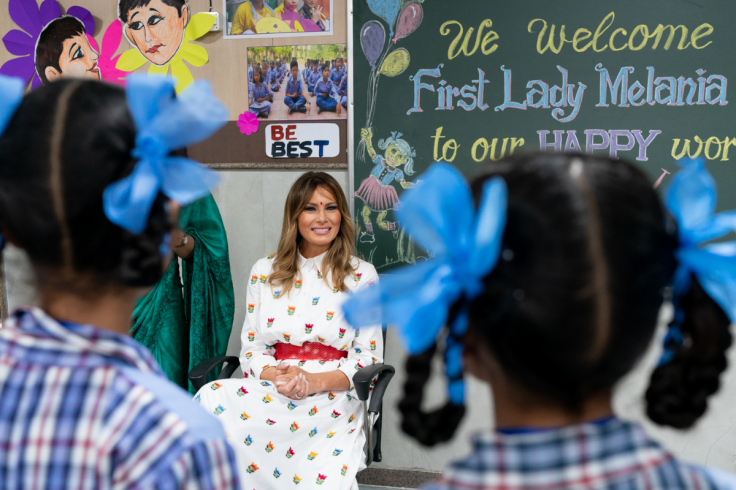
First lady Melania Trump joined pupils using robotic arms during a visit to a North Carolina elementary school on Tuesday, 15 September, as she promoted the use of artificial intelligence and other technology in education.
Trump visited Mountain View Elementary School in Jefferson, Ashe County, where pupils demonstrated projects involving AI, robotics, engineering and 3D printing. The school has made technology a significant part of its curriculum, according to the Associated Press.
Asked about growing concerns over artificial intelligence, Trump said young people needed to learn how to use the technology if the United States wanted to remain a global leader.
'I think they need to learn we need to lead,' Trump said. She added that pupils should also remain vigilant as AI develops.
Her visit came amid a wider debate in the United States over how artificial intelligence should be regulated. President Donald Trump had a day earlier rejected calls for additional restrictions on the technology, describing concerns about further limits as a 'hoax', according to AP.
Melania Trump Takes Part in Classroom Technology Demonstrations
During the school tour, the first lady sat with fifth-grade pupils as they conducted a science experiment involving changes in pressure inside the human chest cavity. Pupils then used AI tools to produce a video based on their model.
Trump later visited the school's media centre, where children were building chatbots to research possible careers and working with 3D printers. AP reported that she joined pupils as they manipulated robotic arms operating in the room.
The Irish Star separately reported that pupils guided Trump while she attempted to use one of the robotic arms to position a golf ball. IBTimes UK has not independently verified that specific exchange, and AP's account of the visit did not characterise Trump as struggling with the equipment.
Trump later encouraged the pupils to continue experimenting with technology, telling them that 'anything is possible' and urging them not to give up.
The visit also included new technology support for schools in Ashe County. Trump announced that her Be Best initiative would help provide StudyFetch, an AI learning platform, to 1,500 pupils in the county.
Mountain View Elementary and other schools in the district are also set to receive 100 Nvidia Jetson Nano Developer Kits, small computers designed to run AI applications.
Trump also marked the second anniversary of Hurricane Helene during the visit. The storm forced local pupils out of school for more than 30 days, while Mountain View Elementary was used first as an emergency childcare facility and later as a distribution centre for supplies, AP reported.
Melania Trump's 2001 EB-1 Green Card Remains Separate Historical Issue
Trump's visit comes against a long-standing history of public scrutiny over the immigration category through which she obtained permanent US residency, although there is no verified evidence that the issue resurfaced specifically because of Tuesday's school visit.
Melania Knauss, as she was then known, became a lawful permanent resident in March 2001 through the EB-1 extraordinary-ability category. The route has sometimes been informally referred to as the 'Einstein visa', although the classification is not limited to scientists or academics.
The category can apply to people who demonstrate extraordinary ability in fields including the sciences, arts, education, business and athletics.
The Washington Post reported in 2018 that Trump's professional résumé before receiving permanent residency included European runway work, a Camel cigarette billboard in Times Square and an appearance in Sports Illustrated's swimsuit edition. However, the evidence submitted with her immigration petition has not been publicly disclosed.
Government statistics cited by the Post showed that 3,376 of more than one million green cards issued in 2001 went to immigrants classified as having extraordinary ability. Five people from Slovenia received green cards through the broader EB-1 programme that year.
Bruce Morrison, a former Democratic congressman who chaired the House subcommittee involved in drafting the 1990 immigration law, questioned in 2018 whether Trump's résumé appeared consistent with the requirements of the category.
Her attorney, Michael Wildes, defended her eligibility. He told the Post that Trump was legally qualified for permanent residency but declined to disclose the evidence contained in her petition, citing her privacy.
There is no public evidence that Trump obtained her green card unlawfully. A 2016 letter from Wildes said she had self-sponsored as a model of 'extraordinary ability' and became a lawful permanent resident on 19 March 2001.
Tuesday's visit, meanwhile, focused on AI education, robotics and the recovery of the Ashe County community following Hurricane Helene. Technology in education has become one of the first lady's principal areas of advocacy during her second period in the White House.
© Copyright IBTimes 2026. All rights reserved.
- Recommended For You