

'I'll Stop Trading': Donald Trump Threatens Complete Global Trade Ban if the Fed Won't Lower Rates
Trump's rate-cut pressure reaches beyond the Fed, tying US trade relationships to a monetary-policy battle with major economic and legal stakes ahead

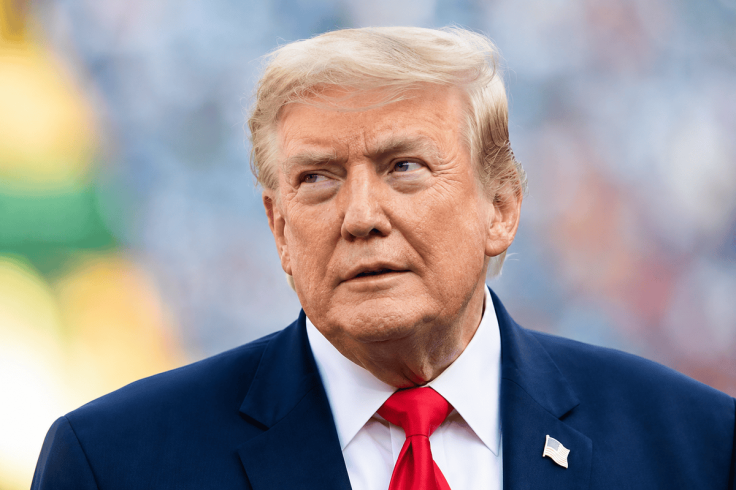
President Donald Trump threatened on Friday to halt US trade with countries where the United States runs trade deficits unless the Federal Reserve cuts interest rates, linking trade policy to monetary policy after official figures showed employers added 162,000 jobs in August.
The Bureau of Labor Statistics said on 4 September that nonfarm payroll employment increased by 162,000 last month while the unemployment rate remained at 4.1 per cent. Trump celebrated the report on Truth Social before renewing pressure on Federal Reserve Chair Kevin Warsh and other policymakers to lower borrowing costs.
Trump Links Trade Threat To Interest Rates
Trump argued that the strength of the US economy justified lower interest rates and said the country should have the lowest rates in the world. He then escalated his criticism of the central bank by tying his demand to countries that sell more goods and services to the United States than they buy from it.
'LOWER THE RATE OR I'LL STOP TRADING WITH COUNTRIES WITH WHICH WE HAVE A DEFICIT,' Trump wrote.
Great jobs number just announced, breaking all estimates (except mine!) by double and triple - And you haven’t seen anything yet! EMPLOYERS ADDED 162,000 JOB IN AUGUST. Lower the interest rates because the U.S.A. is a much stronger credit than it was just a short time ago! A… pic.twitter.com/wf3zdFfqRO
— Commentary Donald J. Trump Truth Social Posts On X (@TrumpTruthOnX) September 4, 2026
The threat marked a direct attempt to connect the Federal Reserve's interest-rate decisions with the president's trade agenda. The Federal Open Market Committee, not the president, sets the target range for the federal funds rate. At its latest meeting in July, the committee kept that range at 3.5 per cent to 3.75 per cent.
Warsh took office as Federal Reserve chairman on 22 May after being nominated by Trump and confirmed by the Senate. The Federal Reserve said the FOMC also unanimously selected Warsh as its chairman.
Trump said higher US interest rates created what he regarded as an unfair disadvantage and urged Federal Reserve officials to 'get smart.' He also called on them to 'BE PATRIOTS for a change.'
His argument came as the latest official trade figures showed a sharp monthly increase in the US goods and services deficit. The Bureau of Economic Analysis said the deficit rose 24.4 per cent to $88.6 billion (£65.55 billion) in July, from a revised $71.2 billion (£52.62 billion) in June, as imports increased and exports fell.
However, the year-to-date picture was different. The BEA said the goods and services deficit for the first seven months of 2026 was 29.6 per cent lower than during the same period in 2025.
Trade Deficits and Trump's Supreme Court Claim
Trump has repeatedly portrayed trade deficits as evidence that foreign countries benefit disproportionately from access to the US market. Economists at the Federal Reserve Bank of Dallas have cautioned against treating a trade deficit as automatically harmful, saying such deficits can reflect foreign capital inflows that support investment or fiscal expansion.
Trump also invoked a February Supreme Court decision involving his tariff policy, claiming the ruling confirmed an 'absolute right' for a president to stop trading with countries where the United States runs deficits.
The Supreme Court did not make that finding.
In Learning Resources, Inc. v. Trump, the court held that the International Emergency Economic Powers Act, or IEEPA, did not authorise the tariffs challenged in the case. The decision discussed statutory language allowing a president, in specified circumstances, to regulate or prohibit imports and exports, but it did not rule that a president has an unrestricted power to end trade with deficit countries.
IEEPA itself limits the use of those authorities. Under the statute, presidential emergency economic powers may be exercised to address an 'unusual and extraordinary threat' originating wholly or substantially outside the United States after a national emergency has been declared in relation to that threat.
Trump's statement therefore represents his characterisation of the court ruling rather than a power the Supreme Court expressly recognised.
The remarks tie Trump's continuing campaign for lower interest rates to a potential restriction on US trade, even as the Federal Reserve's most recent policy statement said inflation remained elevated relative to its 2 per cent goal.
© Copyright IBTimes 2026. All rights reserved.