Former Official Warns Trump Might Resort to the 'Nuclear Option' Because He Refuses To Accept Loss
Annelle Sheline warns Donald Trump could consider a nuclear strike against Iran, but no evidence confirms any operational plan

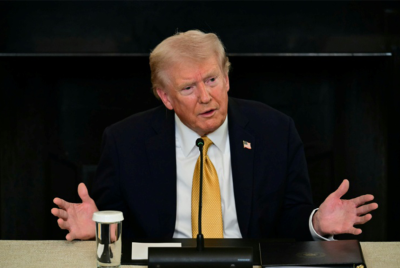
A former US State Department official has warned that President Donald Trump could consider a nuclear strike against Iran, while stressing there is no confirmed evidence that such an order is being prepared.
Annelle Sheline, a research fellow in the Middle East programme at the Quincy Institute for Responsible Statecraft and a former Foreign Affairs Officer at the US Department of State, made the comments in an interview published on 22 September 2026.
Sheline said Trump may believe he has exhausted his conventional options after the subsequent breakdown of a memorandum of understanding signed by the US and Iran in June. She also described economic pressure on Tehran as having failed to force a change in Iran's position, an assessment that remains her analysis rather than an independently established fact.
Trump's 'Nuclear Option' Warning
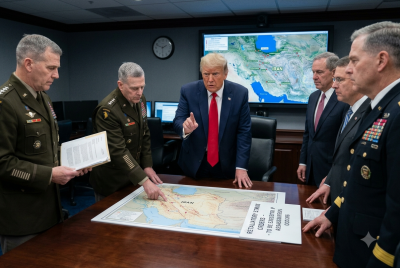
Sheline said Trump may feel he has few options left as he seeks to end the conflict without launching a ground campaign.
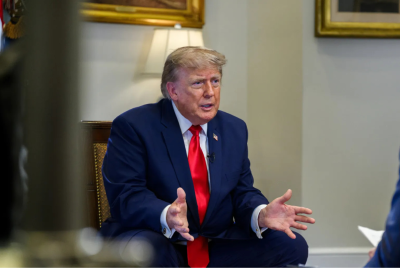
'He may feel his only option is the nuclear option,' she said.
According to Sheline, deploying American troops could expose US forces to further casualties and create serious political problems for Trump. She described the potential loss of more American lives as 'political suicide' for the president, particularly because she said the American public already opposed the war.
She argued that Trump could struggle to compel Iran to accept US demands without a significant escalation. In her assessment, the president may also be unwilling to acknowledge what she called the 'humiliation' of having lost the confrontation.
There is no evidence in the report of an operational order, military plan or official US decision to use nuclear weapons against Iran. Sheline acknowledged that the possibility was not concrete, saying it was based on rumours among Republican figures and political analysts, as well as comments from some members of Congress.
'We've heard from some members of Congress who, at various points in the war, have said things like, 'The options that the administration is considering are absolutely horrifying,' she said.
Sheline suggested Tehran could be the target, while saying Trump and Israeli Prime Minister Benjamin Netanyahu were seeking to remove Iran's leadership. That claim about their intentions remains attributed to Sheline and is not independently established in the material reviewed.
The central question is whether a nuclear strike would achieve its intended political aim. Sheline argued that Iran's decentralised decision-making structure could allow its government to continue operating even after senior officials were killed.
'Other than the absolute devastation it would cause, it wouldn't actually achieve the policy outcome they're pursuing,' she said.
She also said Iranian officials had indicated that catastrophic destruction would not necessarily force Tehran to surrender. That assessment was not independently established in the material reviewed.
Nuclear Escalation Could Spread
Sheline's concern extends beyond the immediate consequences for Iran. She warned that using a nuclear weapon could weaken the long-standing reluctance of nuclear powers to cross that threshold.
'We could then see the breaking of the nuclear taboo. We could see an escalation between India and Pakistan. And we could see Russia thinking, 'Well, OK, let's use a nuclear weapon against Ukraine,' she said.
Sheline added that a nuclear strike could push Iran to pursue its own nuclear weapon. She said such a development could encourage Saudi Arabia, the United Arab Emirates and Qatar to seek similar capabilities.
Those outcomes are not confirmed forecasts. They are Sheline's assessment of the potential consequences of a nuclear attack, rather than evidence that any of those governments have decided to pursue nuclear weapons.
Nuclear weapons have not been used in warfare since the US atomic bombings of Hiroshima and Nagasaki in August 1945. Sheline said crossing that line could have 'massive' consequences for global security and the international order.
The political timing could also matter, in her view. Sheline suggested Trump might face fewer constraints after the US midterm elections, regardless of the result, and said a poor Republican performance could make him particularly angry.
'There is a lot of concern that, after the midterms, Trump will be really unhinged,' she said. 'If the Republican Party doesn't do well, he may be especially angry.'
The description is Sheline's characterisation and should not be treated as an established assessment of Trump's mental state.
Sheline also said divisions were emerging within the Republican Party over the administration's Middle East policy. Some figures, she claimed, were questioning how the approach could be described as 'America First' when it appeared closer to an 'Israel First' policy.
The disagreement has not been presented as evidence of a nuclear decision. It forms part of Sheline's explanation for why political pressure may not prevent further escalation.
She called the prospect of a nuclear attack 'astonishing', arguing that such a move could be both devastating and ineffective. Her warning is serious, but the evidence remains limited.
There is no confirmation that Trump plans to use a nuclear weapon against Iran. What exists instead is a former official's warning, based partly on rumours and political interpretation. With a claim this grave, that distinction is not a footnote.
© Copyright IBTimes 2026. All rights reserved.
- Recommended For You