

A $170 Alarm Clock Was Never Supposed to Make $200 Million — Then Gen Z Got Obsessed
Hatch's growth mirrors Gen Z's shift to simple, purpose-driven devices amid the rising digital minimalism movement

Hatch, the Menlo Park sleep tech company that started with smart changing pads for newborns, earned $200 million (£147 million) last year after its $170 (£125) sunrise alarm clock became an unlikely bestseller among teens and young adults.
The company's Restore device was originally designed for sleep-deprived parents. Co-founder and chief executive Ann Crady Weiss built it in 2021 as a phone-free wind-down tool for adults like herself. 'My kids were a little older, and I was experiencing — as a mom and as a startup builder — a ton of stress in my life,' Weiss told Inc. 'I tended to doom scroll.'
Gen Z had other plans for the half-dome gadget.
From Shark Tank Reject to £147 Million Revenue Machine
Weiss and her husband Dave co-founded the company in 2014 under the name Hatch Baby. Two years later, the pair appeared on Shark Tank seeking $250,000 (£183,000) for 2.5 per cent equity in a smart changing pad that tracked an infant's weight and feeding patterns. Most of the panel balked at the $10 million (£7.3 million) valuation for a product with zero sales. Guest investor Chris Sacca eventually took a stake, but on far steeper terms — $250,000 (£183,000) for 25 per cent.
The changing pad never became a mass-market hit. Weiss pivoted. Hatch dropped 'Baby' from its name, launched the Rest sound machine for children and, in 2021, released the Restore for adults.
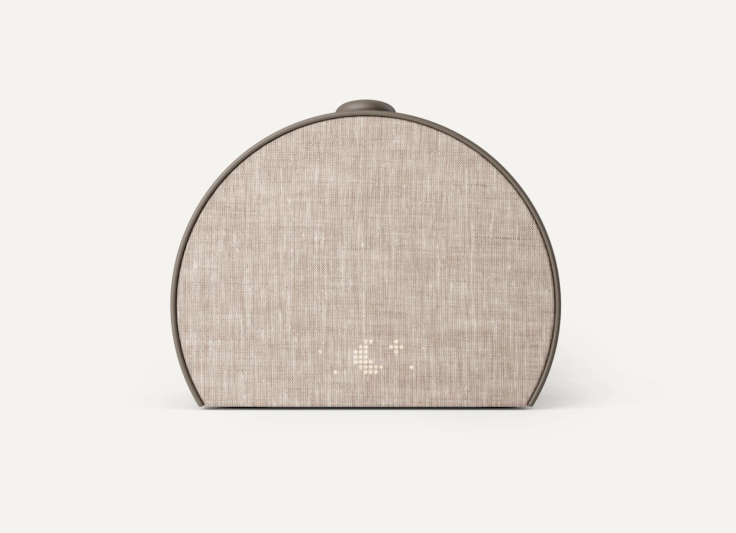
TIME Magazine named the original Restore one of the 100 Best Inventions of 2020. Amazon's Alexa Fund also invested in the company, giving it both capital and distribution muscle through the retail giant's platform.
By 2019, Hatch had crossed $40 million (£29 million) in cumulative sales. Five years later, annual revenue alone reached $200 million (£147 million), and the company is profitable.
TikTok Wishlists Turned a Sleep Gadget Into a Status Symbol
The Restore's breakout among younger buyers started showing up on social media late in 2025. Thousands of teenagers posted TikTok holiday wishlist videos featuring the device alongside Lululemon leggings, Ugg boots, and Rhode skincare refills.
Casey Lewis, the trend researcher behind the After School Substack newsletter, tracked the device as one of the top 15 most-requested Gen Z gifts of the season.
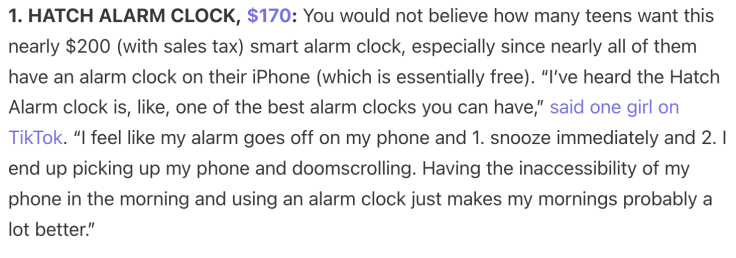
The appeal is straightforward. The Restore mimics a natural sunrise with gradually brightening warm light and ambient sounds: crickets, birdsong, bubbling water. It is designed to replace the phone alarm that leads, as one college-age TikTok user put it, to 'snooze immediately' followed by 'picking up my phone and doom scrolling.'
At $170 (£125) before tax, the Restore is not cheap for a clock. But for a generation already spending on wellness routines and documenting them online, it slots neatly into the nighttime ritual content that dominates platforms like TikTok and Instagram.
A Broader Push Against Smartphone Dependency
Hatch's growth sits within a wider consumer shift. Gen Z buyers are increasingly trading smartphones for single-purpose devices as part of a digital minimalism movement that has picked up considerable pace. Newsweek noted the trend extends beyond alarm clocks to film cameras, physical planners, wired headphones, and so-called 'dumb phones' stripped of apps and notifications.
The global market for basic feature phones is projected to exceed $10.6 billion (£7.8 billion), driven largely by awareness of digital burnout and the mental health toll of excessive screen time. Groups like New York City's 'Luddite Club', where teenagers meet to read paper books and leave smartphones at home, reflect how far the counter-movement has spread.
For Hatch, the commercial payoff of landing in the middle of that cultural current has been enormous. The company raised a total of roughly $27 million (£20 million) across multiple funding rounds from backers including True Ventures, Amazon's Alexa Fund, and several angel investors. It now generates nearly eight times that figure in annual revenue.
Weiss did not set out to build a Gen Z brand. But the generation's willingness to pay £125 for a device that keeps their phones off the nightstand has turned what started as nursery technology into one of the fastest-growing consumer electronics stories in the wellness space.
© Copyright IBTimes 2026. All rights reserved.