

Is Hudson Williams More Successful Than Connor Storrie? 'Dark' Theory Plagues Heated Rivalry Stars
The real rivalry isn't on the ice, but in how fame and fandom quietly decide which young man at the centre of a queer love story is allowed to feel safe, desirable and bankable.
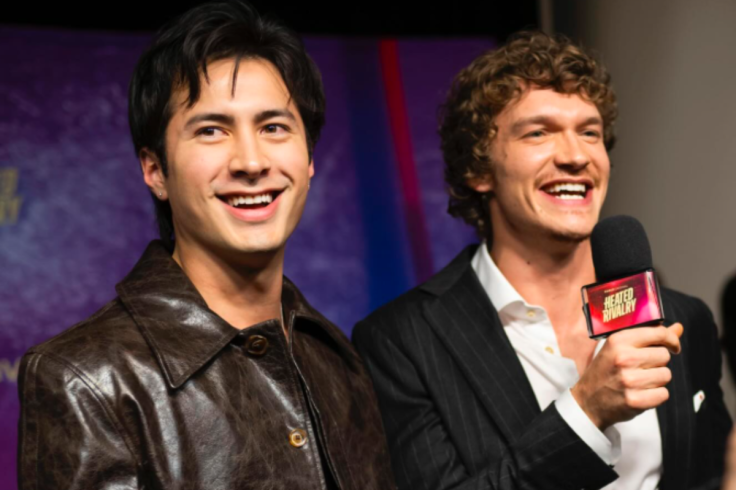
Hudson Williams walks into a Balenciaga campaign looking every inch the next big thing. A few months ago, he was waiting tables. Now he is fronting one of fashion's most notorious houses, fresh from leading a viral queer love story that took over TikTok and X.
Standing just off to the side of that spotlight, at least in the public imagination, is his Heated Rivalry co‑star Connor Storrie. Same show, same breakout moment, similar origin story. And yet, for reasons that are making parts of the fandom deeply uneasy, Hudson appears to be the one being pushed into the broader mainstream.
Fans think they know why—and their theory is not especially flattering about the industry, or the people watching.
Is Hudson Williams Really 'Winning' The Heated Rivalry Game?
The Canadian ice hockey drama Heated Rivalry, adapted from the Game Changers novels, dropped late last year and instantly burrowed into the algorithm's brain. On paper it's sports melodrama: Shane Hollander and Ilya Grigoryevich Rozanov, rivals on the ice, harbouring a secret romance off it. In practice, it became one of those rare shows that doesn't just find an audience—it builds a small, frantic civilisation.
Millions of posts on TikTok and X bear the show's name. There are edits cut with surgical precision, slow‑motion stares dissected like state secrets, fan essays about who leans in first during interviews. It's obsessive, and very online, and exactly the sort of passion streamers dream of engineering and almost never manage to.
For Hudson Williams and Connor Storrie, it has been nothing short of transformative. Before Heated Rivalry, both were essentially anonymous; archived clips show them working as waiters not long before they laced up their skates for camera. Within months, they've gone from swapping shifts to fronting a phenomenon.
Hudson's ascent has been the flashier of the two. He has been named an official face of Balenciaga, strutted through major fashion weeks and become a familiar fixture in the high‑gloss, heavily filtered corners of celebrity media. Connor's rise, while less meme‑friendly, is equally serious: he had more acting experience before the show, and has now signed with Creative Artists Agency (CAA), one of Hollywood's most powerful talent firms—exactly the kind of move that quietly sets up a decades‑long career.
In a rational world, you'd simply say: two talented actors, two slightly different but comparably exciting trajectories. Online, where nothing is ever that straightforward, a different narrative has taken hold. It insists that Hudson is being anointed the breakout star for reasons that have very little to do with skill.
At the heart of it is a question fans are almost embarrassed to utter aloud: are straight women warping the playing field?
The Dark Hudson Williams Theory Fandom Won't Let Go
Heated Rivalry is, at its core, a queer romance. That hasn't stopped it attracting a substantial viewership of straight women, many of whom adore the central relationship. Others, according to growing corners of the internet, appear distressingly keen to slot themselves into it.
The 'dark' theory doing the rounds is blunt. As the only one of the two leads who has a public girlfriend, Hudson is perceived as the safer crush. He reads, to certain viewers, as more stereotypically 'straight'—less threatening to the fantasy that they could, if only the script allowed, be the one on his arm.
Connor, by contrast, is read by some as more 'feminine', based largely on his manner in interviews and public appearances. That feminisation, in a culture that still punishes deviation from masculine norms, is making parts of the fandom anxious for him. The fear is not abstract: many queer actors have discovered the hard way that being visibly outside the box can narrow the roles you are offered, and widen the abuse you receive.
Neither Williams nor Storrie has made any definitive statement about their sexuality, and frankly they shouldn't have to. The scramble to label them—often based on vibes and posture rather than anything they have said—is exactly the kind of speculative behaviour queer audiences have been calling out for years. Yet it is also shaping how some fans, particularly straight women, choose whom to elevate.
Hudson becomes the projected self‑insert: the one with a girlfriend, the one to whom they can attach a fantasy of being 'the real one' in his life, even as he plays a man deeply in love with another man. Connor, ironically, risks landing closer to the character he plays—romantic, vulnerable, and, therefore, easier to other.
What makes all of this more troubling is that it chimes with a very old pattern. Queer media gets embraced, but only so long as straight audiences can remain at the centre of the story in their heads. The pairing is adored; the actually or potentially queer performer is dissected, defended, or discarded depending on how well they serve that fantasy.
Heated Rivalry, Queer Stories And Who Gets To Be Safe
Strip away the Balenciaga gloss and the CAA acronym, and you're left with a very old pattern in shiny new packaging. Queer media gets embraced by the mainstream, but only under certain conditions: the romance can be adored, the angst can be consumed, but straight audiences must be able to keep themselves at the emotional centre of the narrative.
The pairing is worshipped; the possibly queer actor is fussed over, fetishised, or quietly frozen out depending on how well they serve that fantasy.
To be fair, we are still in the early chapters of this story. One fashion campaign does not lock in Hudson Williams as a permanent A‑lister. A heavyweight agency deal does not guarantee Connor Storrie an Oscar. With season two of Heated Rivalry due to shoot this summer, both men are only just stepping into the long, messy middle bit of an acting career.
Yet the noise around them already tells us something worth sitting with. When a queer‑centred series explodes, the culture that forms around it is not automatically progressive simply because the leads are two men in love. Old prejudices are remarkably adept at cosplay; they turn up draped in rainbow merch, insisting that the 'more straight‑passing' lead just happens to feel more bankable, more brand‑safe, more worthy of plastering across luxury campaigns.
Caught in the crossfire are two actors who, not so long ago, were navigating double shifts and difficult customers. Now they are contending with strangers interrogating every hand gesture for clues about who they might want to kiss in real life.
If there is any kind of justice in this industry—and some days that feels like a big if—the future of Hudson Williams and Connor Storrie should be decided less by which segments of straight fandom can most easily claim them, and more by the work they fight to do.
Because whatever the darker corners of the internet are muttering, Heated Rivalry only worked because both of them sold that love story so completely that millions believed it. Everything else really ought to be background noise.
© Copyright IBTimes 2026. All rights reserved.