

Scientists Find Possible Sixth Dwarf Planet Beyond Pluto After It Hid in Telescope Images for a Decade
Object 2026 ED138 was first identified in 2026 observations, but archival images show it was captured as early as 2016

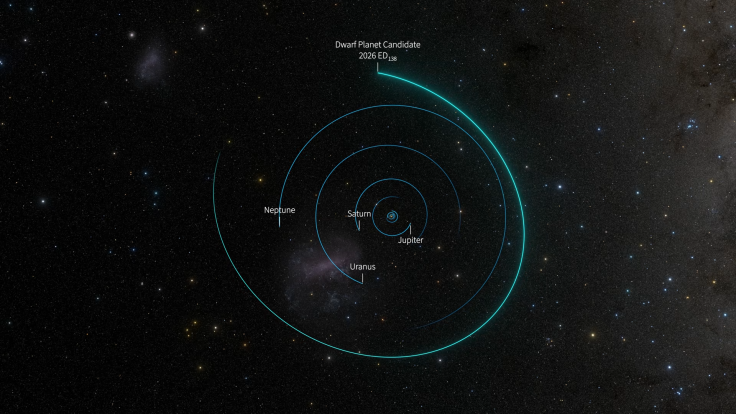
Astronomers announced the discovery of a possible sixth dwarf planet beyond Pluto on 27 October 2026, after Matthew Holman identified the distant object in data from Chile's Vera C. Rubin Observatory earlier that month.
Telescope images had captured the same body as far back as 2016 without it being recognised.
Designated 2026 ED138, the object is considered a dwarf planet candidate rather than a confirmed addition to the Solar System's officially recognised dwarf planets.
The International Astronomical Union (IAU) currently recognises five, including Pluto, which was reclassified in 2006.
The discovery is notable not only because ED138 may be unusually large. It also remained unnoticed in observations collected over roughly a decade, blending into a crowded background of stars until new search techniques revealed its movement.
How the Possible Sixth Dwarf Planet Escaped Notice
On 13 October, Holman, an astronomer at the Center for Astrophysics | Harvard & Smithsonian, analysed Rubin observations using software developed with colleague Kevin Napier. The programme searched detections recorded on different nights, looking for patterns that could reveal previously unidentified moving objects.
One candidate stood out. Its brightness and distance suggested an unusually large body orbiting far beyond Neptune.
'My first reaction was one of excited disbelief,' Holman said, recalling his initial response to the finding. He began checking whether the apparent discovery resulted from an error in the software or his analysis.
Mario Jurić, an astronomer at the University of Washington who leads Rubin's solar system team, subsequently examined the observatory's records. Researchers identified 30 images of ED138 captured across 20 nights between 4 March and 11 July 2026.
The Asteroid Institute's ADAM Precovery service also uncovered earlier observations dating back to 2016, captured by the Dark Energy Camera on the Victor M. Blanco Telescope in Chile.
Those archival images established that ED138 had been photographed years before astronomers recognised it as a distinct object.
Its position helps explain why it escaped detection. ED138 lies close to the apparent plane of the Milky Way, where millions of background stars complicate searches for faint, moving objects.
Rubin's powerful camera and image-processing technology allowed astronomers to connect observations that earlier searches had missed.
The observatory's 3.2-billion-pixel camera can photograph an area of sky equivalent to roughly 45 full moons in a single exposure. By repeatedly observing the same regions, researchers can identify subtle movements that reveal distant objects against relatively fixed background stars.
Why the Possible Sixth Dwarf Planet Is Not Confirmed Yet
Scientists estimate that ED138 could have a diameter of between 600 and 1,500 kilometres, although its actual size remains uncertain.
Determining its dimensions is difficult because brightness alone does not establish an object's size. A smaller world with a highly reflective icy surface can appear as bright as a much larger, darker one.
Astronomers have also not established whether ED138 is sufficiently round to qualify as a dwarf planet under the IAU's classification system.
Under the IAU's definition, a dwarf planet must orbit the Sun, be nearly round under its own gravity, have not cleared its orbital neighbourhood and not be a satellite.
The organisation recognised Haumea as its fifth dwarf planet in 2008. Other unrecognised candidates also exist, meaning ED138 is not the only distant world that could eventually qualify for official recognition.
For now, describing ED138 as a possible sixth dwarf planet reflects its potential status, not an official designation.
Jurić described the discovery as exceptionally rare, suggesting that finding an object roughly 1,000 kilometres across might happen 'once in a generation'.
ED138 is approximately 46 astronomical units from the Sun, equivalent to about 4.3 billion miles. One astronomical unit represents the average distance between Earth and the Sun.
Its orbit is inclined by nearly 25 degrees relative to the plane followed by most planets. Astronomers classify it as a hot-classical trans-Neptunian object, with 'hot' referring to its orbital characteristics rather than its temperature.
NASA explains that some unusual orbits in the outer Solar System may reflect gravitational encounters with Neptune during the planets' early evolution.
Researchers hope infrared observations will refine estimates of ED138's size and reflectivity. Jurić has also suggested observing occasions when the object passes in front of distant stars, potentially providing evidence about its shape.
Rubin's wider search is already producing discoveries. In April 2026, the observatory reported more than 11,000 newly discovered asteroids, including approximately 380 beyond Neptune.
Its ten-year survey began in June 2026 and will repeatedly image the southern sky. Those observations could uncover more distant worlds that have remained concealed in earlier telescope data.
© Copyright IBTimes 2026. All rights reserved.